
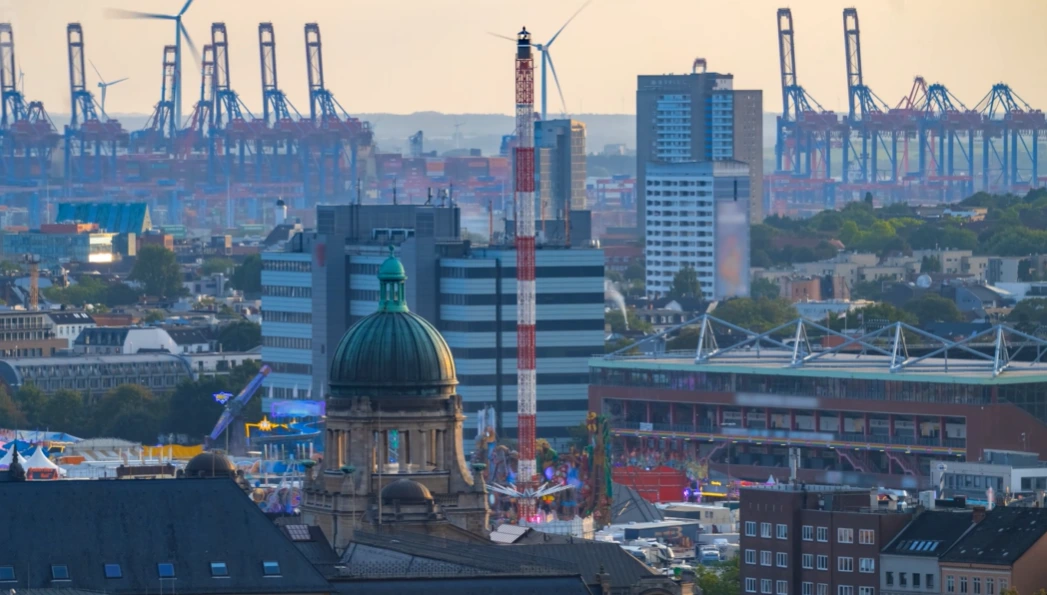
Europe’s economy just posted its fastest business activity growth in three years despite an Iran war energy shock, $100 oil, and a second ECB rate hike. Here is a full analytical breakdown of what is happening and what comes next.
Something unexpected is happening in the European economy. The continent is absorbing a war-driven energy shock that has pushed oil above $100 per barrel, forced the European Central Bank to raise interest rates twice in three months, driven eurozone inflation to 3.3 percent, and generated the kind of energy cost environment that triggered a near recession in 2022. And yet, by almost every measure of real economic activity, Europe is growing faster than it has in years.
Business activity across the euro zone accelerated in September at its fastest rate in over three years, with the S&P Global Flash Euro Zone Composite PMI Output Index jumping to 53.1 from August’s 52.0, defying expectations in a Reuters poll for a dip to 51.7. That number, published just hours ago, has forced economists to revise upward their assumptions about European resilience and created a genuine analytical puzzle that this article unpacks in full.
How is Europe’s economy growing faster in the middle of a war-driven energy shock than it was before the shock arrived? And can it last?
The Shock That Was Supposed to Break Europe
To understand the paradox, you need to understand the scale of the energy shock Europe is currently absorbing.
The ECB raised interest rates by a quarter point on September 10, lifting its deposit rate to 2.5%, as the energy shock driven by the Iran war pushed eurozone inflation higher and forced a second hike in three months. The decision followed an August inflation reading of 3.3 percent, up from 2.9 percent in July and the highest since September 2023. Energy costs did nearly all the work, with energy inflation jumping to 14.3 percent from 10.3 percent, as fighting around the Strait of Hormuz kept crude supply constrained.
The problem persists as Brent crude crossed $100 a barrel again on Wednesday due to renewed exchanges of fire between the US and Iran.
The ECB’s own scenario modelling earlier this year had painted a stark picture of what sustained energy disruption could do. In the severe scenario, oil prices rise by around 60 percent and gas prices double, reaching $166 per barrel and €98 per MWh respectively. While that worst case has not materialised, the trajectory remains deeply uncertain, and the ECB has been explicit that the economic outlook for the euro area remains highly uncertain in the context of the war in the Middle East, the closure of the Strait of Hormuz and elevated oil price volatility.
Against that backdrop, the September PMI reading looks almost surreal.
What the PMI Data Actually Shows
The Purchasing Managers’ Index is the most timely and widely followed gauge of economic momentum available to analysts. A reading above 50 signals expansion. A reading above 53 signals strong expansion. The S&P Global Flash Euro Zone Composite PMI Output Index jumped to 53.1 in September from August’s 52.0, with the improvement broad based across both manufacturing and services sectors.
The September data show stronger services activity, resilient manufacturing, rising orders and increased hiring, indicating that businesses have continued to operate despite the energy shock.
The geographic breadth of the improvement is particularly striking. Germany, the region’s largest economy, recorded solid growth in September despite increasing inflationary pressures facing businesses. France also recorded stronger activity, with growth reaching its fastest pace in more than two years as demand for services rebounded.
For Germany in particular, this is remarkable. Germany’s economy has faced severe structural headwinds throughout the mid-2020s, including the energy transition away from Russian gas, a slowdown in Chinese demand for German manufacturing exports, and the disruption of its automotive sector by electrification. That Germany is now posting solid PMI growth while simultaneously absorbing elevated energy costs and a global trade slowdown requires some explanation.
Why Is Europe Growing Despite the Shock?
Several structural factors are combining to make European growth more resilient than analysts expected.
Defence spending as a stimulus. European defence budgets have expanded sharply since Russia’s full-scale invasion of Ukraine in 2022. Technology investment is booming, defence budgets are expanding and reshoring creates opportunities in some markets. Defence spending functions as a direct fiscal stimulus, injecting government money into manufacturing, engineering, and technology sectors that then ripple through the broader economy. Countries building new military infrastructure, procuring weapons systems, and expanding their armed forces are simultaneously creating domestic economic activity that does not depend on global trade conditions.
The energy transition investment wave. European companies and governments have been investing heavily in renewable energy, energy storage, grid modernisation, and efficiency upgrades, partly to reduce vulnerability to exactly the kind of oil and gas price spike now occurring. That investment cycle generates economic activity even as energy prices rise, partly offsetting the demand destruction that high energy costs would otherwise create.
Services sector resilience. The eurozone’s services sector, which is less directly exposed to energy costs than heavy manufacturing, has proved particularly robust. Tourism, financial services, professional services, and digital economy activity have held up well, and France’s services rebound in particular has contributed meaningfully to the overall eurozone improvement.
Fiscal support. European governments, drawing lessons from the 2022 energy crisis, have maintained targeted support measures for households and businesses most exposed to energy cost increases. That support has prevented the kind of demand collapse that might otherwise accompany a sharp rise in household energy bills.
The Inflation Picture: Two Economies in One Number
The eurozone inflation average conceals a wide spread. August inflation ran at 4.5 percent in Spain, 2.9 percent in Germany and 2.7 percent in France, three economies facing the same energy shock with markedly different outcomes.
That divergence matters because it reflects genuinely different economic structures, energy mixes, and existing household exposure to energy costs. Spain, with higher direct energy costs passed through to consumers, is experiencing more severe inflationary pressure than Germany, where significant prior investment in renewables has partially insulated the domestic energy mix from global gas price volatility.
Underneath the headline, the picture is calmer. Core inflation, which strips out energy, food, alcohol and tobacco, actually fell to 2.4 percent from 2.5 percent in August, while services inflation, the component most sensitive to wages, dropped to 3 percent from 3.3 percent. There is still little sign that expensive energy is spreading into the rest of the economy.
This is the critical distinction that the ECB is wrestling with. In a paper published earlier this month, its economists found that adverse energy supply factors accounted for around 90 percent of the rise in energy inflation between January and May of this year, contrasting it with the 2021-22 surge that prompted a far more aggressive response.
In plain language: the inflation Europe is experiencing right now is almost entirely driven by one factor, the Iran war’s impact on oil and gas prices, rather than by broad-based overheating across the economy. That distinction is enormously important for how the ECB should respond.
The ECB’s Dilemma: Rate Hikes That Could Hurt the Recovery
The ECB’s decision to raise rates to 2.5 percent in September reflects a genuine dilemma at the heart of European monetary policy. On one hand, inflation at 3.3 percent, driven by energy costs, is above the ECB’s 2 percent target and carries the risk of becoming embedded in wage expectations if not checked. On the other hand, raising interest rates is precisely the wrong tool for combating an inflation that is driven by an external supply shock rather than by excessive domestic demand.
Markets are pricing three more ECB rate hikes by the end of June 2027. If those hikes materialise, the ECB will have raised rates to approximately 3.25 percent, a level that would significantly tighten financial conditions across the eurozone and risk converting a resilient but fragile expansion into a contraction.
ING’s Brzeski warned that today’s PMI readings make it more difficult for even the ECB’s most dovish policymakers to rule out another rate hike. But he also struck a note of caution that deserves careful attention. Brzeski described the PMI figures as “almost too good to be true,” adding: “A euro zone economy that remains completely unharmed by an energy price shock and supply chain disruptions is a welcome surprise. Let’s hope it doesn’t turn out to be a mirage.”
That phrase, too good to be true, captures the fundamental uncertainty in Europe’s current economic position. The September PMI data is real and reflects genuine business activity. But business surveys are forward-looking confidence indicators as much as they are backward-looking measurements. Companies that are currently operating and hiring might revise their outlook rapidly if energy prices remain elevated for longer, if the Iran conflict escalates further, or if the ECB’s rate hikes begin to bite into credit availability and investment appetite.
Jack Allen-Reynolds at Capital Economics said the September PMI data “supports our view that despite the weakness in the official activity data in July, GDP will increase in Q3.” But GDP growth in Q3 2026 does not guarantee continued growth in Q4 if the energy shock worsens.
Who Wins and Who Loses Inside the Eurozone
The aggregate PMI figure conceals significant variation in how different parts of the eurozone economy are experiencing this moment.
Germany is outperforming its recent trend. Its manufacturing sector, long battered by the energy transition, Chinese competition, and automotive disruption, is showing signs of stabilisation. The defence spending boom is a direct benefit to German engineering and industrial companies, and the reshoring of supply chains to reduce dependence on Chinese manufacturing is creating new domestic industrial activity.
France is experiencing its fastest services growth in over two years. The Paris services economy – financial services, tourism, professional services, and the luxury goods sector, is proving remarkably insulated from energy cost pressures that land more heavily on industrial producers.
Southern European economies face more difficult conditions. Spain’s 4.5 percent inflation is squeezing household purchasing power, and Italy’s heavy industrial base is more directly exposed to energy cost increases than France’s services-heavy economy. The persistence of high energy costs will test these economies’ resilience more severely than the September PMI data might suggest.
Britain, outside the European Union, recorded cooling growth in September, a divergence that reflects both the specific pressures facing the UK economy and the partial decoupling of British economic conditions from the eurozone trend.
The Scenarios: What Happens Next
The European economy in September 2026 faces three plausible forward trajectories.
The optimistic scenario is that the US-Iran ceasefire negotiations currently underway in The Hague produce a durable agreement before the end of the year. Oil prices fall back toward $80 per barrel, energy inflation retreats sharply, and the ECB halts its rate hiking cycle before it can do significant damage to the recovery. GDP growth continues at or above 1.5 percent in 2027, and headline inflation falls sharply in the second quarter of 2027 as energy base effects drop out of the year-on-year comparison. The ECB’s own projection models anticipate that headline inflation will fall sharply in Q2 2027 to 2.3 percent and stabilise around 2.0 percent over the medium term if energy commodity prices normalise.
The baseline scenario is that the Iran conflict remains contained but unresolved, oil prices oscillate between $90 and $105 per barrel, and the ECB delivers one or two additional rate hikes before pausing. Growth continues at a moderate pace, held up by defence spending and services activity, but high energy costs gradually erode consumer purchasing power and business investment appetite through the winter. Inflation remains above target through mid-2027.
The adverse scenario is that the Iran conflict escalates, producing oil prices rising to $166 per barrel and gas prices doubling in the severe case the ECB has modelled. In this scenario, the energy shock transmits into second-round wage effects, the ECB is forced to hike aggressively, and European growth tips into contraction in early 2027. This scenario remains a tail risk rather than the central forecast, but its plausibility has increased with each exchange of fire between US and Iranian forces over the past three months.
What This Means for European Households and Businesses
For the tens of millions of European households currently paying elevated energy bills, the strong PMI numbers offer cold comfort. The aggregate economy may be growing, but the distributional impact of an energy shock falls most heavily on lower-income households who spend a higher proportion of their income on energy and food, and on small businesses in energy-intensive sectors who cannot absorb cost increases through scale efficiencies the way large companies can.
Shocks are the obvious short-term impact, where supply chain disruptions or commodity price shocks drive up input costs and hit demand, feeding inflation and weakening consumption. Even without any shock actually happening, heightened geopolitical uncertainty increases risk premiums, delays investment decisions and encourages precautionary savings, dragging on aggregate demand in the short term and slowing the build-up of productive capacity over time.
Those channels of damage operate below the level of aggregate PMI data. A services sector that is hiring and expanding can coexist with a manufacturing SME that is cutting back on investment because its gas bill has doubled and its bank has tightened its credit terms. The aggregate resilience of September 2026 is real, but it is not evenly distributed.
The Bottom Line
Europe’s economy in September 2026 is doing something it was not supposed to be able to do: growing robustly while simultaneously absorbing an energy shock caused by a war in the Middle East that has driven oil above $100 per barrel and forced the ECB to raise rates twice in three months.
The explanation lies in the convergence of defence-driven fiscal stimulus, a services sector that is less exposed to energy costs than previous decades’ manufacturing-heavy economies, targeted government support measures that have prevented demand collapse, and the early dividends of a decade of renewable energy investment that has partially insulated parts of the European economy from global fossil fuel price volatility.
But the resilience is fragile. It depends on energy prices not rising further, on the Iran ceasefire negotiations making progress, on the ECB not overtightening in response to inflation that is almost entirely supply-driven, and on European consumers and businesses maintaining confidence through a winter that will test both.
The September PMI data is the most encouraging economic signal Europe has received since the Iran war began. Whether it is the beginning of a durable recovery, or a mirage that dissolves in the energy cost pressures of the months ahead, is the most important economic question facing the continent as it heads into the final quarter of 2026.
Related Articles:




[…] READ MORE: Europe’s Economy Is Defying the Odds: War, Energy Shock and the Paradox of September 2026 […]
[…] Europe’s Economy Is Defying the Odds: War, Energy Shock and the PMI Paradox of September 2026 […]
[…] Europe’s Economy Is Defying the Odds: War, Energy Shock and the PMI Paradox of September 2026 […]
[…] READ MORE: Europe’s Economy Is Defying the Odds: War, Energy Shock and the Paradox of September 2026 […]