
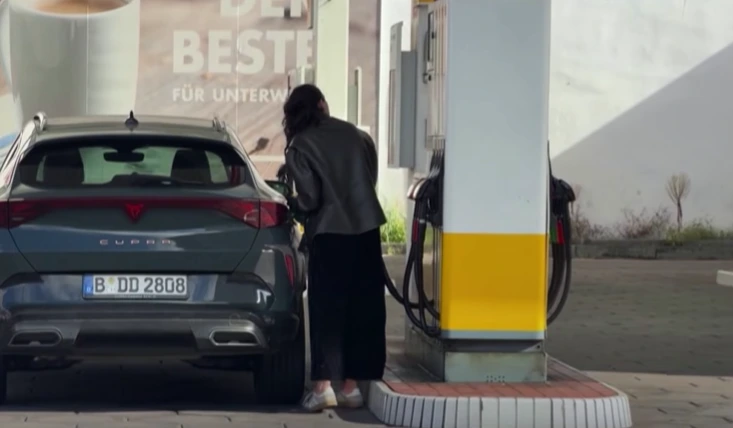
EU diesel hit a record €2.24 per litre on October 1, 2026, a 41% surge from pre-war levels. Here is a complete analytical breakdown of why European fuel prices are at historic highs, who is paying the most, and what governments are doing about it.
Every time a European driver pulls up to a fuel pump this week, they are paying the price of a war they did not start, fought by countries they do not govern, over a strait most of them could not locate on a map six months ago. The average price of diesel across the European Union has hit a record €2.24 per litre, according to European Commission data published on Thursday, compared with €1.59 before the war erupted in the Middle East. Diesel has become Europe’s costliest pump fuel, with the EU average reaching a record €2.226 per litre on September 21, 2026.
That is not simply an inconvenience. It is a structural economic shock that is reshaping household budgets, government finances, transport costs, and the political landscape of the continent in real time. EU drivers are spending an extra $231 million a day on diesel, according to Transport and Environment, a nonprofit group.
This is the full analytical picture of what is happening, why it is happening, who is paying the most, and whether relief is coming.
How We Got Here: From $72 Oil to $109 in Seven Months
The story begins on February 28, 2026, when the United States and Israel launched coordinated strikes on Iranian military and nuclear sites, triggering the conflict that has dominated global news ever since. The energy market consequences were immediate and severe.
Brent crude oil prices surged 10 to 13 percent to around $80 to $82 per barrel by March 2, 2026. As of early September 2026, prices surged up to $109 as renewed attacks on shipping and energy infrastructure reversed earlier gains. The head of the International Energy Agency described the situation as the greatest global energy security challenge in history.
The mechanism of disruption is the Strait of Hormuz, the narrow waterway between Iran and Oman through which roughly 20 percent of the world’s oil supply passes. The closure of the Strait of Hormuz during the 2026 Iran war disrupted roughly 20 percent of the world’s oil supply, triggering a global economic downturn and fuel shortages.
Since the beginning of 2026, the weighted EU average petrol price has risen by about 29 percent, while diesel has surged by almost 40 percent. Retail fuel prices have surged since the outbreak of the conflict in the Middle East, adding to inflationary pressures. Eurozone energy inflation rose to 14.3 percent in August, up from 10.3 percent in July, according to the European Central Bank.
Why Diesel Has Been Hit Harder Than Petrol
One of the less understood dimensions of the current fuel crisis is why diesel, rather than petrol, has taken the steeper blow. Energy flows through the Strait of Hormuz have been disrupted by the war with Iran, and diesel has taken a heavier blow than petrol.
There are two structural reasons for this divergence. First, Middle Eastern refineries produce a higher proportion of diesel-range products from the crude grades processed in the region. When Middle Eastern refinery output is disrupted, the diesel supply chain suffers disproportionately. Second, refining margins, the premium refiners earn for converting crude into finished fuel, have played a compounding role.
ECB experts told Euronews Business that the margin for diesel is expected to peak in October, based on refined diesel futures from LSEG on September 16. Petrol margins peaked in August. That ECB assessment, published in mid-September, means that even without further escalation in the Middle East, the worst of the diesel price surge may still be arriving this week rather than already behind us.
A further supply shock materialised last week. Saudi Aramco told at least two European refiners that they would receive no oil under long-term contracts in October following an attack on the kingdom’s key pipeline to the Red Sea. That announcement, reported by Bloomberg, adds a Gulf dimension to a crisis already driven by Iranian supply disruption, and it is why analysts are refusing to call a near-term price peak with any confidence.
The Human Cost: Who Is Paying the Most
The aggregate EU average conceals a wide and deeply unequal spread of prices and impacts across the 27 member states.
Diesel ranged from €1.21 per litre in Malta to €2.51 in Finland. That gap, more than a euro per litre between the cheapest and most expensive countries in the same economic bloc, reflects differences in national tax structures, energy mix, geographic distance from supply routes, and historical policy choices around fuel subsidies.
Diesel has surpassed $10 a gallon in several European countries, including France, Germany, the Netherlands, Belgium, Finland and Denmark.
A new Euronews analysis found that filling a 50-litre tank with diesel now costs the equivalent of more than 15 percent of the gross monthly minimum wage in Bulgaria. In a country where the minimum wage is already modest by European standards, that figure means a single tank of fuel has become a significant financial decision for a working household. The regressive nature of fuel price shocks, falling hardest on those who can least afford them and who are least able to switch to alternative transport, is one of the most politically volatile dimensions of the current crisis.
Belgium, Czechia and Bulgaria saw the steepest rises, each up 22 percent. Among the EU’s four largest economies, France recorded the biggest increase at 18 percent, followed by Germany at 15 percent. Italy at 7 percent and Spain at 3 percent saw more modest rises. Diesel prices rose even more sharply, with the EU average for gas oil climbing from €1.59 to €2.01 per litre, a 26 percent increase, more than double the rise in petrol.
What Governments Are Doing: Tax Cuts, Subsidies and Strategic Reserves
The political pressure generated by record fuel prices has forced governments across Europe into a familiar and expensive set of responses.
Wars in the Middle East and Ukraine are prompting governments across Europe to introduce subsidies, change taxes and revise policies to shield their economies, companies and households from record petrol and diesel prices.
Germany’s Parliament cut a gas and diesel tax, a move costing about $2.85 billion in lost revenues. Spain, Italy, Romania, Portugal and Belgium are among other EU nations that have slashed fuel taxes. Spain’s government also extended petrol and diesel tax cuts it introduced in March as part of a €5 billion package to counter the effects of the Iran war on domestic energy prices.
Germany has implemented a 17-cent cut from October 1, and Czechia is expected to reduce diesel taxes by approximately 10 cents. Those cuts, arriving this week, are the most immediate relief measure available to governments without disrupting supply chains or requiring international coordination, but they carry a significant fiscal cost at a moment when European public finances are already under strain from defence spending increases and earlier pandemic-era debt.
To offset the crunch, EU nations have also tapped into their strategic oil reserves. The EU has separately been in discussion about releasing reserves from the International Energy Agency’s collective emergency stockpile, a mechanism last used during the early phases of the Ukraine war and the initial COVID-19 supply disruptions.
The EU says an oil reserve release is possible amid US pressure. That statement, from Brussels this morning, signals that the discussion has moved from possibility to active planning, though the political coordination required to execute an IEA release across multiple member states means the timeline remains uncertain.
The US Diesel Export Threat: A Second Crisis Inside the Crisis
Just as European governments were beginning to coordinate their responses to the Iran-driven supply shock, a second and entirely distinct threat emerged from Washington.
Trump’s support for a ban on US diesel exports to lower domestic prices has raised concerns in the bloc, which would have to find alternative sources of the fuel. The Iran war has made the relationship between the EU and the US both more vital and more complicated, as the EU has increasingly turned to the US for diesel.
That dependency is the direct result of the war. As Middle Eastern supply contracted, European refiners turned to American producers to fill the gap. The US became one of the EU’s most important energy suppliers almost overnight. A ban on US diesel exports, if it materialises, would remove a supply source that European markets have come to depend on precisely because the alternative Middle Eastern sources are disrupted, forcing a search for replacement supply from Russia, which most European governments have committed not to purchase, or from other producers who cannot rapidly scale output.
The Energy Commissioner has warned that volatility is here to stay regardless of what happens in the short term. Even if a ceasefire between the US and Iran produces an easing of direct hostilities, the physical infrastructure of Middle Eastern energy production, pipelines, refineries, and storage facilities has been damaged during the conflict in ways that will take months to repair. Supply normalisation, when it comes, will be gradual rather than immediate.
The Silver Lining: Solar Has Saved Europe €37.4 Billion
Against this grim picture, one structural development has provided meaningful insulation from the full severity of the shock. Solar has saved the EU €37.4 billion since the war on Iran began, as Europe’s solar boom cushions households from the crippling costs of gas and the war continues to highlight the dangers of fossil fuel reliance.
That figure represents electricity that European households and businesses did not have to generate from gas or oil because solar capacity installed over the past decade was producing it instead. The countries that invested most heavily in renewable energy infrastructure in the 2010s and early 2020s — Germany, Spain, and the Netherlands among them, are experiencing measurably lower electricity price increases than those that delayed the energy transition.
The IEA noted that the crisis is prompting a reshaping of global energy investment and accelerating diversification away from Middle Eastern supply routes. The political salience of that acceleration has never been greater. Every record diesel price at every European fuel pump this week is an argument, made in euros rather than words, for the energy transition that climate policy has been trying to make for twenty years.
What This Means for European Drivers and Businesses
For European households, the practical calculation is stark. At the latest average prices, it costs about €103 to fill a 50-litre tank with petrol and €108 with diesel. For a household running two vehicles that each require filling once a week, the monthly fuel cost has increased by €80 to €100 compared to pre-war levels. For lower-income households without the option of switching to public transport or remote work, that increase is not an abstraction.
For European businesses, the impact spreads far beyond the fuel pump. Road transport costs are rising, which feeds through into the prices of delivered goods. Agricultural businesses running diesel-powered machinery are facing input cost increases that are not yet fully reflected in retail food prices. Airlines are absorbing jet fuel cost increases that will eventually appear in ticket prices. The Transport and Environment calculation that EU drivers are spending an extra €203 million per day on diesel alone significantly understates the total economic impact when commercial transport is included.
The Three Scenarios for What Comes Next
Relief through ceasefire. The US-Iran negotiations that have been intermittently active since the spring ceasefire collapsed continue in The Hague. A durable new ceasefire agreement that includes a credible commitment to reopening the Strait of Hormuz would remove the principal supply disruption. Brent crude would likely fall back toward $80 per barrel within weeks of a genuine agreement, and European diesel prices would follow, though with a lag of several weeks as the supply chain restocks. This scenario is possible but depends on political dynamics in Tehran and Washington that remain highly uncertain.
Managed persistence. The conflict continues at its current level without further escalation. Saudi Arabia finds alternative pipeline routes for its Gulf exports, partially offsetting the Aramco supply cut to European refiners. Germany’s October tax cut and similar measures in Czechia and Spain ease consumer pressure marginally. Diesel margins peak in October as ECB experts project and begin to ease in November. European diesel stabilises around €2.00 to €2.10 per litre through the winter, painful but not worsening. This is the base case that most energy market analysts are currently pricing.
Escalation. Further attacks on Gulf energy infrastructure, a US decision to ban diesel exports, or a widening of the conflict to additional Gulf states drives Brent toward the IEA’s severe scenario of $166 per barrel. European diesel crosses €2.50 in multiple member states. The ECB faces an impossible choice between raising rates to fight energy inflation and cutting them to support growth. European governments exhaust their strategic reserves and face a winter energy crisis comparable to or exceeding 2022. This scenario is the one that European energy security planners are preparing contingency plans for without publicly acknowledging its probability.
The Bottom Line
Europe is paying, in euros per litre, for the fragility of a global energy system built on the assumption that the Strait of Hormuz would remain open and that Middle Eastern supply would flow reliably to European refiners. That assumption is broken. The head of the IEA described the situation as the greatest global energy security challenge in history.
The immediate responses, tax cuts, subsidy packages, reserve releases, and diplomatic pressure, are the necessary tools of crisis management. They ease the pain without addressing the structure. The structural response, accelerating the energy transition that solar expansion has already demonstrated is both technically and economically viable, is simultaneously the most obvious and the most politically difficult direction to pursue.
For now, European drivers will fill their tanks at €2.24 per litre or higher, governments will cut taxes they cannot afford to cut, and the IEA will prepare reserve releases it hoped it would not need again this decade. The war in the Middle East is still being fought. Its bill is still being calculated. And every European fuel pump is a receipt.
Sources: European Commission Weekly Oil Bulletin; Euronews Business; Transport and Environment; ECB September 2026 energy analysis; IndexBox EU diesel analysis; Courthouse News; Mehr News Agency; Wikipedia 2026 Iran war fuel crisis; AFP.
Related Articles:






[…] Europe’s Fuel Crisis Explained: Why Diesel Has Hit €2.24 a Litre and What Happens Next […]
[…] Europe’s Fuel Crisis Explained: Why Diesel Hit €2.24 a Litre and What Happens Next […]
[…] Europe’s Fuel Crisis Explained: Why Diesel Hit €2.24 a Litre and What Happens Next […]