France’s largest nationwide protest in years is unfolding today as Yellow Vests, students, teachers and trade unions converge across 500 cities and towns. Here is the full analytical picture of what started it, what each group wants, and what it means for France’s presidential election.
The gilets jaunes are back, eight years after a man in a yellow fluorescent vest stood in the middle of a roundabout in rural France and sparked a movement that would paralyse the country for months. Today, Saturday, October 17, 2026, they are marching through the streets of Paris, Lyon, Marseille, Nantes, Toulouse and more than 500 towns and cities across France alongside a new generation of protesters who were barely teenagers when the original movement erupted.
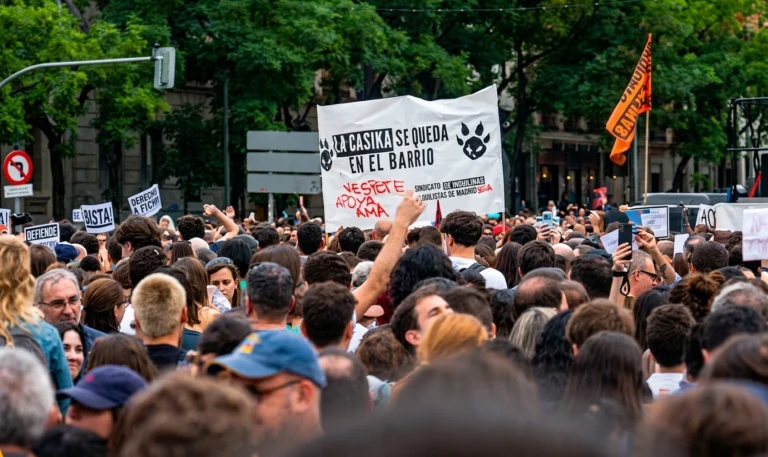
The convergence is extraordinary. Tens of thousands of students, trade unionists and remnants of the Yellow Vest movement are joining forces to demonstrate against high prices and the fraying social model in the country. More than 1,300 separate Yellow Vest actions have been registered nationwide, including demonstrations, gatherings at 158 roundabouts, 320 service stations and 88 railway stations, as well as 45 bridges, six ports, 95 motorway toll barriers, five refineries and 37 oil depots.
The sheer geographic spread of today’s mobilisation tells us something important about what is happening in France. This is not a Parisian protest. It is a national one, rooted in a fury that has been building in provincial France for years and that has now found a new catalyst in the combination of record fuel prices, crumbling schools, and a political class that is perceived as having run out of answers.
How It Started: Schools, Suburbs and a Movement That Caught Everyone Off Guard
Since September 18, 2026, a series of demonstrations and blockades by lycée students has been taking place in France, having originated in Créteil, a commune in the suburbs of Paris.
Créteil is significant. French elite politics typically watches other places for signs of intellectual unrest, not the affluent sixth arrondissement or the Grandes Écoles milieu. It is a working-class suburb of Paris with high immigrant populations, overcrowded classrooms, and schools that have been waiting for maintenance budgets that never arrived. The initial protests were specific and local: teacher absences, dilapidated buildings, and classrooms that lacked adequate heating or equipment.
The initial wave of protests began last month at high schools in Paris’ poor northern suburbs, where anger over teacher absences and shabby facilities quickly morphed into a nationwide movement against inequality, weak public spending and falling standards.
The speed of the escalation surprised everyone, including the student unions that nominally lead the movement. On October 5, 400 to 500 schools across France were partially or totally closed. On October 6, the third nationwide day of mobilisation began, with high school and university students joining demonstrations and blockades across France, including at the Sorbonne in Paris.
By October 13, unions reported that 480,000 people had joined a day of school protests, making it one of the largest single-day student mobilisations in France since May 1968.
What the Students Want: The €11 Billion Question
The student movement’s core demands centre on a single figure: €11 billion in additional annual funding for French public education. That figure, calculated by education economists and adopted by the main student unions, represents the investment they argue is necessary to hire enough teachers, repair school buildings, reduce class sizes to acceptable levels, and restore the quality of public education that France’s republican tradition promises but no longer consistently delivers.
The demands also include a moratorium on school closures, particularly in rural areas where consolidation has left communities without local secondary schools; the reinstatement of teaching assistants whose contracts were cut in recent budget rounds; increased salary floors for teachers to address the recruitment crisis that is driving the teacher shortage; and dedicated maintenance budgets for school buildings.
France’s finance minister responded to the initial protests by announcing an emergency €200 million package for school maintenance. The student unions immediately rejected it as a fraction of what is needed and evidence that the government still does not understand the scale of the problem.
The gap between €200 million and €11 billion captures, in numerical terms, the chasm between what the government is currently willing to offer and what the movement is demanding. It also captures the fiscal constraint that shapes everything in France right now. The country is running a deficit of approximately 6 per cent of GDP and is under European Commission pressure to reduce it. Finding €11 billion for schools requires either higher taxes, reduced spending elsewhere, or a confrontation with the European fiscal rules that France has been navigating uncomfortably for years.
The Yellow Vests Return: What Has Changed and What Has Not
The Yellow Vest movement started in 2018 as a protest against taxes on diesel before morphing into an outpouring of anger at high living costs and income inequality. It was eventually quieted when Macron agreed to billions of euros in tax cuts and initiated a Grand National Debate that gave French citizens an unprecedented direct voice in national policy discussions.
The movement never fully disappeared. Its networks, its WhatsApp groups, its Facebook pages and its notable individuals remained active at a lower level of mobilisation. What has changed in 2026 is the fuel. Literally.
Yannick Maillou, a teacher from La Crèche in western France, joined the Yellow Vests in 2018 and remains involved in the movement. One of the movement’s most resonant voices captured the current moment with striking simplicity. “I was a Yellow Vest protester when petrol cost €1.40 a litre, so imagine how I feel now that it’s €2.20,” he said.
That comparison is the core of the Yellow Vest grievance in 2026. The original movement was triggered by a diesel tax that pushed fuel prices past a threshold ordinary working people in rural France could absorb. Today, without any new tax, fuel costs €2.20 at the pump — driven by the Iran war and the resulting disruption to global energy markets. The economic pain that animated 2018 has returned at even greater intensity.
Jérôme Rodrigues, one of the best-known figures from the original 2018 movement, said in a Facebook video, “Yellow vests, lycée students, workers, pensioners – our struggles can come together, and today we have a date to focus on: October 17, 2026.”
François Boulo, another prominent Yellow Vest figure, told AFP: “Ultimately, the Yellow Vests’ demands have become more pressing because the situation is even more serious than it was back then.”
The psychological resonance between the 2018 movement and the 2026 student protests is not accidental. Both began with a specific, concrete grievance, a fuel tax then, school conditions now, and rapidly expanded into a broader indictment of systemic inequality. Both drew their energy from the parts of France that feel most distant from the priorities of the Paris political establishment. And both have been met initially with a governmental response that the protesters regard as inadequate.
The Trade Union Dimension: CGT and the November 5 Horizon
The involvement of France’s trade unions in today’s protests marks an escalation beyond student and Yellow Vest action into the realm of organised labour, which carries the capacity to shut down transport, energy, and public services in ways that street protests alone cannot.
The CGT, one of France’s major labour unions, backs the protests, calling for “higher wages and pensions, lower prices and the protection of public services that meet people’s needs.”
The CGT’s presence is important for several reasons. It signals that the student movement has been legitimised by France’s mainstream left-wing labour organisations, not just by student unions or informal social media networks. It broadens the coalition beyond young people and Yellow Vest veterans to include workers across the public and private sectors. And it points toward a more sustained campaign of disruption.
Student unions have called for a day of protests on October 17, and five major teaching unions said they would strike Thursday in solidarity with their students, with little sign that school blockades will halt in the meantime. More significantly for the government, the broader movement is already its focus on November 5, when France’s main trade unions have called for strikes.
November 5 is the date to watch. A coordinated strike across transport, education, healthcare, and energy sectors, combined with street protests linking Yellow Vests, students, and union members, would represent a level of social disruption that would make today’s protests look like a rehearsal.
The Violence Question: Police, Stun Grenades and 6,800 Arrests
The October 17 protests are taking place under a security operation of considerable scale. The Interior Ministry tallies about 500 planned actions across France and more than 90 demonstrations, roughly double what was anticipated at the start of the week. Minister Laurent Nuñez expects a strong turnout, driven by a surge of calls on social media.
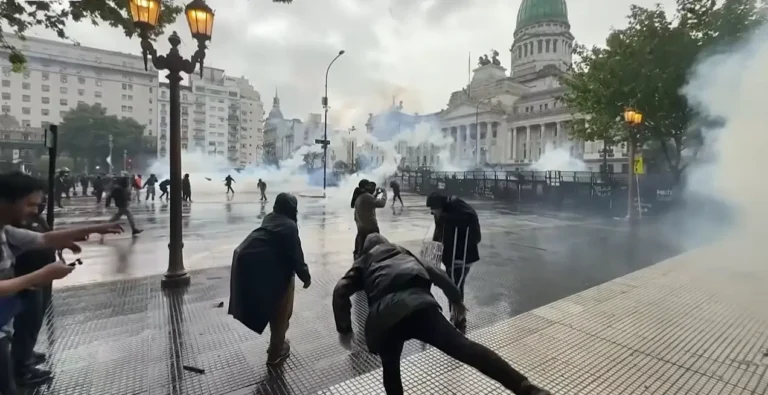
The violence of the preceding weeks has already produced serious institutional consequences. Since the protests began, more than 6,800 people, 86 percent of them minors, have been taken into police custody, and 36 investigations have been opened by the police oversight body IGPN.
Those numbers, particularly the 86 percent minors figure, have generated intense political controversy. Images of teenage students being detained or confronted by riot police circulated across French social media and international news networks, producing the kind of visceral public reaction that student movements generate when the imagery of state force against young people becomes inescapable.
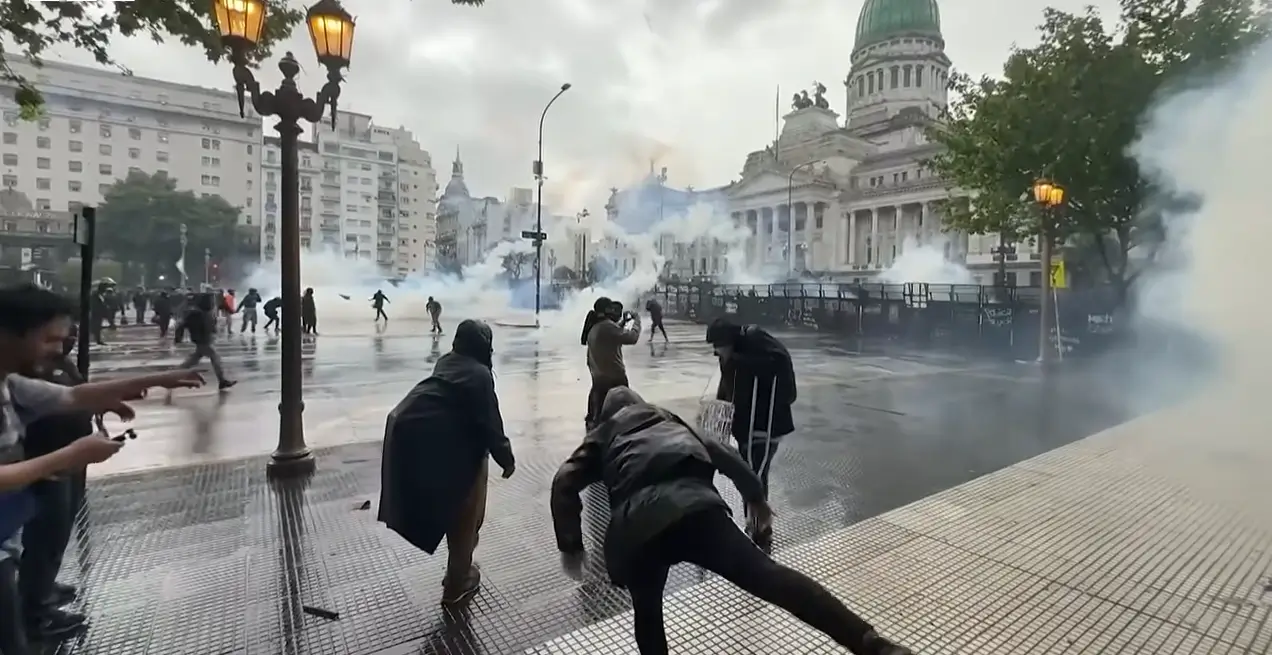
Prime Minister Sébastien Lecornu described the demonstrations as no longer a pure student movement but one sliding into “urban violence”. France suspended the use of stun grenades for the student demonstrations, but Interior Minister Laurent Nuñez said they could be used in Saturday’s protest.
Rodrigues sees Saturday’s demonstration as a continuation of the high school student protests, saying students have faced police “repression” similar to that experienced by the Yellow Vests. The parallel is politically powerful. The original Yellow Vest movement was partly defined by confrontations between protesters and police, including the use of rubber bullets and stun grenades that left several protesters seriously injured and generated significant international condemnation.
The Macron Factor: A Presidency in Its Final Stretch
The protests come at a difficult time for France, as President Emmanuel Macron enters the final stretch of his presidency, leaving a polarised electorate and a fragmented domestic political situation behind.
Macron cannot stand for re-election. His two terms expire, and the political consequences of the current unrest are already shaping the 2027 presidential election. The candidates watching today’s protests most carefully are not the ones in government, they are the ones positioning themselves for what comes next.
Marine Le Pen and the National Rally have been careful in their response to the student protests, neither endorsing the blockades nor condemning the underlying grievances too loudly. The cost of living crisis that is driving today’s protests is precisely the terrain on which Le Pen has built her political brand: a France that feels abandoned by its establishment, priced out of ordinary life, and looking for someone who will actually prioritise their economic reality.
Macron’s popularity hits its lowest level since 2017 this week, according to polling. The parallel collapse of Le Pen’s own numbers, cited alongside that figure in today’s reporting, suggests a broader political exhaustion with all established options rather than a simple transfer of support from the centre to the far right.
The French left, represented principally by Jean-Luc Mélenchon’s La France Insoumise and the Socialist Party, has been more openly supportive of the student movement. LFI figures have appeared at protests, provided political backing for the €11 billion demand, and positioned themselves as the natural political home for the anger being expressed in the streets. Whether that positioning translates into electoral support in 2027 depends on whether the movement sustains itself past the autumn school holidays and into the winter.
Why This Is Different from 2018: The Compounding Crisis
The original Yellow Vest movement emerged at a moment when France’s underlying economic conditions were, by historical standards, relatively stable. Growth was positive. Unemployment was falling. The grievance was real: rural France was being priced out of mobility by a fuel tax, but it was a specific policy trigger rather than the expression of a systemic breakdown.
The 2026 movement is something different. It is the convergence of multiple crises that have been building simultaneously.
Energy costs have roughly doubled from pre-Iran War levels, with diesel at €2.20 compared to €1.40 when the Yellow Vests first appeared. That increase is not the result of a government tax decision that can be reversed. The structural consequence of a geopolitical conflict that shows no sign of resolution is what this increase represents.
School conditions have deteriorated steadily through a decade of budget constraints in which French public finances were squeezed by the fiscal rules that govern eurozone membership. The teacher shortage that triggered the Créteil protests is the cumulative result of years of salaries that did not keep pace with the private sector and of training pipelines that were not maintained at sufficient scale.
France’s broader social model, the dense network of public services, social protection, and state provision that constitutes the French republican contract, is under pressure from demographic ageing, fiscal constraint, and the rising cost of everything that makes it function. When a French student says their school is falling apart, they are not simply complaining about their specific building. They are describing the visible deterioration of a promise that France has made to its citizens since 1945.
What the Government Can Actually Do
The French government faces a set of constraints that make satisfying the movement’s demands genuinely difficult rather than merely politically inconvenient.
France is currently running a deficit of approximately 6 per cent of GDP, well above the 3 per cent ceiling set by European Union fiscal rules. The European Commission has opened an excessive deficit procedure against France, requiring a credible consolidation plan. Against that backdrop, announcing €11 billion in new annual education spending without a corresponding revenue measure or spending cut would immediately confront the government with a choice between its domestic political survival and its European fiscal commitments.
The government’s room for manoeuvre on fuel prices is similarly constrained. Cutting fuel taxes, as it did partially in 2022, provides relief but at the cost of the revenue that funds the public services the protesters are simultaneously demanding be improved. The deeper structural problem, that France’s public finances cannot simultaneously honour the European fiscal rules, maintain the social model, invest in education, and absorb an energy cost shock, does not have a simple answer.
What the government can do is signal. Emergency packages, even if insufficient in scale, demonstrate responsiveness. Negotiations with student union leaders, even if they cannot deliver the full €11 billion demand, create a dialogue that reduces the intensity of confrontation. The question is whether the movement, having grown beyond student unions to encompass Yellow Vests and trade unions, can still be addressed through the channels of institutional dialogue, or whether it has already outgrown them.
Three Scenarios for What Comes Next
The de-escalation scenario sees today’s protests as the movement’s peak rather than its beginning. School holidays begin this weekend, removing the daily blockade dynamic that has sustained momentum through October. Students return after the break to schools that have received some emergency maintenance funding. The government opens substantive talks with union leaders on a multi-year education investment plan. Yellow Vest participation turns out to be smaller than feared, and the absence of major violence removes the imagery that would otherwise sustain media and political attention. The November 5 strike goes ahead but at a lower scale than projected. This is the scenario the government is working toward. It requires that today does not turn violent.
The escalation scenario sees today’s protests lead to major confrontations between police and demonstrators, which circulate internationally and harden public opinion against the government. The autumn holiday pause proves temporary, with school blockades resuming in November. The November 5 union strike is large and effective, shutting down transport and schools simultaneously. The combination of Yellow Vest tactics, student energy, and union coordination creates a winter of disruption that the Lecornu government cannot manage politically. Macron’s final months in office are defined by social crisis rather than any positive legacy project.
The political transformation scenario is the most structurally significant. The movement does not produce immediate policy victories but fundamentally reshapes the political landscape of the 2027 presidential election. A generation of young French voters whose political consciousness was formed in the blockaded schoolyards of October 2026 enters the electorate with a specific, lived experience of state failure. The Yellow Vest voters who have been oscillating between Le Pen and abstention find a new coalition with student activists and union members that creates pressure for a candidate who can hold that fragile alliance together. The 2027 election becomes a referendum on the French social model itself.
The Bottom Line
France is in the streets today because the gap between what the French social contract promises and what it delivers is now impossible to ignore. Energy prices double. Schools fall apart. Teachers cannot be recruited. Pensioners choose between heating and eating. The political class focused on managing the deficit and navigating European fiscal rules has failed to address the crisis in a way the affected people consider adequate.
The Yellow Vests appeared in 2018 and shook France’s political foundations for months before a combination of concessions, the Grand National Debate, and the Covid pandemic gradually absorbed their energy. What has returned in 2026 is the same underlying fury, reinforced by eight more years of accumulated grievance and expressed through a new generation of young people who have grown up watching a social model they were promised prove increasingly insufficient.
Jérôme Rodrigues, marching again for the first time since 2019, said it simply: “Finish what we started.”
Whether France’s institutions can hear what that sentence means and respond to it with sufficient seriousness before the winter amplifies everything is the most important political question facing the country as its final pre-election year begins.
Sources: Reuters, October 17, 2026; Connexion France, October 17, 2026; France 24, October 16, 2026; EUalive/Yerepouni News, October 17, 2026; AsiaOne/Reuters, October 17, 2026; CNN, October 7, 2026; Wikipedia: 2026 French lycée protests; Sortiraparis, October 17, 2026; The Bridge Chronicle, October 17, 2026.
Related Articles: