
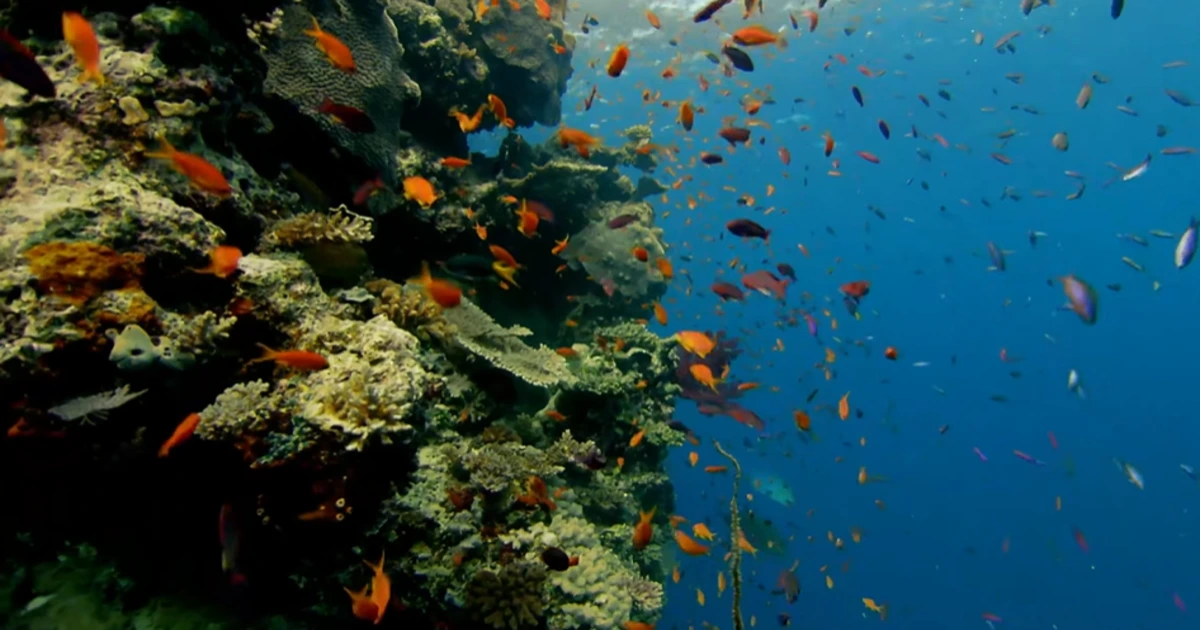
Australia’s Great Barrier Reef has just endured its most extensive bleaching event ever recorded. Coral cover is falling, recovery windows are shrinking, and new research says bleaching could become near-annual.
Stretching for 2,300 kilometres along the northeast coast of Queensland, Australia, the Great Barrier Reef is the largest living structure on Earth, visible from space and listed as a UNESCO World Heritage Site since 1981. It is home to more than 1,500 species of fish, 400 types of coral, 4,000 varieties of mollusc, 240 species of birds, and creatures as extraordinary as the dugong and the large green turtle. It generates around AUD 6.4 billion for the Australian economy each year and supports tens of thousands of jobs in tourism, research, and marine management.
It is also dying faster than at any point in its recorded history.
The most recent comprehensive assessment of the reef’s health, published by the Australian Institute of Marine Science, delivered findings that scientists described with a degree of restraint that barely concealed the alarm underneath. The reef has just endured its most spatially extensive mass bleaching event since records began in 1986. Coral cover has fallen sharply across all three regions of the Marine Park. Recovery windows between bleaching events are shortening. And new modelling published in early 2026 projects that if current warming trajectories continue, mass bleaching could occur in most years for the remainder of this century.
What Just Happened: The Summer of 2025-26
The most recent summer season brought a convergence of threats to the Great Barrier Reef that would have been considered extraordinary even a decade ago and which scientists now describe as part of an accelerating new normal.
The Reef Authority’s latest health update confirms that parts of the Marine Park were hit by coral bleaching, cyclone damage and flooding over the 2025-26 summer from prolonged heat exposure, cyclones and flood plumes, particularly in the Northern and Far Northern regions.
Bleaching was observed on 11 of 19 reefs surveyed in recent monitoring rounds, with the coral bleaching associated with prolonged heat exposure experienced during summer, while much of the coral damage recorded in the Far Northern and Northern regions is consistent with impacts from Severe Tropical Cyclone Narelle.
Compounding the bleaching and cyclone damage, crown-of-thorns starfish, a naturally occurring predator that feeds on coral, have reached outbreak levels across significant sections of the reef. As of May 31, 2026, the Crown-of-Thorns Starfish Control Program and Reef Joint Field Management Program response teams have surveyed and, where needed, culled starfish on 214 reefs this financial year, with active culling underway on 60 reefs to suppress outbreaks.
The AIMS Report: Coral Cover in Free Fall
The authoritative annual assessment of reef health comes from the Australian Institute of Marine Science, whose Long-Term Monitoring Program has been tracking coral cover across the reef’s three major regions since 1986. The 2024-2025 LTMP report, released in August 2025, delivered some of the most sobering findings in the programme’s nearly four-decade history.
The 2024 mass coral bleaching event, the fifth since 2016 and the largest in spatial extent ever recorded, was the primary driver of coral decline, reversing years of coral recovery. Coral cover dropped by 14 to 30 per cent regionally, with some reefs losing more than 70 per cent of their coral compared to 2024 levels.
The Northern Great Barrier Reef was hit hardest, with coral cover falling from 39.8 percent to 30 percent, marking the largest annual decline on record for the region. That figure matters enormously because the northern section of the reef had previously been considered among the most pristine and resilient, largely because it receives fewer visitors and is further from agricultural runoff. The fact that even the northern reefs are now experiencing record declines signals that climate-driven temperature stress has become so pervasive that geographic remoteness no longer offers meaningful protection.
Scientists also found that coral cover declined by almost one-third, down to just 26.9 percent, in the southernmost third of the reef, as the southern reefs experienced their highest recorded levels of heat stress.
The report highlights that recovery windows are shrinking as climate-driven marine heatwaves become more frequent and severe, and warns that without decisive global climate action combined with strong local management measures, the resilience of this World Heritage site will be increasingly compromised.
What Bleaching Actually Is and Why It Matters
To understand the severity of what is happening to the Great Barrier Reef, it helps to understand what coral bleaching actually means at the biological level.
Corals have a symbiotic relationship with photosynthetic algae known as zooxanthellae, which provide the coral polyps with nutrients as well as their bright colours. Heat stress causes the corals to expel the zooxanthellae, leaving the skeletal structures with a bleached appearance.
Bleaching is not automatically fatal. If sea surface temperatures return to normal quickly enough, corals can reabsorb their algae and recover. But recovery takes time, typically years under favourable conditions. The problem the Great Barrier Reef now faces is that the intervals between bleaching events are shortening dramatically, leaving less and less recovery time between each successive assault.
A common metric used to assess the risk to coral reefs from high water temperature is the number of weeks that sea surface temperatures have exceeded the mean monthly maximum temperature by 1 degree Celsius. Significant coral bleaching may occur after four weeks of elevated temperatures, and severe, widespread coral bleaching is likely after eight such weeks.
During the 2024 bleaching event, parts of the reef experienced between eight and ten hotter-than-normal weeks. At that level of sustained heat stress, bleaching is not just widespread. It is lethal.
A Record That No One Wanted to Break
The Australian Institute of Marine Science said it surveyed the health of the reefs between August 2024 and May 2025 and found the most spatially extensive bleaching since records began in 1986, which was predominantly driven by climate change-induced heat stress.
AIMS CEO Professor Selina Stead said that mass bleaching events are becoming more intense and are occurring with more frequency, adding that the future of the world’s coral reefs relies on strong greenhouse gas emissions reduction.
Previous mass bleaching events on the reef occurred in 1998, 2002, 2016, 2017, 2020 and 2022. According to the Australian Institute of Marine Science, prior to these years, there is no evidence of such widespread events in the Great Barrier Reef’s 500-year coral record history.
That timeline tells a devastating story. For five centuries, the reef experienced no mass bleaching events of the kind now recorded almost annually. Since 1998, it has experienced nine. The acceleration is not subtle.
The Science of What Comes Next
New research from Tulane University projects that large-scale coral bleaching could occur in most years this century as ocean temperatures rise. The study finds that even when natural protective factors such as clouds and currents are included, the reef is still projected to bleach during most years this century in most scenarios.
Lead researcher Thomas DeCarlo said: “Over the past four decades, the Great Barrier Reef has already experienced nine mass bleaching events. Our projections show that if warming continues on its current track, bleaching will become a near-annual occurrence, which is essentially incompatible with a healthy, functioning reef.”
That phrase deserves to sit with the reader for a moment. Near-annual bleaching is essentially incompatible with a healthy, functioning reef. Not damaging to it. Not a challenge it can manage. Incompatible with its existence as a healthy ecosystem.
The research examines a highly optimistic scenario in which corals steadily become more tolerant of heat, based on evidence that mass bleaching now tends to occur at higher temperature thresholds than in past decades. Even then, the study finds the reef only reaches average bleaching breaks of four to five years under the lowest-emissions pathways, still shorter than the decade or more that scientists believe corals need to fully recover between events.
DeCarlo said: “There is no realistic future this century in which the Great Barrier Reef returns to its pre-bleaching state. But our results also show that every step toward lower emissions matters. Cutting greenhouse gas emissions can still prevent some bleaching events and reduce the overall damage to the reef.”
The Other Threats: Cyclones, Starfish and Sediment
Bleaching driven by rising sea temperatures is the greatest threat to the Great Barrier Reef, but it does not operate alone. A combination of other pressures has converged with the bleaching crisis to create what scientists describe as an elevated disturbance environment from which the reef has increasingly little capacity to recover.
Cyclones have always been a natural part of the reef’s ecological history, capable of causing significant wave damage but also, paradoxically, of bringing cooler water to the surface and temporarily relieving heat stress. The problem is that as climate change intensifies tropical cyclones and makes them more frequent, the destructive aspects of cyclone activity are escalating faster than any potential cooling benefits.
Crown-of-thorns starfish represent a different category of threat. Crown-of-thorns starfish are a species that continues to grow more comfortable on the Great Barrier Reef as surrounding waters warm, and they are a favourite food predator targeting staghorn, elkhorn, and tabletop corals, which, though prolific, are easily broken up by cyclones.
Since 2016, mass bleaching events have occurred with increasing frequency, leaving shorter intervals for recovery, and this trend coupled with cyclones, crown-of-thorns starfish outbreaks and chronic pressures such as poor water quality is creating an elevated disturbance environment that vastly limits the reef’s resilience.
Water quality from agricultural runoff remains a persistent problem along the Queensland coast. Sediment, pesticides, and nutrient pollution from farming operations inland travel through river systems and into the Marine Park, smothering corals and promoting algae growth that competes with coral for space on the reef. Despite significant investment in reef water quality programs, the improvement has been slower than scientists believe is needed to meaningfully support reef resilience.
The Recovery Story That Isn’t Quite What It Seems
In 2022, AIMS reported the highest levels of coral cover across two-thirds of the Great Barrier Reef in over 36 years. It was widely reported as a positive sign and an indication that the reef could recover. Scientists urged caution even at the time, and subsequent events have demonstrated why.
Scientists from the Woods Hole Oceanographic Institution warned that the apparent recovery concealed a dangerous shift in reef composition. Instead of a diverse, old-growth forest, the reef may now be like a monoculture of planted pulp trees, with less diversity of corals on the Great Barrier leading to fewer structures that house and feed various species of fish and marine invertebrates.
Some species like the parrotfish, a valuable grazer that keeps algae from smothering corals, have already suffered decline in the northern third of the reef following mass bleaching events that began in 2016.
What this means in practice is that even periods of apparent recovery may be concealing a reef that is becoming structurally simpler, ecologically less diverse, and therefore more vulnerable to the next bleaching event. A reef with a broader diversity of coral species, some of which are more heat-tolerant than others, has a built-in buffer against temperature stress. A reef dominated by a narrow range of fast-growing but heat-sensitive species has far less resilience.
What Is Being Done
The scale of the problem does not mean the response has been passive. Australia has invested substantially in reef management, science, and monitoring, and some of those interventions are producing measurable results at the local scale even as the global picture worsens.
The Great Barrier Reef Marine Park Authority’s Crown-of-Thorns Starfish Control Program is one of the more tangible success stories. The program uses a science-based prioritisation process to focus effort on reefs with high ecological and economic value, and crown-of-thorns starfish are at sustainable levels on 80 reefs, or 43 percent of those monitored, while active culling is underway on 60 reefs to suppress outbreaks.
Research into coral restoration and assisted evolution, the selective breeding of heat-tolerant coral strains, is advancing at institutions including the Australian Institute of Marine Science. Scientists have demonstrated that some coral populations show signs of increasing heat tolerance over time, which is the basis for the optimistic scenario in the Tulane University bleaching projections. Whether that natural adaptation can outpace the rate of ocean warming is the central and as yet unanswered question.
The Australian government’s Reef 2050 Plan sets out a long-term framework for protecting and managing the reef through to 2050, with targets across water quality, climate change adaptation, and biodiversity. The plan has faced repeated criticism from scientists and conservation groups who argue that its ambitions are undermined by Australia’s continued status as one of the world’s largest coal exporters, a contradiction that has become increasingly difficult for the government to reconcile as bleaching records fall year after year.
While United Nations experts say the Great Barrier Reef should be included among the World Heritage Sites classified as in danger, the Australian government has lobbied to keep it off the endangered list, fearing it could affect the billions of dollars in tourism revenue the reef generates annually.
Why This Matters Beyond Australia
The Great Barrier Reef is the most famous coral reef system on Earth, but it is not the only one under threat. Coral reefs cover less than one percent of the ocean floor, yet they support an estimated 25 percent of all marine species. They protect coastlines from storm surge and erosion, provide food security for hundreds of millions of people in tropical nations, and generate tourism revenues essential to the economies of dozens of countries.
For European readers, the reef may seem geographically remote, but the forces destroying it are global. The greenhouse gas emissions driving ocean warming are produced by every industrialised economy on the planet, and the consequences of a reef system collapse extend through global fish stocks, marine biodiversity, and ultimately to the stability of coastal ecosystems worldwide.
Australia remains a major exporter of fossil fuels, including coal from the controversial Adani coal mine, which is shipped out past the Great Barrier Reef itself. That detail captures something of the fundamental contradiction at the heart of reef conservation: the country responsible for protecting the world’s most famous coral reef is simultaneously one of the largest contributors to the carbon emissions that are destroying it.
The Bottom Line
The Great Barrier Reef is not dead. It retains significant areas of coral cover, continues to support extraordinary biodiversity, and shows signs in some areas of recovery from previous bleaching events. It remains one of the most complex and scientifically fascinating ecosystems on Earth.
But the trajectory is deeply alarming. Nine mass bleaching events since 1986, five of them since 2016. Record spatial extent in the most recent event. Coral cover falling across all three regions. Recovery windows are shortening. Modelling that projects near-annual bleaching under current emissions trajectories.
DeCarlo’s conclusion says it plainly: there is no realistic future this century in which the Great Barrier Reef returns to its pre-bleaching state. But every step toward lower emissions still matters and can still prevent some bleaching events and reduce the overall damage.
The reef is fighting for its survival. Whether the world is willing to fight alongside it is a question that the coming decade of climate policy will answer definitively, in one direction or the other.
Related Articles:








+ There are no comments
Add yours