
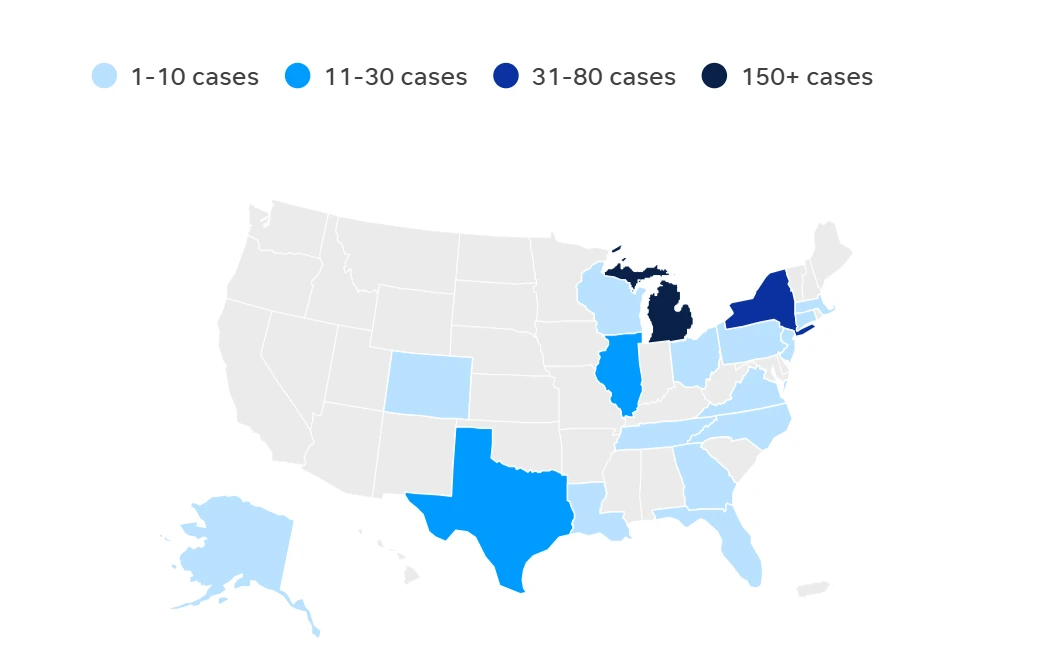
The CDC is investigating a multistate cyclosporiasis outbreak that has sickened at least 145 people across 17 US states since May 2026, with 20 hospitalised. Michigan has reported a sudden surge of over 170 cases.
American health authorities are tracking a multistate outbreak of cyclosporiasis, a parasitic intestinal illness whose most distinctive and distressing symptom is frequent, watery, and sometimes explosive diarrhea.
The US Centers for Disease Control and Prevention has confirmed at least 145 domestically acquired cases across 17 states since May 1, 2026, with 20 people hospitalised.
The case count is now rising sharply, with Michigan alone reporting more than 170 new cases since late June in what state health officials have described as a sudden and large increase.
What Is Cyclosporiasis?
Cyclosporiasis is a foodborne illness caused by Cyclospora cayetanensis, a microscopic single-celled parasite. People become infected by consuming food or water that has been contaminated with human faeces containing the parasite’s eggs, known as oocysts. The CDC emphasises that because Cyclospora requires one to two weeks outside the human body to become infectious, direct person-to-person transmission is considered unlikely. You cannot catch it from a sick person the way you catch a cold or the flu. The contamination happens at the food source, typically fresh produce.
Symptoms typically appear between two and fourteen days after ingesting the parasite, with most people falling ill around a week after exposure. The illness can last anywhere from a few days to more than a month, and symptoms may disappear and then return in cycles, making it difficult to distinguish from other gastrointestinal complaints. Without treatment, cyclosporiasis tends to drag on considerably longer than standard food poisoning.
Symptoms: What to Watch For
The main symptom of cyclosporiasis is severe, watery explosive diarrhea. Beyond that defining feature, infected people commonly experience appetite loss, stomach cramps and bloating, nausea, vomiting, and a low-grade fever. Fatigue is also widely reported, sometimes lasting well beyond the acute phase of the illness. Some people infected with Cyclospora develop no symptoms at all, which is one reason the CDC notes the true number of cases is likely higher than the confirmed count, since people who recover quickly without seeking care are never tested or reported.
The Scale of the Current Outbreak
As of June 16, the CDC has identified 145 domestically acquired cases across 17 states. Investigators said those infected became ill after eating food in the United States and reported no international travel during the 14 days before their symptoms began. Patients ranged in age from 5 to 86, with a median age of 42. About 61 percent of those infected were female. Illnesses began between May 1 and June 6, with a median onset date of May 13. Twenty of the 145 patients were hospitalised. No deaths have been reported.
New York has been the hardest hit, with 31 to 80 people sickened there since the outbreak began. Other states linked to the outbreak include Alaska, Colorado, Connecticut, Florida, Georgia, Louisiana, Massachusetts, New Jersey, North Carolina, Ohio, Pennsylvania, Tennessee, Virginia and Wisconsin. Public health teams are investigating several clusters of cases in New York, Illinois, and Texas specifically.
The numbers have continued to climb since that June 16 update. Health officials in Michigan are investigating a sudden and large increase in cases of cyclosporiasis. Since June 22, 2026, more than 170 cases of cyclosporiasis have been reported in southeast Michigan. That cluster emerged rapidly and caught state health officials by surprise, given that it appeared in a region not previously associated with significant cyclosporiasis activity.
What Is Causing It?
The CDC has not yet identified a single food source responsible for linking all current cases. The CDC says it monitors cyclosporiasis year-round to quickly detect outbreaks linked to a shared food source. However, the team says they have not currently found evidence of a single, multistate Cyclospora outbreak linking all of the current cases.
That distinction matters. Some of the 17 states may be experiencing separate, unrelated clusters rather than a single contamination event traced to one product. The CDC is investigating each cluster individually to determine whether a common food source can be identified.
In the US, cyclosporiasis outbreaks have been linked to fresh fruits and vegetables, including basil, cilantro, raspberries and snow peas. In 2022, a large cluster of cases in Florida was attributed to a Caesar salad kit containing bagged romaine lettuce. Fresh herbs and leafy greens imported from countries where the parasite is endemic are among the most frequent culprits, as the parasite can survive on produce surfaces through standard washing.
Why Summer Is Peak Season
The timing of this outbreak is not a coincidence. The CDC says case counts typically rise in the spring and summer, with May 1 through August considered peak season. The warmer months bring higher consumption of fresh produce, increased outdoor dining, and more opportunities for contamination to occur along complex food supply chains. Most cases in the United States are associated with imported fresh produce from regions of Latin America and the Caribbean where Cyclospora is endemic in soil and water.
Treatment and Prevention
Cyclosporiasis is treatable. The standard antibiotic course is a combination of trimethoprim and sulfamethoxazole, commonly known as TMP-SMX or co-trimoxazole, which is effective against the parasite. Without treatment, the illness can persist for weeks or months and symptoms can recur in cycles. People who are immunocompromised face a higher risk of severe and prolonged illness.
Prevention comes down to food safety fundamentals. The CDC recommends avoiding food or water that may be contaminated with faeces, washing hands thoroughly before handling food, and following safe food preparation and storage practices. Because Cyclospora cannot be reliably eliminated from fresh produce through standard washing alone, the risk from contaminated produce cannot be entirely eliminated through home hygiene measures. Cooking fresh produce thoroughly kills the parasite, though this is obviously impractical for salads and raw herbs.
What Europeans Travelling to the US Should Know
With millions of European visitors currently in the United States for the FIFA World Cup 2026 and the Independence Day holiday weekend, the outbreak carries particular relevance for international travellers. European visitors are not immune to Cyclospora and have no greater natural resistance to the parasite than American residents.
Travellers eating at restaurants or events serving fresh salads, raw herbs, or uncooked produce in the affected states should be aware of the outbreak and seek medical attention promptly if they develop severe diarrhoea, stomach cramps, or fatigue after eating, particularly if symptoms persist beyond a day or two or appear to improve and then return.
Related Articles: