The Black Hundreds: How a Tsarist Death Squad Turned a Siberian City into a Crematorium
There is a particular kind of silence that falls over a city after it has burnt its people alive. It is not the silence of peace or shock. It is the silence of complicity, of a community trying to pretend that the smoke still rising from the charred timbers is merely the residue of an accident, a tragedy, anything but what it truly was: state-sponsored murder.
On the morning of October 20, 1905, in the Siberian city of Tomsk, that silence settled over Novosobornaya Square like ash. The Korolevsky Theatre, which had stood as a monument to culture and refinement since its opening in 1885, was now a smouldering ruin. Inside its collapsed walls lay the remains of men, women, and children who had gathered the previous evening for a political meeting, only to find themselves trapped in a furnace built by their own neighbours. The Black Hundreds had come to Tomsk, and they had brought hell with them.
To understand how a theatre became a crematorium, one must first understand the Russia that produced the Black Hundreds. It was a Russia unravelling.
The Empire in Agony
By 1905, the Russian Empire was bleeding from a thousand wounds. The disastrous war with Japan had exposed the military incompetence of the Tsarist regime, draining the treasury and shattering the illusion of Russian invincibility. At home, workers in St. Petersburg and Moscow were organising strikes that paralyzed industry. Peasants in the countryside were seizing land and burning manor houses. National minorities from Poland to the Caucasus were demanding autonomy. And everywhere, intellectuals, students, and professionals were calling for constitutional reform, civil liberties, and an end to autocracy.
Nicholas II, the last Tsar, responded to this mounting crisis with a mixture of paralysis and panic. He believed, sincerely and fanatically, that he ruled by divine right. The very idea of sharing power with elected representatives struck him as a betrayal of God. Yet the pressure was becoming unbearable. On January 9, 1905, his soldiers had fired on a peaceful procession of workers marching to the Winter Palace to present a petition, killing hundreds in what became known as Bloody Sunday. The massacre turned a restive population into a revolutionary one.
In the months that followed, terrorism became the language of Russian politics. But it was not only the revolutionaries who spoke this language. The Tsarist regime, unable or unwilling to reform, found another answer: counterterror. And the instrument of that counterterror was the Black Hundreds.
The Birth of the Black Hundreds
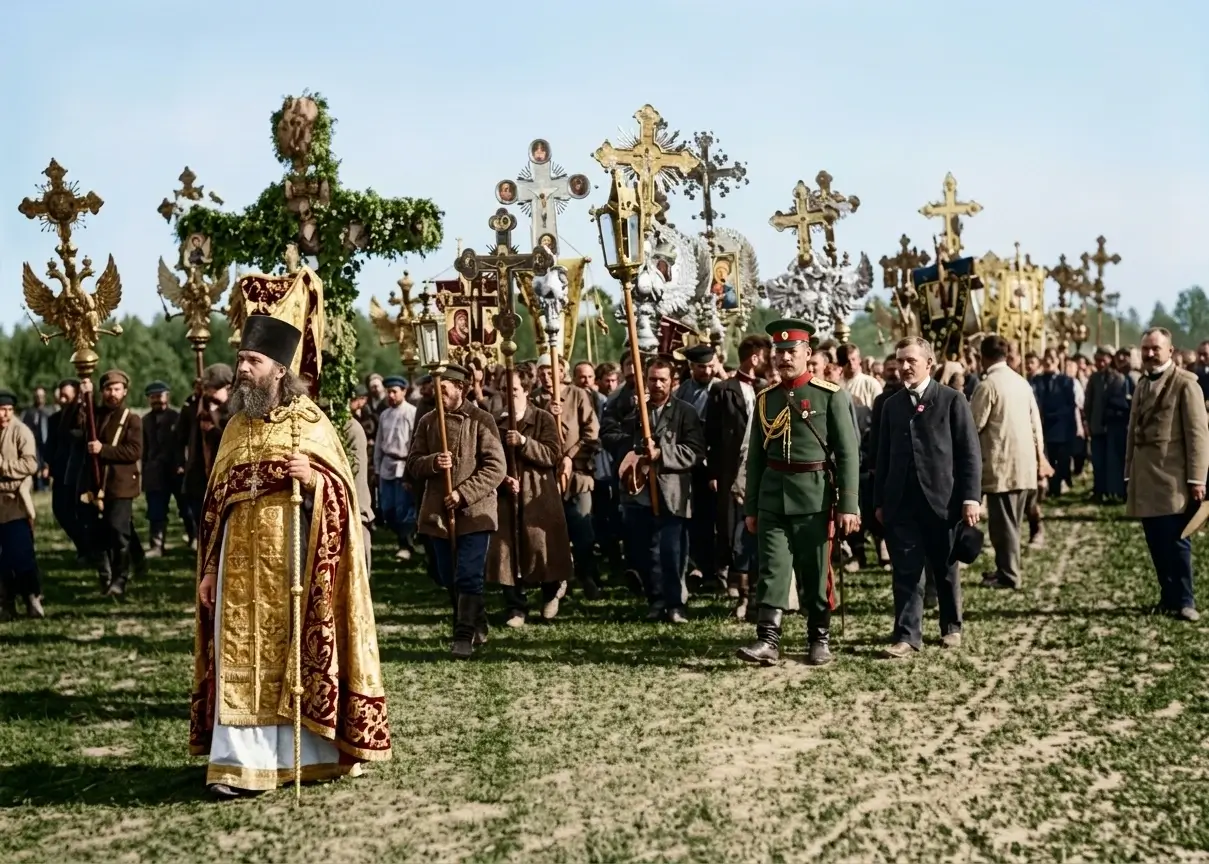
The Black Hundreds were not a single organization. They were a movement, a mood, a method of political violence that coalesced from various reactionary groups already circulating in the Russian Empire. Their ideological roots stretched back to the Slavophiles of the nineteenth century, to the mystical nationalism of the Orthodox Church, and to the paranoid antisemitism that had long festered in the Russian psyche. What unified them was a simple creed, often reduced to three words: orthodoxy, autocracy, and nationality.
The most important of the Black Hundred organizations was the Union of the Russian People, founded in November 1905 in St. Petersburg by a physician named Alexander Dubrovin. Dubrovin was a man of ferocious convictions and limited imagination. He believed that Russia was being destroyed by a conspiracy of Jews, revolutionaries, and foreign agents, and that only the most ruthless violence could save it. Under his leadership, the Union of the Russian People grew rapidly, establishing branches across the empire and claiming hundreds of thousands of members at its peak.
The movement drew its strength from a particular social stratum: shopkeepers, minor officials, Orthodox clergy, small craftsmen, and workers who felt threatened by the chaos of modernization. These were men who had little to gain from revolution and much to fear from it. They were joined by elements of the aristocracy and bureaucracy who saw in the Black Hundreds a useful tool for preserving their privileges.
What made the Black Hundreds genuinely dangerous was not their numbers or their ideology, but their relationship with the state. The Tsarist regime, while officially maintaining a monopoly on violence, actively encouraged and subsidised the Black Hundreds. Nicholas II himself took the Union of the Russian People under his auspices in December 1905, lending the movement an aura of royal legitimacy. The Ministry of Internal Affairs provided funding. Local police and gendarmerie often cooperated with Black Hundred operations, arresting revolutionaries while turning a blind eye to pogroms. In some cases, police officers actively participated in the violence.
The result was a hybrid entity: part political party, part paramilitary gang, and part unofficial state security force. The Black Hundreds operated with the knowledge that they enjoyed impunity. And they used that impunity to unleash a wave of terror that would stain Russian history forever.
The Methods of Terror
The Black Hundreds did not engage in terrorism as it is commonly understood today. They were not trying to destabilise the state. On the contrary, they were trying to preserve it, or at least preserve the autocratic version of it that benefited their patrons. Their terrorism was directed not against the government but against its enemies, real and imagined.
Their primary targets were Jews. Antisemitism was the central organising principle of the Black Hundred worldview. They believed that Jews were behind every revolutionary movement, every strike, and every demand for reform. This was not merely prejudice; it was a complete theory of history, a paranoid cosmology in which a small, alien minority was responsible for all of Russia’s troubles. The solution, in their minds, was extermination through pogroms.
Between January and October 1905, at least fifty-four pogroms took place across the Russian Empire. The Black Hundreds did not organize all of them, but they were the driving force behind the most vicious. In Zhitomir in April 1905, Black Hundred fighters led the assault on Jewish neighbourhoods, marking the first time the movement emerged as a visible instigator of mass violence. In Odessa, in Kiev, in Kishinev, the pattern repeated: armed gangs attacking Jewish homes and businesses, beating and killing men, raping women, burning synagogues, while police stood aside or joined in.
But the Black Hundreds did not limit their violence to Jews. They targeted anyone they considered an enemy of the autocracy: liberals, socialists, students, journalists, and even moderate reformers. In 1907, a Black Hundred operative in Moscow tricked two would-be left-wing revolutionaries into murdering G. B. Iollos, the editor of the newspaper Russkie Vedomosti and a former member of the Duma. The operative had convinced the assassins that Iollos was himself a Black Hundred member marked for death by revolutionaries. It was a calculated act of political manipulation, using the revolutionaries’ own methods against them.
The Black Hundreds also employed bombings, arson, and targeted assassinations. In early 1907, two bombs that had failed to detonate were discovered in the home of former Prime Minister Sergei Witte, who had angered the far right by his support for the October Manifesto. The bombs were constructed differently from those typically used by left-wing revolutionaries, and suspicion immediately fell on the Union of the Russian People, although the organisation denied involvement. Not long afterward, a former liberal Duma deputy and newspaper editor was murdered near the offices of the Black Hundred newspaper Veche, which had previously published death threats against him.
This was terrorism in its purest form: violence designed to terrify a population into political submission. And it worked, at least for a time. The Black Hundreds succeeded in creating an atmosphere of fear that made open opposition to the autocracy genuinely dangerous. They drove intellectuals into exile, silenced newspapers, and convinced many ordinary Russians that the choice was not between autocracy and freedom, but between autocracy and anarchy.
The Tomsk Pogrom: Anatomy of a Massacre
The city of Tomsk, in western Siberia, might seem an unlikely stage for one of the most horrific episodes of the Black Hundred terror. It was not a major political centre like St. Petersburg or Moscow. It was not a city with a large Jewish population like Odessa or Kyiv. It was a provincial capital, a railway hub, a place where the empire’s eastward expansion had deposited a mixture of bureaucrats, merchants, students, and railway workers in the cold isolation of the taiga.
Yet Tomsk had become a focal point of revolutionary activity in 1905. The Trans-Siberian Railway, which passed through the city, was the artery of the empire, and its workers were among the most militant. The October Manifesto, issued by Nicholas II on October 17, granted civil liberties and promised a legislative Duma. To the workers and intellectuals of Tomsk, the manifesto was not enough. They wanted real change, and they wanted it immediately.
On October 20, the Tomsk committee of the Russian Social Democratic Labour Party called a mass meeting at the Korolevsky Theatre. The theatre was a magnificent building, constructed in 1885 by the merchant E. I. Korolev at a cost that reflected his ambition to bring culture to the Siberian wilderness. Over the years, it had hosted performances of Gogol, Ostrovsky, Shakespeare, and Schiller. Its stage had been graced by some of the finest actors in Russia. On this October evening, however, it was not art that drew the crowd but politics.
Approximately three thousand people packed into the theatre. They were workers, students, railway employees, and ordinary citizens who had come to hear speeches about the revolution, to debate the future, and to feel the electric solidarity of a crowd united by hope. The mood was tense but not violent. This was a meeting, not an insurrection.
Outside, however, another crowd was gathering. The Black Hundreds had been preparing for this moment.
The precise sequence of events remains contested, but the broad outline is clear from contemporary accounts, newspaper reports, and the investigations that followed. A Black Hundred mob, armed with sticks, stakes, and revolvers, had assembled near the Trinity Cathedral on Novosobornaya Square. They were not random thugs. They were organised, directed, and in contact with elements of the local authorities.
The city militia, a volunteer force that had been formed to maintain order during the revolutionary unrest, arrived at the theatre and attempted to disperse the meeting. They intended to clear the building and send the crowd home peacefully. But the Black Hundreds had other plans. They attacked the militia, driving them back toward the theatre and the adjacent building of the Siberian Railway Administration.
What happened next was not a clash between two armed forces. It was a slaughter.
The Black Hundreds broke into the ground floor of the railway administration building, which housed a beer hall. They smashed the furniture, looted the premises, and then set the building ablaze. The fire spread quickly, leaping from the administration building to the neighbouring structures: the pension savings bank and then the Korolevsky Theatre itself.
Inside the theatre, three thousand people suddenly found themselves trapped in a burning building. Panic erupted. People rushed for the exits, only to find them blocked by flames or by the mob waiting outside. Those who managed to escape through the doors were met with clubs, axes, and gunfire. The Black Hundreds had formed a cordon around the building, and they were killing anyone who emerged.
Contemporary witnesses described scenes of unimaginable cruelty. Men and women who jumped from the second-floor windows to escape the fire were beaten to death as they lay on the ground. Those who tried to climb down drainpipes were hacked with axes. A woman who survived wrote later that the mob tore at escaping victims immediately, beating them with clubs, iron bars, and weights, and stabbing them with knives and daggers.
The soldiers and Cossacks who had been deployed to the square did not intervene to save the victims. On the contrary, some accounts suggest that they prepared to fire on the militia and the escaping civilians rather than on the pogromists. The commander of the city garrison demanded that the militia surrender their weapons. When shots were fired from the upper floors of the burning railway building, the troops withdrew to a safe distance and aimed their rifles at the building, as if preparing to shoot the trapped victims rather than their attackers.
Firefighters arrived, but the mob prevented them from reaching the blaze. They beat the firemen, cut their hoses, and blocked access to the buildings. The Black Hundreds wanted the fire to burn. They wanted the people inside to die.
The death toll has never been definitively established. Contemporary estimates range from fifty-four to three hundred killed. At least sixty-six bodies were recovered, and one hundred twenty-nine people were wounded, though the true number of dead was likely higher, as many victims were consumed entirely by the flames. Among the dead were not only the political activists who had organized the meeting but also railway workers who happened to be in the administration building collecting their salaries, along with their wives and children.
The theatre troupe of Zbrozhek Pashkovskaya and Getmanov suffered heavy losses, particularly among the minor employees, choristers, and musicians. The conductor S. A. Aprelsky lost an opera and operetta library that he had spent twenty-five years collecting, valued at eight thousand rubles. The sets, props, and costumes of the theatre company were destroyed.
The Korolevsky Theatre itself was gutted. It would never be rebuilt. The merchant Korolev’s dream of bringing high culture to Siberia ended in a pyre of political hatred.
And the response of the authorities? The local newspaper Sibirskaya Zhizn, owned by the brother of the city mayor, did not report the massacre at the theatre. Instead, it minimised the overall death toll, claiming that only thirty-six people had been killed in all the pogroms in Tomsk between October 20 and 23, not counting those who died in the fire. The true scale of the horror was suppressed, distorted, or simply ignored.
The State Within a State
The Tomsk pogrom was not an isolated incident. It was part of a pattern of Black Hundred violence that stretched across the empire from 1905 to 1907. What made this violence possible, and what made it so difficult to stop, was the symbiotic relationship between the Black Hundreds and the Tsarist state.
The Black Hundreds were not officially part of the government. They were a civilian movement, a collection of voluntary associations with names like the Union of the Russian People, the Union of the Archangel Michael, and the Russian Monarchist Party. Yet they received substantial subsidies from state organs, particularly the Ministry of Internal Affairs. Police departments across Russia funnelled money to local Black Hundred chapters. Governors and provincial administrators provided them with meeting halls, printing presses, and protection from prosecution.
This arrangement gave the regime a convenient alibi. When pogroms occurred, the government could claim that they were spontaneous outbursts of popular anger, not state-organised campaigns of terror. The Tsar could express formal disapproval of the violence while his subordinates actively encouraged it. It was a system of plausible deniability, perfected decades before the term entered the political lexicon.
But the relationship was more complicated than simple puppetry. The Black Hundreds were not merely tools of the regime; they were also its critics. Many Black Hundred leaders, including Dubrovin himself, believed that the government was not reactionary enough. They condemned the October Manifesto as a betrayal of autocracy. They attacked moderate ministers who favoured even limited reform. They demanded that the Tsar rule with an iron fist, disband the Duma, and crush the revolutionaries without mercy.
This tension between the Black Hundreds and the government they claimed to serve created a dynamic of radicalization. The more the regime compromised, the more the Black Hundreds escalated. And the more the Black Hundreds escalated, the more the regime depended on them to maintain order. It was a vicious cycle that pushed Russian politics toward ever greater extremism.
The peak of Black Hundred influence came in 1906 and 1907, when the movement succeeded in electing deputies to the Second and Third Dumas and when its fighting squads operated with near total impunity. In Ukraine, the Black Hundreds were particularly well organized, with branches in Odessa, Kiev, Kharkiv, and Yelisavetgrad. In Odessa alone, the local branch of the Union of the Russian People claimed twenty-two thousand members in 1907. They published newspapers, ran candidates for local office, and organized armed bands that staged pogroms in Kiev, Odessa, and Yalta.
Yet the movement was already beginning to fracture. In 1907, Vladimir Purishkevich, the vice president of the Union of the Russian People and one of its most visible leaders, broke away to form his own organization, the Chamber of the Archangel Michael. The split was driven by personal rivalries and ideological disagreements. Purishkevich was willing to work within the Duma system; Dubrovin remained opposed to any form of representative government. In 1910, Dubrovin was driven from his own organization by Nikolai Markov, another Duma member who seized control of the Union of the Russian People and forced Dubrovin to form a splinter group.
These schisms weakened the Black Hundreds considerably. Membership declined after 1908, and the movement lost much of its mass appeal. The public revelation of state subsidies damaged its credibility, giving it a reputation as a collection of government lackeys rather than genuine patriots. Yet the various factions survived, kept afloat by continued funding from state organs and by the dedication of hardcore activists who believed that Russia’s salvation required the complete destruction of its enemies.
In March 1907, Prime Minister Pyotr Stolypin ordered all Black Hundred fighting groups to disband and instructed the police to ensure compliance. The order was partially enforced, but it did not end the violence. Black Hundred terrorism continued, albeit at a reduced level, until the outbreak of the First World War and the revolutionary upheavals that followed.
The Revolutionary Response
The Black Hundreds did not operate in a vacuum. Their terrorism provoked a counterterrorism from the revolutionary movements they sought to destroy. The cycle of violence that engulfed Russia between 1905 and 1917 was not simply a story of state oppression and popular resistance. It was a story of two terrorists feeding on each other, each justifying its atrocities by pointing to the atrocities of the other.
The Bolsheviks, Mensheviks, Socialist Revolutionaries, and anarchists all engaged in political violence during this period. They assassinated government officials, bombed police stations, robbed banks to fund their operations, and carried out targeted killings of Black Hundred leaders. In March 1908, according to police records, revolutionary militants in Chernihiv province threw bombs at the homes of local Union of the Russian People chairmen, set fire to their houses, and killed them in the streets.
The Bolsheviks carried out an armed attack on a Tver tea house in St Petersburg, where workers belonging to the Union of the Russian People had gathered. Two bombs exploded, and then Bolshevik militants shot those who ran out of the teahouse with revolvers. Two were killed and fifteen wounded. Prominent Black Hundreds such as Nikolai Bogdanovich and Gavril Luzhenovsky were assassinated by Socialist Revolutionaries.
This was not self-defence, at least not in any legal sense. It was revolutionary terror, deliberate and calculated. And it was, in part, a response to the terror of the Black Hundreds. The revolutionaries understood that the Black Hundreds were not merely a political opponent but an existential threat. They could not be debated or voted out of existence. They had to be destroyed.
The tragedy of this period was that both sides were, in their own way, correct about the nature of their enemy. The Black Hundreds were indeed fascistic precursors, a movement of racial hatred and political absolutism that would have destroyed any possibility of a democratic Russia. And the revolutionaries were indeed, in many cases, ruthless fanatics who would go on to build a totalitarian state far more murderous than the one they overthrew. The violence of 1905 to 1917 was not a struggle between good and evil. It was a struggle between competing evils, each of which claimed to be the sole defender of the Russian people.
The Legacy of the Black Hundreds
The Black Hundreds were officially abolished after the February Revolution of 1917, when the Provisional Government swept away the remnants of the Tsarist order. Many of their leaders fled abroad or went into hiding. Some joined the White armies during the Russian Civil War, fighting against the Bolsheviks in the name of a restored autocracy. Others were arrested and executed by the new Soviet regime, which had no more tolerance for right-wing terror than the old regime had had for left wing revolution.
Yet the Black Hundreds did not truly disappear. Their ideology survived, transmitted through émigré circles, underground religious communities, and the prison camps of the Gulag. In the final years of the Soviet Union, as the communist ideology lost its grip on the Russian imagination, the old nationalist and antisemitic ideas began to resurface. Organizations like Pamyat, founded in the 1980s, explicitly drew on the legacy of the Black Hundreds, combining Orthodox mysticism, monarchist nostalgia, and xenophobic nationalism into a potent cocktail of resentment.
The historian Walter Laqueur, who produced one of the first comprehensive studies of Russia’s far right in the 1990s, traced the post-Soviet resurgence of extremism directly to the Black Hundred tradition. He documented how anti-Western ultranationalists, openly fascistic movements, fanatical sects within the Orthodox Church, and various monarchist factions all echoed the ideology of their prerevolutionary predecessors. These groups espoused militarism, antisemitism, and the belief that Russia could function only under authoritarian leadership. They found fertile ground in the chaos and humiliation of the post Soviet transition.
Today, the echoes of the Black Hundreds can be heard in the rhetoric of Russian nationalist politicians, in the persecution of religious and ethnic minorities, in the state’s cultivation of paramilitary groups like the Wagner mercenary company, and in the broader atmosphere of intolerance that has characterized Russian political life. The specific form has changed, but the substance remains: the idea that Russia is a civilization under siege, that its enemies are both foreign and domestic, and that only ruthless violence can preserve its greatness.
Remembering the Korolevsky Theatre
The Korolevsky Theatre in Tomsk was never rebuilt. Today, if you visit Novosobornaya Square, you will find no monument to the hundreds who died there on October 20, 1905. The site of the theatre is occupied by other buildings, other memories, and other histories. The Siberian Railway Administration building, which also burnt that day, was reconstructed in 1909 and 1910 and now houses Tomsk State University of Control Systems and Radioelectronics. But the theatre itself is gone, erased from the physical landscape of the city.
This erasure is, in its own way, a continuation of the violence. To forget the Korolevsky Theatre is to forget what the Black Hundreds did, and to forget what they did is to risk seeing it happen again. The burning of the theatre was not merely a local tragedy. It was a warning, a demonstration of what happens when a state delegates its monopoly on violence to armed gangs, when political disagreement is treated as treason, and when a significant portion of a society is convinced that its survival requires the extermination of its neighbours.
The three thousand people who gathered in the Korolevsky Theatre on that October evening were not revolutionaries in any meaningful military sense. They were citizens exercising their right to assemble, to speak, to imagine a different future for their country. They were met with fire and axes and bullets, not because they posed a threat to the state, but because their very existence as free citizens was intolerable to those who believed that Russia could only be ruled through fear.
The Black Hundreds understood something that all terrorists understand: that the purpose of terror is not merely to kill enemies but to destroy the possibility of trust. A society in which neighbours burn neighbours alive, in which firefighters are beaten for trying to save lives, and in which soldiers aim their rifles at victims rather than murderers is a society that has lost the capacity for collective action. It is a society that can be ruled only by force.
This was the true goal of the Black Hundred terror. And in the short term, it worked. The revolution of 1905 was suppressed. The Duma was tamed. The autocracy survived, for a time. But the price was the moral corrosion of Russian society, the destruction of its civic fabric, and the creation of a political culture in which violence was accepted as the normal instrument of political competition.
When the next crisis came, in 1917, there was no one left to defend the old order, not because the revolutionaries were so strong, but because the old order had destroyed its own legitimacy through decades of terror and corruption. The Black Hundreds had saved the autocracy in 1905, but they had also ensured its eventual collapse. They were the antibodies that killed the patient.
The Fire Next Time
The history of the Black Hundreds is not merely a historical curiosity. It is a case study in how democracies die, not through foreign invasion or economic collapse, but through the gradual normalisation of political violence. The Tsarist regime did not set out to create a terrorist movement. It simply found the Black Hundreds useful, and in finding them useful, it legitimized them. By the time the regime realised that the movement had become uncontrollable, it was too late.
The burning of the Korolevsky Theatre stands as a symbol of this process. It was an act of violence so extreme, so visibly criminal, that it should have shocked the conscience of the empire. Instead, it was covered up, minimised, and forgotten. The perpetrators were never punished. The victims were never properly mourned. And the precedent was established that certain kinds of violence, committed by certain kinds of people against certain kinds of victims, would be tolerated.
This is how terror becomes routine. This is how societies slide into barbarism. Not through sudden catastrophe, but through the slow accumulation of unacknowledged crimes, each one slightly worse than the last, each one slightly easier to excuse.
Russia paid a terrible price for its tolerance of the Black Hundreds. The world is still paying the price of Russia’s subsequent tolerance of Bolshevik terror and of the various forms of state and non-state violence that have followed. The lesson of the Korolevsky Theatre is that there is no such thing as controlled political violence. Once a society accepts the principle that its enemies may be burnt alive, it has surrendered the moral foundation on which any decent political order must rest.
The theatre is gone. The dead are gone. But the warning remains, written in smoke and ash, waiting for those who have eyes to read it.