
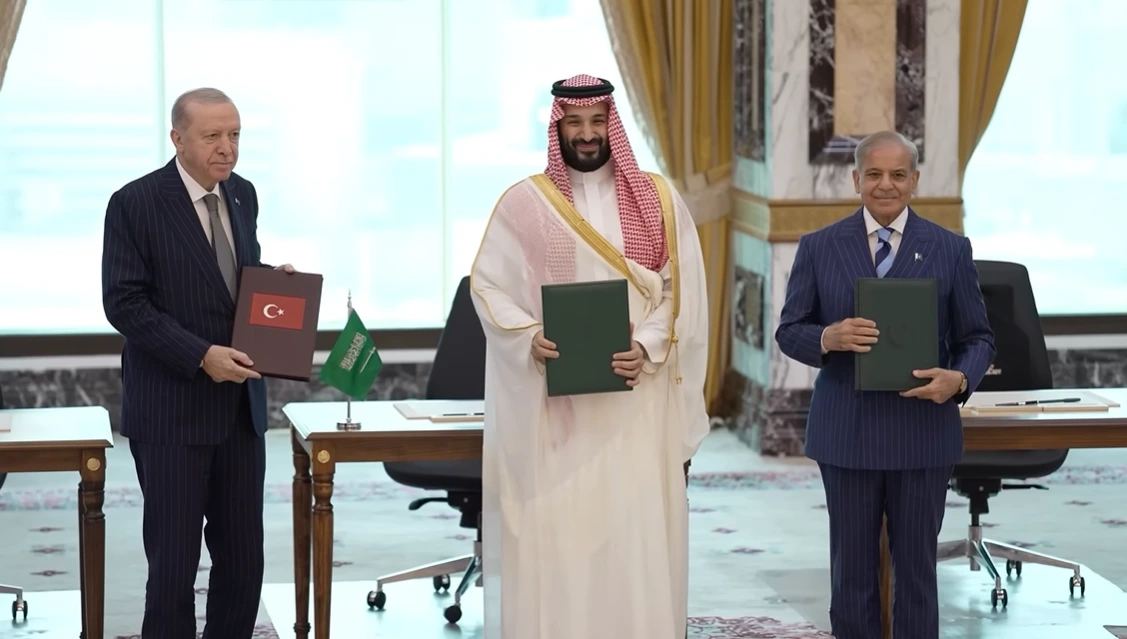
Saudi Arabia, Turkey and Pakistan signed the Mecca Joint Defence Agreement on August 7, 2026, creating what analysts call a Muslim NATO. Here is a comprehensive analysis of its structure, what it means for the world, and why Bangladesh’s potential membership matters.
On August 7, 2026, in the holiest city in the Islamic world, three leaders gathered to sign a document that may prove to be the most consequential security agreement of the decade. Crown Prince Mohammed bin Salman of Saudi Arabia, President Recep Tayyip Erdoğan of Turkey, and Prime Minister Shehbaz Sharif of Pakistan sat beneath cameras in Mecca and formalised what analysts are already calling the Muslim NATO: the Mecca Joint Defence Agreement.
The language of the agreement is unmistakably modelled on the treaty that has defined Western security for 75 years. Its central principle mirrors NATO’s Article 5: an armed attack against any one of the three member states shall be regarded as an attack against them all. Turkish Foreign Minister Hakan Fidan has explicitly compared the arrangement to NATO’s collective-defence principle, while Pakistani officials have described it as a purely defensive arrangement not directed against any particular country.
The world is paying attention. And so, as of this week, is Bangladesh.
How the Mecca Pact Was Built
The agreement did not emerge suddenly. It was the product of a carefully constructed sequence of bilateral deals that accelerated sharply under the pressure of the ongoing US-Iran conflict.
It builds upon the earlier Strategic Mutual Defence Agreement signed between Pakistan and Saudi Arabia on September 17, 2025, to include Turkey. The pact’s ratification was officially announced amidst the 2026 Iran war.
The bilateral Saudi-Pakistan relationship that underpins the pact has deep roots. Pakistan has long provided military training and technical assistance to Saudi forces, and the two countries have maintained extensive people-to-people ties through the millions of Pakistani workers employed across the Gulf. By mid-2026, Pakistan had deployed several thousand troops, fighter aircraft, drones and an air-defence system to Saudi Arabia and opened talks with Kuwait in July 2026 on an expanded security arrangement.
Turkey and Pakistan had separately deepened their own defence ties in the years preceding the agreement, exchanging warships and training aircraft. Saudi Arabia had agreed to purchase Turkish drones in 2023. The trilateral framework, when it finally arrived, was therefore less a leap into the unknown than the formalisation of relationships that had been developing for years.
The Mecca Joint Defence Agreement effectively supersedes legacy security frameworks by consolidating a functional Muslim NATO, building on less formal arrangements proposed last year and on the continuing effort to include Egypt.
What Each Member Brings to the Table
The power of any alliance is only as real as what its members contribute. The Mecca Pact’s three founding members each bring a distinct and complementary capability to the arrangement.
Saudi Arabia brings its vast economic resources; Turkey brings NATO’s second-largest military; and Pakistan brings the world’s only Muslim nuclear arsenal.
More specifically, the Mecca Agreement enables Saudi Arabia to finance and fund defence projects; Turkey to provide deep tech defence equipment, and Pakistan to provide manpower at the frontline.
That division of roles reflects each member’s comparative advantage with remarkable clarity. Saudi Arabia’s sovereign wealth and oil revenues, projected to generate enormous fiscal capacity even as the energy transition reshapes global oil demand, provide the financial foundation that no purely military alliance can sustain without. Turkey’s defence industry, which produces the Bayraktar TB2 and Kızılelma drones, the HISAR air defence family, and a growing range of domestically developed naval vessels, provides cutting-edge conventional military capability. Pakistan contributes something that neither Saudi Arabia nor Turkey possesses: a declared nuclear arsenal with delivery systems, a battle-hardened conventional military, and a geographic position on Iran’s eastern flank that gives the alliance its most direct territorial leverage over its principal implicit adversary.
The result is a geopolitical triangle with significant reach: Saudi Arabia links the Gulf and Red Sea, Turkey connects the Middle East to the Mediterranean, Eurasia and Europe, and Pakistan extends the network into South Asia and the Arabian Sea.
Is It Really a Muslim NATO?
The Muslim NATO label has circulated widely since the agreement was announced, and it captures something real about the pact’s ambition. But analysts are divided on whether the label is premature, accurate, or even useful.
Several experts consider the Islamic NATO label premature. Dr Kristian Alexander, a regional security specialist in Dubai, views the agreement as a formalisation of existing bilateral security relationships into a coherent regional deterrence framework, rather than the creation of a Muslim NATO. Seyed Mojtaba Jalalzadeh, an Iranian independent researcher and political analyst, also describes the pact as neither a fully developed Islamic NATO nor a symbolic gesture, noting that the specific military commitments of the three members remain undisclosed.
The institutional architecture, however, points toward something genuinely substantial rather than merely symbolic. Turkish Foreign Minister Hakan Fidan said the pact would function similarly to NATO, with a minister’s committee, political and military committees, and a permanent secretariat to oversee the implementation of decisions. The permanent general secretariat is expected to be based in Mecca.
A secretariat, a minister’s committee, and political and military working committees are not the trappings of a symbolic declaration. They are the architecture of an operational institution. The comparison that matters most is not what the Mecca Pact is today but what it is designed to become.
Beneath its formal collective defence language, the pact signals a broader geopolitical contest to shape the Middle East as the US-centred security system declines. That decline, accelerated by the Trump administration’s increasingly transactional approach to alliance management and the chaos of the US-Iran war, has created a vacuum that the Mecca Pact’s founders are explicitly positioning themselves to fill.
The Iran Context: What Triggered the Formalisation
The timing of the Mecca Pact’s signing, in the middle of an active US-Iran war that has already claimed thousands of lives and disrupted global energy markets, is not coincidental. The conflict has concentrated minds across the Muslim world on questions of security architecture that were previously theoretical.
The sectarian dimension remains relevant. Saudi Arabia, Turkey, and Pakistan are Sunni-majority states, while Iran is the region’s principal Shia power. However, the agreement’s founding members have been careful not to frame it as an anti-Iran instrument explicitly. The pact is officially positioned as purely defensive and open to membership from any state that shares its principles.
The nuclear dimension is the most delicate. Analysts have noted that it was unlikely that the pact would extend the deterrence of Pakistan’s nuclear weapons to cover either Saudi Arabia or Turkey. The question of whether Pakistan’s nuclear umbrella meaningfully extends to its treaty partners, as America’s nuclear guarantee underpins NATO’s Article 5, remains the central unresolved question of the pact’s strategic architecture.
If Pakistan’s nuclear arsenal genuinely deters attacks on Saudi Arabia and Turkey, the Mecca Pact becomes an extraordinarily powerful instrument. If it does not, the pact remains a significant but conventionally limited alliance. That ambiguity is likely deliberate, maintaining strategic uncertainty that serves deterrence without requiring Pakistan to make explicit nuclear commitments it may not intend to honour.
Against Whom? The Geopolitics of an Implicit Adversary
The pact’s signers played down its widely speculated targets, especially Iran and Israel, soon after it was inked. Yet the question of who the Mecca Pact is designed to deter cannot be answered with diplomacy alone. Alliances are defined as much by their implicit adversaries as by their formal memberships.
The most obvious answer is Iran. A treaty binding three of the region’s most powerful Sunni-majority states, signed during a war in which Iran is actively firing ballistic missiles at Gulf states, in the city most sacred to Sunni Islam, carries an unmistakable message about where the fault line lies.
But the picture is more complex than a simple Sunni-Shia divide. The Mecca group occupies a distinctive middle position. It is neither part of Iran’s proxy network nor an extension of the US-Israel security architecture. It has been described as a counter-Abraham Accords axis, while analysts stress that the group is not strictly religious despite the Muslim NATO framing.
The respective foes of the new Mecca pact are not necessarily mutual foes. Pakistan and Turkey are not nearly as hostile to Yemen or its mutually loathing factions as Saudi Arabia. Saudi Arabia has defence and energy relations with Greece and Cyprus. Turkey and India are fellow G20 members with $10.4 billion in bilateral trade. Trade between Saudi Arabia and India is even higher at $43 billion.
This divergence in the three members’ specific adversarial relationships is the Mecca Pact’s most significant internal tension. Article 5-style mutual defence works most effectively when all members face a common threat. The Mecca Pact’s members each have their own distinct security concerns that do not fully overlap, creating potential frictions when the collective defence clause is invoked in circumstances where one member’s adversary is another’s trading partner.
The STEP Framework: Egypt and the Expanding Alliance
The shorthand STEP, standing for Saudi Arabia, Turkey, Egypt, and Pakistan, is already being used to describe the Muslim NATO envisioned by Ankara and Islamabad. It remains to be seen, however, whether Egypt, which must take into account not only its own security interests but also its longstanding relationship with the United States and its peace treaty with Israel, will join.
Egypt’s potential membership would be transformative. With the largest Arab military and a geographic position controlling the Suez Canal, one of the world’s most strategically vital waterways, Egypt would add both military mass and unmatched geographic leverage to the alliance. Egypt’s defence relationship with the United States, which provides it with approximately $1.3 billion in annual military aid, complicates its membership calculus considerably. Washington would regard Egyptian accession to a Muslim NATO as an act of strategic defection, and the financial and military consequences of that determination could be severe for Cairo.
Egypt also maintains its 1979 peace treaty with Israel, which formally prohibits it from entering military alliances directed against Israel. The Mecca Pact’s official non-alignment on the Israel question may be crafted specifically to leave Egypt a pathway to membership that does not require it to abrogate a treaty that has been the foundation of its strategic relationships for nearly fifty years.
On August 20, 2026, during his visit to Pakistan, Syrian Foreign Minister Asaad al-Shaibani said that Syria was considering whether to join or cooperate with the Mecca Agreement. Syria’s potential accession, coming after the fall of Bashar al-Assad’s government, would add a powerful symbolic dimension, bringing a country devastated by Iran-backed forces into an alliance explicitly designed to balance Iranian power.
Bangladesh: A Historic Choice on the Horizon
The most significant development since the Mecca Pact’s signing, from Bangladesh’s perspective, is the direct invitation from Saudi Arabia to join the agreement. A source in the Bangladesh foreign ministry said Saudi Arabia had invited Dhaka to join the pact.
The response from Dhaka has been carefully calibrated. Junior foreign minister Humayun Kabir stated, “If there is a security arrangement among Islamic nations in the Middle East, it is not unusual for us to consider participating. It is being viewed positively.”
Bangladesh’s Foreign Affairs Adviser Humaiun Kobir stated that Bangladesh maintains a positive approach towards joining a potential economic or defence framework involving Saudi Arabia, Pakistan and Turkey, guided by its Bangladesh First policy and national interests. He also noted that Prime Minister Tarique Rahman’s visit to Riyadh is likely to be finalised soon, while Dhaka is strengthening bilateral ties with Pakistan in trade and people-to-people connectivity.
That diplomatic language, positive approach, Bangladesh First, guided by national interests, signals genuine interest without constituting a commitment. The calculation Dhaka is now making is one of the most consequential foreign policy decisions in the country’s history.
The Case for Bangladesh Joining
Bangladesh’s potential accession to the Mecca Pact carries genuine strategic logic that deserves serious examination rather than dismissal.
Bangladesh’s economy depends fundamentally on remittances from the Gulf, particularly from Saudi Arabia, which is home to the largest community of Bangladeshi workers abroad. Saudi Arabia receives approximately 500,000 to 600,000 Bangladeshi workers, and their remittances constitute a lifeline for millions of Bangladeshi families. A deepened security partnership with Riyadh would strengthen the bilateral relationship that underpins those flows, potentially providing greater protection for Bangladeshi workers in the Gulf and greater leverage in negotiations over labour rights and working conditions.
Bangladesh’s Muslim-majority population of approximately 170 million people, the third-largest Muslim population of any country in the world, gives the country significant demographic weight in any pan-Islamic security arrangement. Bangladeshi accession would dramatically increase the Mecca Pact’s legitimacy as a genuinely representative Muslim security alliance rather than a narrowly Arab and Pakistani affair.
Bangladesh’s military, while modest in conventional power projection terms, has one of the most internationally respected reputations in the world through its extraordinary record of UN peacekeeping contributions. Bangladesh is consistently among the top two or three troop-contributing countries to UN peacekeeping operations globally. That institutional experience in multilateral military coordination would be a genuine contribution to an alliance still building its operational structures.
Turkey’s growing defence industrial partnership with Bangladesh, including discussions about Bayraktar drone acquisitions and naval cooperation, creates concrete bilateral ties that would be strengthened and deepened within a formal alliance framework.
The Case Against Joining
The arguments against Bangladesh joining the Mecca Pact are equally serious and deserve equal analytical weight.
The Mecca Joint Defence Agreement reflects the different security challenges faced by the three founding countries. Saudi Arabia faces tensions involving Iran, Houthi attacks from Yemen and wider instability across the Gulf and Red Sea. Turkey has security interests spanning Syria, Iraq, Libya and the Caucasus, while Pakistan continues to confront threats along its western border and militant violence at home. For these countries, closer defence cooperation may strengthen deterrence and provide greater security. But their security priorities are not necessarily Bangladesh’s.
Bangladesh has no territorial dispute or military confrontation with Iran, nor does it have any interest in becoming involved in a Gulf conflict. If Saudi Arabia were drawn into a future confrontation with Iran while Bangladesh was a member of the Mecca Pact, Dhaka could come under pressure to take sides in a war it had no role in starting. Such a situation could strain Bangladesh’s relations with both Riyadh and Tehran while putting its economic and energy interests at risk, particularly given the country’s dependence on shipping routes through the Strait of Hormuz and the Bab el-Mandeb Strait.
The India dimension is the most immediate and pressing concern. Bangladesh’s possible Mecca Pact membership could strain India ties. The move could complicate Dhaka’s ties with India, already strained over several issues. Analysts said New Delhi was unlikely to welcome Bangladesh’s membership of a security alliance that includes arch-foe Pakistan, although Dhaka would ultimately make its own sovereign decision.
Bangladesh and India share a 4,156-kilometre border, the longest land border Bangladesh shares with any country. Indian investment in Bangladesh is significant; Indian infrastructure, including the Agartala-Akhaura rail link and power interconnections, is woven into Bangladesh’s economic fabric, and the two countries’ economic relationship, though currently under strain, involves trade, transit, and connectivity that Bangladesh cannot afford to jeopardise lightly.
Joining a pact that includes Pakistan, with whom India fought three wars and continues to maintain a hostile security relationship, would be read in New Delhi as a fundamental strategic realignment. The extradition dispute over former Prime Minister Sheikh Hasina, currently in exile in India, further complicates the bilateral relationship at precisely the moment that the Mecca Pact membership question demands careful diplomacy.
Bangladesh’s foreign policy tradition since 1971 has been built around non-alignment, friendship with all and malice to none, a framework that has served the country well in navigating its difficult position between larger powers. Membership in a formal military alliance with explicit collective defence commitments represents a fundamental departure from that tradition, with consequences that extend well beyond the immediate security calculus.
Other Potential Members and the Alliance’s Future Shape
Beyond Bangladesh, the Mecca Pact’s future membership trajectory will determine whether it remains a regionally focused Gulf security arrangement or evolves into the genuinely global Muslim security architecture that Ankara and Islamabad envision.
Indonesia and Malaysia, as the two most populous and economically significant Southeast Asian Muslim-majority nations, are the most obvious candidates for eventual membership. Neither has yet publicly indicated interest, and both maintain careful non-alignment traditions. However, both have also deepened defence relationships with Turkey in recent years, providing potential institutional pathways.
Azerbaijan, which maintains close military ties with both Turkey and Israel and has recently acquired Bayraktar drones, occupies an interesting position. Its membership would extend the alliance’s reach into the South Caucasus and directly adjacent to Russia, a dimension that would significantly complicate both NATO’s and Moscow’s strategic calculations.
Kazakhstan, Kyrgyzstan, Tajikistan, Turkmenistan, and Uzbekistan, the five Central Asian republics, are all Muslim-majority states with varying degrees of security dependence on Russia through the Collective Security Treaty Organisation. Their potential membership in a Mecca Pact that evolves into a genuine global Muslim security architecture would represent the most dramatic reconfiguration of the post-Soviet security landscape since 1991.
Kuwait’s talks with Pakistan about an expanded security arrangement, confirmed in July 2026, suggest that Gulf states beyond Saudi Arabia may be contemplating some form of association with the Mecca framework, even if full formal membership carries diplomatic complications relative to their US security ties.
The European Dimension: What the Mecca Pact Means for Europe
European policymakers, preoccupied with Ukraine, NATO’s eastern flank, and the EU’s internal political tensions, have paid insufficient attention to the Mecca Pact’s implications for European security and economic interests.
Turkey is a founding member. Turkey is also a NATO member with NATO’s second-largest military. The Mecca Pact’s Article 5-style collective defence clause potentially creates a situation in which Turkey has mutual defence obligations both to its NATO allies and to Saudi Arabia and Pakistan, two states whose strategic interests do not always align with Europe’s. If Turkey were required to choose between its NATO commitments and its Mecca Pact obligations in a future conflict scenario, the consequences for NATO’s coherence could be severe.
Europe’s energy security is also directly implicated. European countries that have been diversifying away from Russian energy toward Gulf alternatives are now more dependent on Saudi Arabian and Emirati energy exports than at any point since the 1970s. The Mecca Pact’s reshaping of Gulf security architecture, and the potential for it to escalate rather than stabilise the US-Iran conflict that has already sent oil prices above $90 per barrel, carries direct consequences for European household energy bills that are already at elevated levels.
The Strait of Hormuz, through which approximately 20 percent of the world’s oil and gas passes, and the Bab el-Mandeb Strait, which connects the Red Sea to the Gulf of Aden and serves as the primary maritime route between Europe and Asia, are both directly implicated in the security dynamics that the Mecca Pact is designed to shape. European shipping, European trade with Asia, and European energy imports all pass through waterways whose security conditions are being fundamentally renegotiated by the agreement signed in Mecca on August 7.
An Honest Assessment: What the Mecca Pact Is and Is Not
The Mecca Joint Defence Agreement is a genuinely significant development in the architecture of Muslim world security. It represents the first institutional arrangement of its kind, bringing together three major Muslim-majority states under a formal collective defence commitment with real institutional structures designed to operationalise that commitment over time.
It is not, at least not yet, a Muslim NATO in the full sense. The specific military commitments of its members remain undisclosed. The nuclear deterrence question is unresolved. The divergence in the three founding members’ specific security concerns creates internal tensions that have not yet been tested. And the absence of Egypt, the largest Arab military power, leaves a significant capability gap in the alliance’s regional footprint.
The Mecca Pact is consequently best understood not as the birth of a Muslim NATO, but as one of the clearest expressions yet of a Middle East in which regional powers are attempting to build overlapping security networks of their own, as the US-centred security system recedes.
That framing is important because it situates the Mecca Pact within a broader structural shift rather than treating it as an isolated event. The world is becoming more multipolar. Regional powers are building their own security architectures rather than relying on great power guarantees. The Mecca Pact is the Muslim world’s most significant contribution to that structural transformation since the founding of the Organisation of Islamic Cooperation in 1969.
For Bangladesh, the decision is not simply about joining or not joining a military alliance. It is about deciding what kind of country Bangladesh wants to be in a multipolar world and which relationships it is willing to prioritise when those relationships conflict. That is a question only Bangladesh can answer. But the answer will reverberate across South Asia, the Middle East, and beyond for decades.
Europeans24 covers geopolitics, international security, and global affairs alongside its core European news coverage. Follow us for continuing analytical coverage of the Mecca Pact, its expanding membership, and its implications for European and global security.
Related Articles: