Fatih Erbakan, son of Türkiye’s first Islamist prime minister, has confirmed he will run for president in 2028. Here is who he is, what his New Welfare Party stands for, and what his candidacy means for Erdogan and Turkish politics.
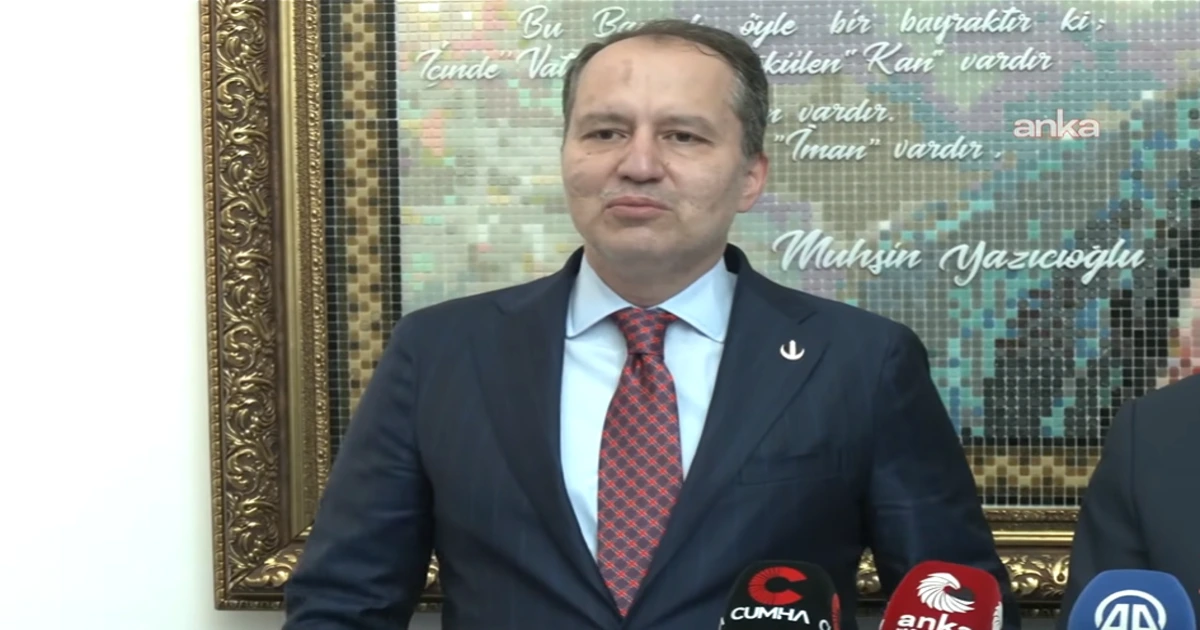
Turkish politics has no shortage of dynasties, but few carry the symbolic weight of the Erbakan name. Fatih Erbakan, the son of Necmettin Erbakan, the country’s first Islamist prime minister and the founding father of the political movement that eventually produced Recep Tayyip Erdoğan himself, has confirmed his intention to run for the presidency in Türkiye’s next election, scheduled for 2028. The announcement, made through his New Welfare Party, has reopened a decades-old question in Turkish politics: who truly represents Turkey’s political Islamist tradition, the man who inherited its name, or the man who built an empire on its foundations?
Who Is Fatih Erbakan?
Muhammed Ali Fatih Erbakan was born on January 1, 1979, in Ankara. He is a Turkish engineer and politician who is the founder and leader of the Islamist New Welfare Party, known by its Turkish acronym YRP. He is the 45-year-old son of Necmettin Erbakan, a man often described as the spiritual godfather of political Islam in modern Türkiye.
Erbakan’s political career began within the Virtue Party from 1999 to 2001 and continued in the Felicity Party from 2001 to 2015, before he founded the New Welfare Party again on November 23, 2018, and was elected as its chairman. As YRP chairman, he organised one of the largest congresses in Turkish political history on November 17, 2019, with the participation of 45,000 people, and held the party’s first major rally, the Jerusalem Rally, on February 9, 2020, in Sakarya’s Democracy Square.
Erbakan currently sits as a Member of the Grand National Assembly, having assumed office on June 2, 2023, representing the Istanbul II constituency.
The Erbakan Name and Türkiye’s Islamist Tradition
To understand why Fatih Erbakan’s candidacy matters, it helps to understand what his father represented. Necmettin Erbakan founded Türkiye’s Islamist National Outlook Movement and led several prominent Islamist parties before the AKP, including the Welfare Party. Underlined by the claim that they represented economically marginalised communities, the Turkish Islamist parties owed their success starting from the 1990s to small business owners, low-income groups, and the urban poor.
That movement, known in Turkish as Millî Görüş, is the ideological soil from which Türkiye’s modern Islamist politics grew. Recep Tayyip Erdogan himself emerged from this tradition. Erdogan, a disciple of Necmettin Erbakan, was 40 years old when he was nominated for and narrowly won the Istanbul Metropolitan Municipality in 1994, having once called Necmettin Erbakan his “teacher”.
That history gives the current rivalry between Erdogan and Fatih Erbakan a distinctly generational and almost familial quality. Today, Erdogan faces Fatih Erbakan, the son of the man he once called his teacher. For Erbakan and his supporters, the AKP under Erdogan represents a betrayal of the original movement’s values, a political Islam that compromised its principles for the sake of power. For the AKP, the YRP is a nuisance candidacy attempting to outflank them on religious authenticity without the governing experience or broad coalition that Erdogan’s party has built over two decades.
The New Welfare Party: Ideology and Standing
The New Welfare Party describes its ideology as rooted in Millî Görüş, Islamism, Neo-Ottomanism, and Pan-Islamism, combined with hard Euroscepticism and ultraconservatism. Its political position is classified as right-wing to far-right. Its official slogan translates to “We are here for our nation.”
As of 2026, the party reports a membership of 652,933 people, holding 4 of 600 seats in the Grand National Assembly, control of 1 of Türkiye’s 51 provinces, 17 of 922 district municipalities, and 1,004 of 20,953 municipal assembly seats nationwide.
The party’s electoral trajectory has been notable for a relatively young political organisation. The party took five deputies to parliament after receiving 2.8 percent of the vote in the 2023 general election. It then unprecedentedly garnered 6.19 percent of votes, becoming the third-largest party nationwide in the 2024 local elections.
That 2024 result is the single most important data point in understanding why Erbakan now feels emboldened to run independently rather than fold into an alliance with the AKP again.
A Complicated Relationship With Erdogan’s AKP
The relationship between Erbakan’s YRP and Erdogan’s AKP has gone through several distinct and contentious phases.
Erbakan announced his candidacy for the 2023 Turkish presidential election but later dropped out of the race and endorsed incumbent president Erdogan. He applied to the Supreme Electoral Council for the presidential candidacy on March 20, 2023, and withdrew his application just four days later.
Before the 2023 general election, YRP signed an alliance protocol with the AKP, including clauses that critics said sought to roll back the rights of women and the LGBTI+ community. Erbakan later explained that the YRP supported Erdogan’s presidential candidacy due to pressure from its conservative base, which was concerned about a CHP victory, with the party extending what he called an “olive branch” to Erdogan and the AKP.
That alliance did not last. After the YRP decided to field its own mayoral candidates in key places following a negotiation disagreement with the AKP, the ruling party announced that the YRP was no longer part of the governing People’s Alliance. Erbakan has said AKP officials offered the YRP only two or three municipal assembly memberships instead of the provincial and district candidatures they had sought, which became the first point of objection between the two parties, compounded by the YRP’s strong showing in the 2023 general election that AKP officials reportedly dismissed.
Erbakan said at the time that he would never ally with Erdogan again, accusing Erdogan’s party of driving people away from religion. Shortly after the 2023 elections, Erbakan delivered scathing criticism of the AKP’s tight monetary policy, accusing the party of neglecting pensioners and treating retirees as an afterthought, and emphasised that the government should not disproportionately burden low-income groups.
Why Erbakan Decided to Run Independently
Fatih Erbakan announced his presidential bid and said he had begun campaign efforts for the 2028 presidential election. The New Welfare Party’s social media account declared, “Our presidential candidate is Dr Fatih Erbakan!” Erbakan shared the post, writing simply, “Here we go!”
During a broadcast the day before the announcement, Erbakan said the party would nominate its own candidate this time, citing significant expectations and demands from the party organisation and its supporters. “In the previous election, we withdrew from the presidential race during the signature collection process,” he said. “Politically and logically, it would not be appropriate for us to refrain from running in favour of another candidate once again.”
Erbakan also addressed the question of who within the party would stand as the candidate, saying: “It is normal for this candidate to be the general chairman of the party.” He reiterated that withdrawing again in favour of another candidate would not be politically meaningful given the party’s growth and the expectations of its base.
The Erdogan Succession Question
Erbakan’s renewed candidacy lands at a genuinely uncertain moment in Turkish politics. Under Turkish electoral law, the next presidential election is scheduled to be held no later than May 14, 2028, alongside the next parliamentary election. In March 2024, Erdogan said he would step down from the presidency once his third term ends in 2028 and that he would retire from politics that same year.
That statement, however, has not settled the matter. As of February 2026, AKP officials have continued to argue that Erdogan should be nominated for the presidency again, with deputy chair Ahmet Buyukgumus stating on broadcaster Kanal 7 that Erdogan should continue “serving the people”. An early election would also pave the way for Erdogan’s eligibility for the presidency if he is nominated before the end of his current tenure, though Buyukgumus noted that such a rescheduling is only technically possible if Parliament approves it with the votes of 360 lawmakers, a threshold the AKP cannot currently meet even together with its ally, the Nationalist Movement Party.
Were Erdogan to run again in 2028, it would mark his fourth real presidential bid, something prohibited under Türkiye’s current constitution, notwithstanding ongoing legal ambiguity around the question.
Adding further complexity, a senior official from the Nationalist Movement Party, a key ally of Erdogan’s AKP, said in March 2026 that his party’s support for the AKP in the 2028 elections would depend on Erdogan’s acceptance of a programme for closer cooperation with Russia and China. That condition illustrates just how unsettled the coalition arithmetic behind Erdogan’s political future genuinely is.
Meanwhile, the opposition Republican People’s Party has its own succession debate underway. CHP leader Ozgur Ozel has said it would be “a healthy democratic process” if Erdogan runs again and the opposition defeats him and has called for an early election, suggesting spring 2026 or November as preferred timing. Ozel does not himself plan to run against Erdogan and has implied that the party’s popular mayors, Ekrem Imamoglu and Mansur Yavas, could be nominated as presidential candidates in 2028.
What Erbakan’s Candidacy Means for the Race
Fatih Erbakan is highly unlikely to win the presidency outright in 2028. The YRP’s national vote share, even at its strongest showing of 6.19 percent in the 2024 local elections, is nowhere near sufficient to compete with the AKP, the CHP, or even the nationalist MHP on a national stage. But that has never really been the function of the YRP’s presidential ambitions.
Türkiye’s latest elections have allowed the YRP to demonstrate success in certain areas of Erdoğan’s traditional, pious base, emphasising the waning power of Erdoğan’s political message after his shift away from ideologically guided politics. Erbakan’s real value as a candidate lies in his ability to peel away religiously conservative voters who feel the AKP has drifted from its founding Islamist principles toward a more transactional, nationalist style of governance focused on security and economic pragmatism rather than religious identity.
In a tightly contested first round, even a modest vote share pulled away from the AKP’s conservative base could meaningfully affect whether Erdogan’s chosen successor, or Erdogan himself if he finds a legal path to run again, can avoid a runoff. That dynamic, more than any realistic prospect of Erbakan himself reaching the presidential palace, is what makes his candidacy worth watching closely over the next two years.
A Personal and Political Inheritance
There is something almost Shakespearean in the shape of this rivalry. The son of the man who founded modern Turkish political Islam, challenging the most successful politician that movement ever produced, in the twilight years of that politician’s multi-decade rule. Whether Fatih Erbakan ever sits in Ankara’s presidential palace or not, his candidacy is a reminder that the ideological currents Necmettin Erbakan unleashed in Turkish politics decades ago are still very much alive, still capable of producing rivals to the very system they helped build.
Europeans24 covers Turkish and Middle Eastern politics alongside its core coverage of Europe. Follow us for continuing analysis of Türkiye‘s path toward the 2028 elections.