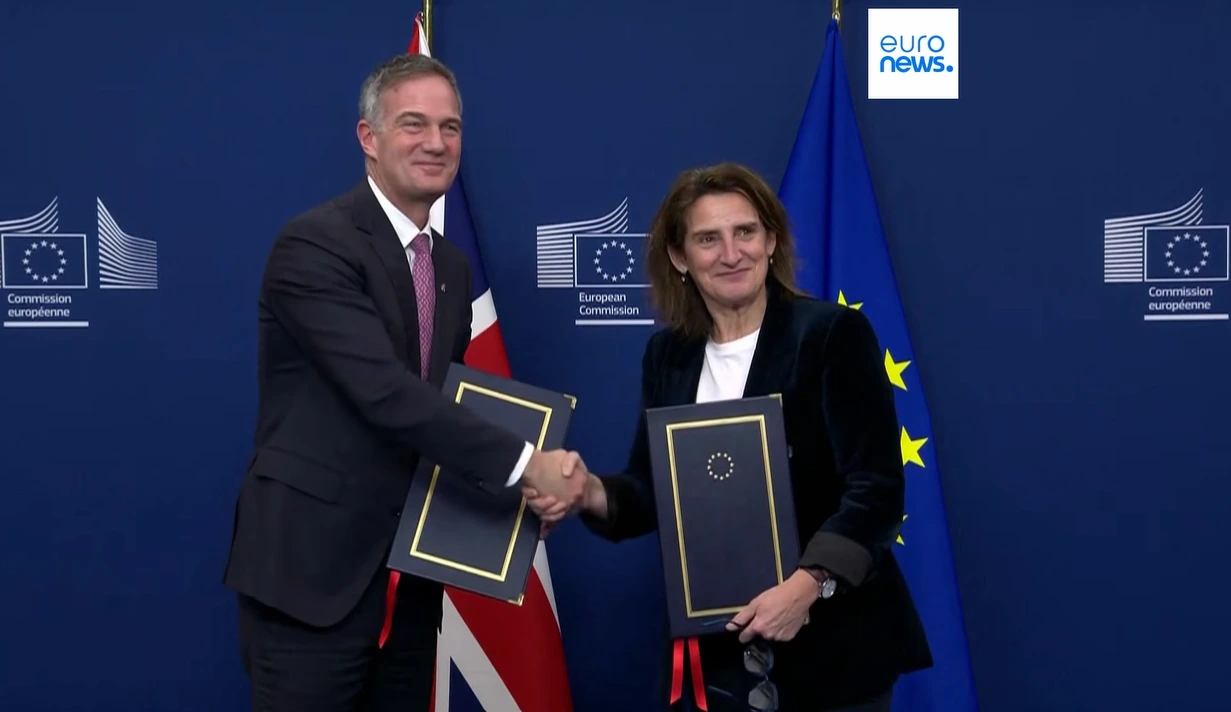
EU-UK Summit: Britain’s prime minister meets EU leaders in Brussels today to sign deals on food, carbon trading and youth mobility.
Imagine a 23-year-old in Lyon who has always wanted to spend a year working in a London café, a Manchester start-up or a Glasgow lab. For ten years, that dream has come with a stack of visa paperwork and a long list of costs. Now imagine a farmer in Kent whose lorry of lamb or cheese sits for hours at the border, waiting for a certificate that only exists because of Brexit. And imagine a steelworker in Port Talbot or Dunkirk who fears a carbon tax on the other side of the Channel.
Those three people, and millions like them, are in the background of today’s summit in Brussels. A decade after Britain voted to leave the European Union, Prime Minister Andy Burnham is meeting Commission President Ursula von der Leyen and Council President António Costa to seal deals on food, carbon trading and youth mobility. It is the second summit of the “reset” that began in May 2025, and it was delayed from July by Keir Starmer’s resignation, according to Briefings for Britain.
This is a story about a divorce that is settling into something more like a long, awkward friendship and about the arguments that still divide both sides of the Channel.
What Is on the Table
According to AFP, three main agreements are expected: a deal cutting red tape for food exports, one linking the two sides’ emissions trading schemes, and one on a “youth experience scheme”. Euronews, which saw the draft conclusions, says Brussels and London are also expected to unveil cooperation on defence industry, economic security and access to the EU electricity market. Burnham argues these steps were in the pipeline long before he entered Downing Street and will help repair some of the damage Brexit caused.
Here is what each of them means in plain words.
Food and farming. The agreement on sanitary and phytosanitary rules, or SPS, is meant to reduce border checks on food, plants and animal products. For exporters, it could mean fewer delays and less paperwork. The price, which critics highlight, is that Britain would follow EU rules in this area. The Conservatives have accused the government of preparing to sell out British farmers by becoming a rule taker.
Carbon trading. The two sides are expected to link their emissions trading systems. According to EUobserver, a factsheet says this could add up to £3.8 billion a year and protect industries such as steel and aluminium from the EU’s carbon border levy, which would otherwise hit about £6.5 billion of British exports. The leaked draft, per Euronews, sets no date for when the link applies.
Youth mobility. The Youth Experience Scheme would let young people live in each other’s territory for up to three years to work or study. The draft aims to seal the agreement by 2028 at the latest and have the scheme running by January 2030, and the House of Commons Library reports that each EU member state is expected to have its own quota of participants. The hardest question has been tuition fees. Brussels wants EU students to pay the same as home students at UK universities. The fees issue has been moved into a parallel agreement, and the draft offers two options: equal treatment or significantly reduced undergraduate fees.
The Hard Part: Electricity and the Bill
If the food and youth deals are the easy headlines, the electricity talks are where the real arguments sit.
The draft statement says both sides commit to concluding negotiations on the UK joining the EU’s internal electricity market in 2027, but sticking points remain. One of them is money. As Euronews reported earlier this month, the leaders of Belgium, Germany, Denmark, Luxembourg and the Netherlands want Britain to contribute to EU regional development funds in return for closer energy ties, adding a new hurdle ahead of the summit.
Critics in Britain are already counting the cost. Briefings for Britain, a think tank that campaigned for Brexit, estimates the reset could cost about £17.6 billion in 2027, rising to £20.5 billion a year by the 2030s, plus £12 billion in one-off compliance costs. It also argues that joining the energy market would mean dynamic alignment with EU rules, with the European Court of Justice as the arbiter of certain disputes. These are the views of a Brexit-sceptic analyst reading a leaked draft, not official figures, and supporters of the reset would dispute them. But they show where the political fight will be fought.
EU officials, for their part, have warned that there is not much fruit left to pick and that Britain should not expect to get the benefits of membership without the obligations.
The Politics: Burnham’s Gamble
Andy Burnham took office in July, succeeding Starmer, and he faces a delicate balance. He pledged not to re-run the Brexit debate, yet AFP notes he has risked doing just that. Last month, he went further, saying out loud that rejoining the EU could one day be an option, breaking a decade-long taboo for major-party leaders.
The public is not as clear as the headlines suggest. The Christian Science Monitor reports that polls find a majority of Britons in favour of applying to rejoin, but that when one poll asked if they would still back it if the old membership terms were unavailable, support fell from 58 percent to 35 percent. That is a telling gap. Many people want closer ties with Europe in principle, but fewer want to pay full price, give up the pound or accept the euro, which Britain no longer has an opt-out from if it rejoins.
Burnham has tried to sound firm. He said he would walk away from a deal if it were not in Britain’s interests, and his office says that if an agreement is reached, legislation will be brought forward in Parliament next week. He has argued that about three-quarters of British people support closer ties.
His opponents see an opening. Conservatives call it surrender. Nigel Farage, whose Reform UK party stands at about 25 percent in polls, will hold his own press conference in Brussels today to warn against closer ties. Reform’s Richard Tice has accused the prime minister of trying to sneak Britain back into Brussels through the back door. The Breitbart website reports that the EU wants a so-called “Farage clause”, a penalty if a future government withdraws from a deal, and quotes Farage calling such a measure illegitimate. That report comes from a partisan outlet, and I have not been able to confirm it elsewhere, so it should be treated as unverified.
Why Europe Should Care Too
It is easy to see this as a British story. It is not.
For the EU, a closer relationship with the UK serves a clear strategic purpose. Britain is a major military power, a permanent member of the UN Security Council and a leading supporter of Ukraine. The May 2025 summit produced a defence and security partnership and an agreement extending EU access to UK fishing waters until 2038. Today’s draft points to further cooperation on defence, migration control and a digital partnership to start in early 2027 covering secure connectivity, artificial intelligence and digital identities.
But the EU also has a rule it does not want to bend: that leaving the club must cost something. Several member states, especially those paying into the bloc’s budget, are wary of giving Britain the benefits of the single market without equal obligations. That is the logic behind the demand for payments into regional funds. Governments in Brussels, Berlin and The Hague must also persuade their own voters that the reset is fair, while remembering that other countries, from Norway to Switzerland, are watching how Britain is treated.
What It Means for People
Back to our three imagined people.
The 23-year-old in Lyon is the clearest winner, but she must wait. If the youth scheme goes ahead as drafted, it will not run until 2030. By then she may be 27. The scheme helps the next generation more than hers.
The farmer in Kent may gain quickly, with less paperwork at the border, though he will probably be asked to follow EU standards that he had hoped to leave behind. Whether he sees that as a fair trade depends on how much of his business depends on the continent.
The steelworker in Wales or France has perhaps the most to gain from the carbon link, since it protects an industry from a charge that could threaten jobs. For her, the details of a line in an emissions trading agreement are not abstract. They are about whether the plant stays open.
Three Scenarios
A modest success. The three agreements are signed today, with clear timelines for the youth scheme and the carbon link. The electricity talks continue through 2027. Burnham brings legislation to Parliament next week and presents the deal as proof that closer ties are possible without a return to full membership. Reform and the Conservatives attack it, but the public mood, weary of ten years of dispute, stays calm. This is the outcome both sides are working toward.
A bruising delay. Talks stall over fees, payments or the “Farage clause”, and the summit ends with partial agreements and a promise to keep talking. Critics in Britain say the EU is taking advantage; critics in Brussels say the UK wants the benefits without the obligations. The reset slows down, and Burnham’s room for manoeuvre narrows.
A step toward something bigger. The agreements pass, and over the following years the web of alignment grows so tight that the argument shifts from whether Britain is outside the EU to whether it should formally rejoin. That would be a profound change, and it would need the unanimous agreement of EU member states. It is not on the table today, but this summit is a stone on that path, and everyone in Brussels and London knows it.
The Bottom Line
A decade after the vote, the relationship between Britain and the EU looks less like a break and more like a long negotiation about how close two neighbours can be without sharing a house. Today’s deals are modest and technical: fewer lorry queues, a carbon link, a youth scheme that will not start for years. But they carry weight, because they reveal a shift in the national mood. Most Britons, it seems, do not want to re-fight 2016, yet most also want the practical benefits of working with their nearest neighbours.
The harder part is still to come. The electricity bill, the question of who pays for what, and the deeper issue of how much of its own rulebook Britain is willing to hand over are the real tests. As the EU’s officials warned, there is not much easy fruit left. What remains requires choices that politicians on both sides of the Channel would rather postpone.
For the young person in Lyon and the farmer in Kent, the summit’s real message is simple. The two sides are talking again, and for now they are talking about practical things.
Related Articles: