Riot police blocked Poland’s chief judge from his own court, the president turned his plane around, and ambassadors resigned. Here is what is happening in Warsaw, why both sides claim the law, and what it means for Europe.
On the evening of Friday, October 30, a judge could not get into his own court. Riot police stood at the entrance of Poland’s Constitutional Tribunal in Warsaw and blocked its president, Bogdan Święczkowski, from walking through the door. Hours earlier, a senior judge had announced that he and his deputy were suspended for a month. Thousands of kilometres away, in West Africa, Poland’s president, Karol Nawrocki, heard the news, cancelled the rest of his trip to Senegal and ordered his aircraft to turn around. He went straight from the airport to the tribunal. There, according to reports, he clashed physically and verbally with the judges who were taking over.
It sounds like the plot of a political thriller, but it is happening to a real country of nearly 38 million people, on the eastern edge of NATO, next to a war. This article explains what is going on, why both sides believe they are defending the law, and why the people watching most closely are not only in Warsaw.
A Crisis With a Long Memory
To understand Friday, you have to go back more than a decade. The dispute over Poland’s Constitutional Tribunal began in 2015, when a conflict over the appointment of five judges set the stage for years of confrontation. Under the Law and Justice party (PiS), the court became a battleground. The European Commission froze billions of euros in EU funds over PiS’s judicial reforms, and the issue became one of the defining rule-of-law fights in the European Union.
When Donald Tusk’s pro-European coalition took office in 2023, it promised to restore the rule of law and reform the court. It ran into two obstacles. The first was the tribunal’s own leadership: Święczkowski, a former deputy justice minister under PiS, refused to seat judges elected by the current parliamentary majority. The second was President Nawrocki, elected in 2025 with 50.9 percent of the vote and aligned with PiS. He has refused to swear in several judges chosen by parliament. In Poland, judges are elected by the Sejm, the lower house, but sworn in by the president. Without his oath, a judge cannot take a seat.
The result was a stalemate. Judges elected by parliament were waiting; the old leadership would not let them in, and the president would not let them start. Tusk himself admitted that after repeated failed attempts, the government chose a less orthodox path, one that might not be to everyone’s liking.
What Happened on October 30
On Friday, senior judge Anna Korwin-Piotrowska, whose own appointment is contested, announced that she was suspending Święczkowski and his deputy, Bartłomiej Sochański, for a month for failing to carry out their duties properly. She also suspended some of the tribunal’s staff and called a general assembly of judges for November 3 to set the tribunal’s 2027 budget. Reports said police blocked the chief judge’s entry. Prosecutor General Waldemar Żurek filed five requests to lift judicial immunity, four of them concerning Święczkowski.
Nawrocki called it a forcible takeover of a constitutional body. Tusk gave a televised speech, saying that shouting, lies and brawling cannot be the source of law in Poland. On X he wrote that restoring the rule of law is a duty after years of lawlessness and that the process is difficult, sometimes painful, and requires decisive action.
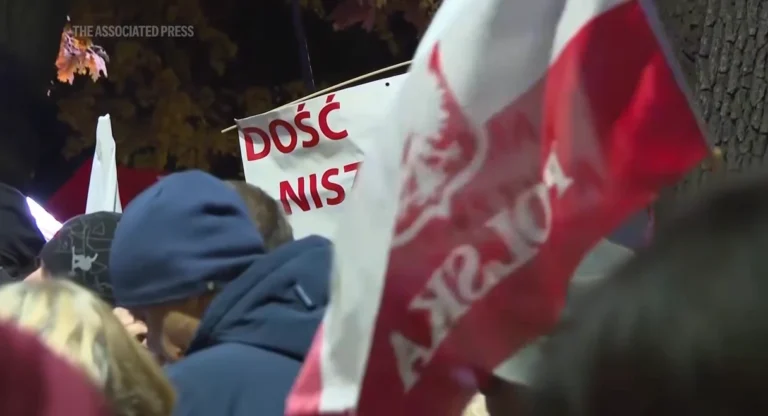
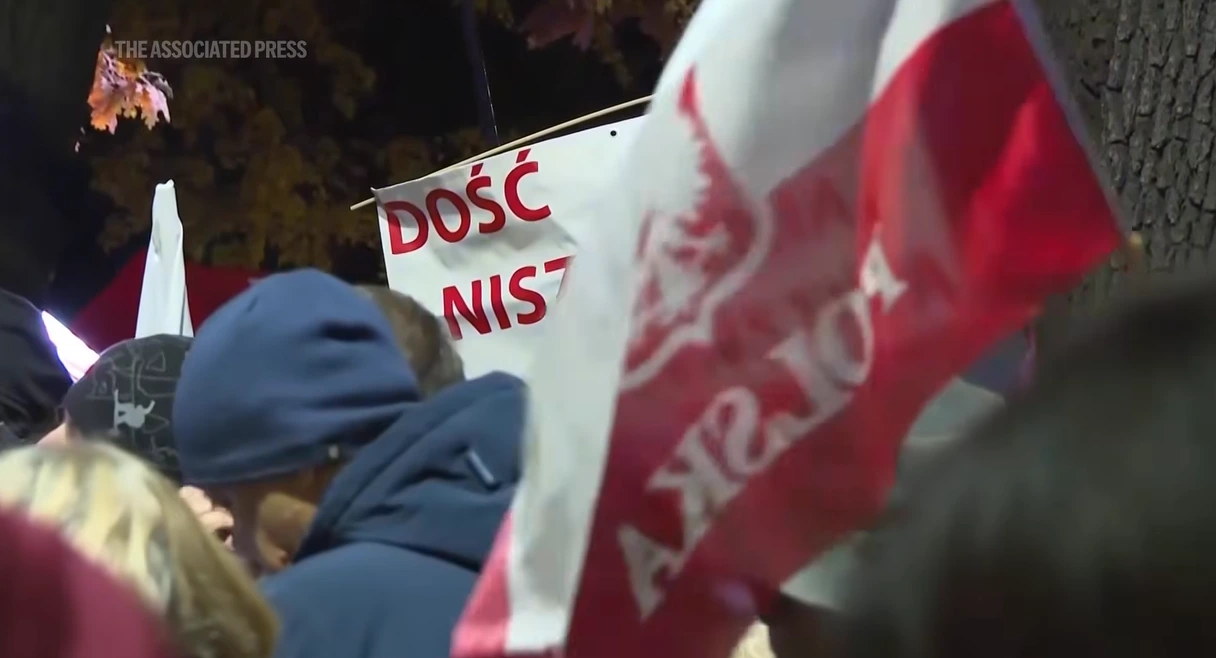
Outside the court, demonstrators clashed with police. Three people were detained. Over the weekend the dispute only grew. On Tuesday, November 3, protests in front of the building intensified as the tribunal’s judges met to decide its future.
Two Sides, Both Claiming the Law
What makes this crisis hard to read is that nobody involved sees themselves as the lawbreaker.
The government’s case. Tusk’s side argues that the tribunal has been captured for years by appointees of the previous government, and that its leaders are blocking legally elected judges from taking their seats. The European Commission appears to agree on at least part of this: a spokesperson said that the appointment of eight new members lies within the constitutional power of the Sejm. For Tusk’s supporters, this is the last step in a long, painful repair of the justice system, and waiting longer only gives the other side more time to dig in.
The president’s case. Nawrocki and PiS argue the opposite: that the tribunal is a constitutional body with its own procedures, that suspending its president with the help of riot police is an unlawful seizure, and that the government has used force where it should have used law. Law professor Marcin Matczak, a former ally of Tusk, said there was no legal basis for suspending Święczkowski. Three senior diplomats, including Poland’s ambassador to the United Nations, Krzysztof Szczerski, resigned, one of them calling it a matter of conscience. Russian politicians, including Dmitry Medvedev, have described the government’s moves as a coup, a word that Polish critics have also used.
The neutral voices. The Swiss-based International Commission of Jurists criticised the takeover of the tribunal but also chastised the president for refusing to swear in judges elected by parliament. The Helsinki Foundation for Human Rights, a Polish rights group, has said Nawrocki has no right to block or invalidate parliament’s election of judges. The leadership of Poland’s bishops’ conference warned that the dispute is leading to a profound crisis of the state. Former EU commissioner Věra Jourová told Euronews that the judicial crisis is weakening Poland at a very unfortunate time.
In other words, there is no clean side. The government appears to be right that the court was being obstructed. Critics appear to be right that the method was troubling. Both can be true, and that is the whole difficulty.
Why a Court Matters to Ordinary People
It is easy to think of a constitutional tribunal as an abstract institution of robes and procedure. In Poland, people have learned otherwise.
This is the court that, in 2020, struck down a legal ground for abortion in cases of severe foetal abnormality, a ruling that changed the lives of many women overnight. It is the body that decides whether laws are compatible with the constitution, and whether the government of the day is bound by rules or can simply do as it pleases. A court that is trusted by everyone is a shield for ordinary citizens. A court that is seen as belonging to one party is a weapon, and each side now fears the other will wield it.
That is why the polarisation runs so deep. Many Poles remember how fragile democracy felt in 1989 and how hard people worked to build independent institutions. Watching those institutions become a prize in a fight between politicians hurts, whichever side they support.
The Russian Shadow
A third player has entered the story, and it is the one that makes this more than a domestic quarrel.
On Tuesday, Tusk accused Russia and pro-Russian actors of trying to fuel instability in Poland by exploiting the dispute over the tribunal. In the same cabinet meeting, he said that just after midnight he received a report from the Border Guard that people with flashlights had been spotted moving along the border with Russia’s Kaliningrad exclave. He said forces were quickly mobilised, and that intelligence, including from NATO, had been warning of possible acts of diversion or more serious provocations in the first half of November, even the entry of armed people into Poland. Substantial police and counterterrorism units have been sent to the border. Tusk acknowledged that it could not be confirmed with full certainty that the incident was a deliberate provocation.
This should be read carefully. The government has an obvious political interest in linking its opponents to Moscow, and critics have already accused it of using the border story to deflect attention from the court. At the same time, European leaders have increasingly warned that a stalled Russian invasion of Ukraine has pushed Moscow toward covert sabotage across the continent, and Poland has been a frequent target. Both things can be true at once: the border alert may be real, and the political use of it may be convenient.
What is beyond doubt is that Russia benefits from a divided Poland. Poland is one of Ukraine’s strongest supporters, a logistics hub for military aid, and a frontline NATO state. A country absorbed in a fight between its president and its prime minister is a country with less attention for the border.
Why Europe Cannot Look Away
The Polish crisis matters to people far from Warsaw, for at least three reasons.
First, it is a test of the European Union’s rule-of-law toolbox. For years, Brussels has said that independent courts are a condition of membership and of access to EU money. Now, a government that Brussels trusts is using unconventional means to restore a court that Brussels long criticised. If the EU backs the government without reservation, critics will say it applies its principles selectively. If it does not, it risks undermining a government that is on its side. The Commission’s careful wording, that the Sejm has the power to elect judges, suggests it knows this is a tightrope.
Second, it is a security issue. Poland’s stability is a European interest. Anything that distracts Warsaw, divides its security services, or gives Moscow a pretext to stir up trouble matters for the whole eastern flank.
Third, it is a warning about how democracies fall into legal deadlock. When two institutions each have a veto, a president who must swear in judges and a parliament that must elect them, and neither will give way, the resolution too easily becomes force. That lesson applies well beyond Poland.
Three Scenarios
A settlement. Tusk has ruled out compromise, but notes from Poland report that he has offered a one-on-one meeting with Nawrocki to find solutions that would protect Poland from political upheaval. If the two meet, a negotiated route could emerge: a new law on the tribunal, agreed procedures for swearing in judges, and a face-saving arrangement for both sides. This is the outcome that most Poles, and most of Europe, would prefer. It requires each man to give up something he regards as a matter of principle.
Two courts, two truths. The standoff hardens. The government-backed judges run the tribunal in practice, while the president and PiS refuse to recognise their rulings. Poland ends up with a court whose decisions are accepted by half the country and rejected by the other half, and laws whose validity is endlessly disputed. This outcome would be costly for investors, for EU funding and for the credibility of Polish institutions, and it would be hard to reverse.
Escalation. Street protests grow, incidents multiply, and outside actors add fuel. A border provocation, a cyberattack or a wave of disinformation makes a domestic quarrel look like a national emergency. The government declares security needs, the opposition calls it an excuse, and the crisis becomes a test of whether the state can function. This is the scenario that European security planners worry about most, and the one that the Kremlin would find most useful.
The Bottom Line
It is tempting to look for a villain in this story. A president who will not swear in judges. A prime minister who used police to take a court. A chief judge who would not let parliament’s choices take their seats. Each has a case, and each has a flaw.
Behind them are people who deserve more attention: ordinary Poles who want a court they can trust, judges caught in the middle, protesters standing in the cold, border guards watching a dark treeline for people with flashlights. The best outcome for them is the dullest one, a settlement that is slow, legal and agreed.
Poland has faced this kind of test before and has often come through it. Tusk and Nawrocki still have a chance to show that two men who disagree about almost everything can agree on a way to put the law above the fight. If they do not, the question of who sits on a court in Warsaw may soon be a question about how safe the whole eastern edge of Europe really is.
Related Articles:
- Two Phone Calls, One Divided Europe: Why Finland and Norway Speaking to Putin Has Split the Nordics
- From Paris to Frankfurt: Why Europe’s Young People Are Taking to the Streets
- France Is on the Brink: How a Debt Crisis, Street Riots and a Broken Parliament Are Converging
- Trump’s Russia Diesel Deal, the Energy Ceasefire and Europe’s Moment of Truth