France is facing its most intense and earliest major heatwave on record, with 49 departments placed under red alert from Monday, temperatures hitting 42.2°C, RER and Transilien trains cancelled, and hundreds of schools closed.
France is in the grip of what its own government has described as a heatwave that is “particularly intense and particularly early”, with the country on Monday recording the highest number of departments ever placed under red heat alert and temperatures threatening to make June 22 the hottest day ever measured in France, across any month of the year.
The scale of the crisis has forced cancellations across the country’s rail network, the closure of hundreds of schools, the abandonment of Fête de la Musique concerts in several cities, and a sharp rise in emergency medical calls, all while the country grapples with a heatwave season that has arrived earlier and harder than at almost any point in its recorded history.
A Record Number of Departments Under Maximum Alert
Fourteen additional departments moved into red heatwave alert at midday on Monday, bringing the total number of departments under maximum alert to 49, an unprecedented figure for France. That surpasses the previous record of 35 departments, which had been set only the day before, on Sunday.
A further 40 departments were placed under orange alert, meaning a total of 89 departments across the country were considered to be at particular risk. Météo-France confirmed that more than 90 percent of the French population would be under either orange or red alert, with the heatwave sparing only parts of Occitanie and the Alps.
According to an AFP count based on population estimates and Météo-France’s latest bulletin, around 34.89 million people live in the 49 departments placed under red alert on Monday. Of those, 3.85 million are aged 75 or older, according to INSEE data from January 1, 2026, a detail that matters enormously given how disproportionately the elderly suffer during extreme heat events.
Mathieu Lefèvre, the minister delegate for ecological transition, announced from Météo-France’s headquarters on Sunday that the 14 additional departments would move to red alert for Monday. Lefèvre summarised the situation as a heatwave episode that is “particularly intense and particularly early,” warning that new records were expected to be broken on Monday and Tuesday and that extreme temperatures would persist through the end of the week.
Temperatures Pushing Toward All-Time June Records
The numbers coming out of Météo-France’s monitoring stations over the weekend were extraordinary even by the standards of a country that has grown accustomed to summer heatwaves in recent years.
On Sunday, the thermometer climbed to 42.2 degrees Celsius in Pissos in the Landes, 42°C in Châteaumeillant in the Cher, and 41.5°C in Montmorillon in the Haute-Vienne, as well as in Bélis in the Landes and Navarrenx in the Pyrénées-Atlantiques. At 5pm on Sunday, Météo-France also recorded 40.9°C in La Couronne in the Charente, 40.6°C in both Saintes in the Charente-Maritime and Pauillac in the Gironde, 39.2°C in Poitiers in the Vienne, and 38.6°C in Avord in the Cher.
Météo-France described these as unprecedented values for the month of June. The agency also warned that the night between Sunday and Monday would remain hot, with minimum temperatures as high as 26°C in some areas, denying the population the overnight relief that is often the only respite during a heatwave.
Météo-France calculates a daily thermal indicator corresponding to the average temperature across mainland France, and the agency suggested that Monday, June 22, could match the level of the hottest day ever measured in France across any month, not just June.
Trains Cancelled Across the Rail Network
The intensity of the heat has had direct and disruptive consequences for France’s rail infrastructure, which is not built to withstand the kind of sustained extreme heat now battering the country.
Disruption has been building for over a week across the Paris region. Public transport across Paris and Île-de-France faced disruption from June 15 to 21, with the Fête de la Musique on Sunday drawing a massive influx of travellers right as new engineering works began on the RER E and Transilien lines, according to RATP and SNCF.
The heat itself, separate from any scheduled works, has caused direct damage to infrastructure. Disruptions were also reported on Sunday on the Metz-Thionville-Luxembourg line, with SNCF citing “very high temperatures that had damaged rail installations.” Heat-buckled tracks and damaged signalling equipment are a recurring hazard during extreme heatwaves, forcing operators to reduce speeds or cancel services outright on affected sections to avoid derailments.
SNCF has gone so far as to actively discourage certain categories of passengers from travelling by train at all while the heatwave persists, recommending that vulnerable people avoid rail travel during the most intense periods of the alert. In response to the conditions, station operators have also moved to mitigate the impact on waiting passengers. Large fans were installed at Nantes station in the Loire-Atlantique, a station known for its stifling glass roof during periods of intense heat, to cool travellers waiting to board their trains.
Schools Close as Authorities Scramble to Protect Children
The education system has borne a significant share of the disruption. A total of 845 schools and middle schools were closed on Monday, while 1,800 others, out of 60,000 establishments nationwide, released students in the early afternoon. Education Minister Edouard Geffray confirmed those figures over the weekend.
But the patchwork nature of the response, left largely to the discretion of individual local authorities, has drawn sharp criticism. Michel Cadet, the mayor of Périgueux in the Dordogne, said on regional broadcaster ICI Périgord that he would have liked clearer national measures for red zones. He suggested options such as banning the Fête de la Musique outright or taking more radical steps that would be easier to enforce uniformly, complaining: “Right now, we’re telling mayors to figure it out on the ground. Some schools are closing, others aren’t, so we’re in a fog.”
One teachers’ union, the FSU-SNUipp Paris, went further still, calling on teachers to exercise their right to withdraw from unsafe conditions and on schools to close entirely, citing the unsuitability of Parisian school buildings for extreme heat. Many of the Haussmann-era school buildings common across Paris were constructed long before climate considerations entered architectural planning, with poor insulation and minimal shading that turn classrooms into ovens during a heatwave of this intensity.
Fête de la Musique Goes Ahead, But Not Everywhere
France’s nationwide Fête de la Musique, a beloved annual tradition now in its 45th edition, became an unlikely flashpoint in the heatwave response. The event drew large crowds into Paris’s streets despite the heat, with revellers gathering in sometimes packed streets, even though a ban on public alcohol consumption was not always respected.
Several towns and cities, including Auch, Nanterre, and Châteauroux, opted to cancel their festivities outright due to the heat. Numerous other municipalities also cancelled their Fête de la Musique concerts on Sunday.
Where concerts did proceed, organisers adapted. In Lyon, a choir performance by Les Phonies Polies went ahead in the shaded cloister of the city’s Musée des Beaux-Arts rather than in the open street, as temperatures in the city approached 40°C. One 30-year-old attendee, Baptiste Fonton, said that if the concert had been held in the street, he would have had reservations about attending, noting that the fact it was held under tree cover was a decisive factor in his decision to go.
In Paris, a concert organised by La France Insoumise began around 6pm at Place de la République, with the square far from full as temperatures hovered near 37°C, an AFP journalist observed. A banner reading “Anti-racist concerts” hung over the stage as the first band performed.
The security operation required to manage the combination of a major cultural event and an extreme heat emergency was substantial. A total of 4,800 police officers and gendarmes, along with 2,500 firefighters, were mobilised across the Paris region, according to the police prefecture, tasked with the difficult job of enforcing the public alcohol ban in departments under red alert.
That enforcement effort met open resistance from some festival-goers. “The government can ban alcohol, but that just makes people want it even more,” said Kelvin Ayivor, a 28-year-old Londoner holding a bottle of Martinican rum, in the crowded streets of the 11th arrondissement. Elsewhere, organisers took a more cautious approach voluntarily. In the Loire-Atlantique, placed under red alert, organisers of the Hellfest rock and metal festival decided to stop selling strong spirits to preserve the safety of festival-goers.
A Strain on Emergency Services
Behind the headlines about cancelled trains and abandoned concerts lies a more serious public health story that medical professionals are watching with growing concern.
Dr Agnès Ricard-Hibon, an emergency physician and spokesperson for Samu Urgences de France, reported a high volume of calls to the 15 emergency medical number, noting a 25 percent increase in Samu calls in the Val-d’Oise for cases of fainting, impaired consciousness, and cardiac problems affecting people across all age groups.
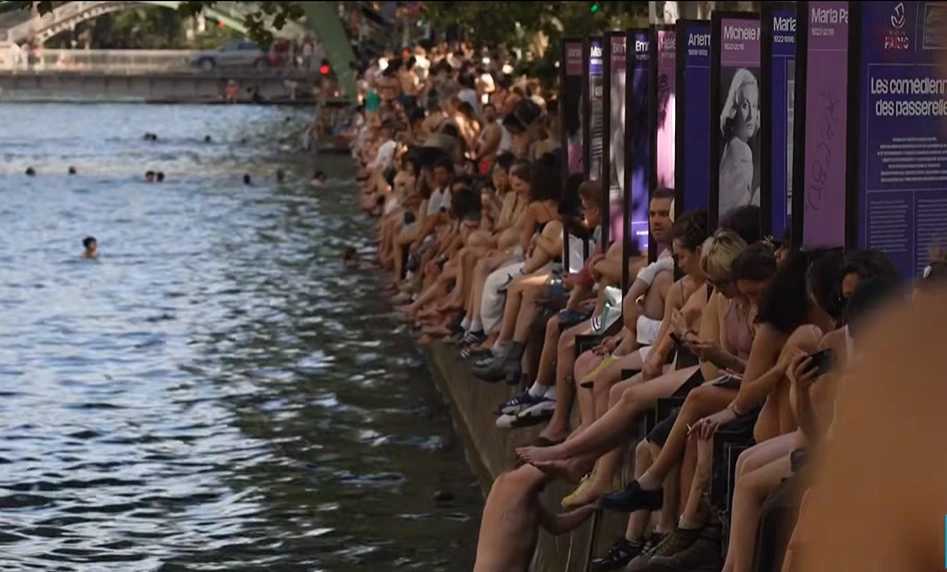
The human cost of the heatwave has already proven fatal in some cases, though not always through heatstroke directly. Authorities repeatedly urged caution after four teenagers drowned over the weekend in Besançon, the Dordogne, and Dunkirk in the Nord, a grim reminder that the search for relief from extreme heat, often in unsupervised waterways, carries its own dangers.
Elsewhere, the heat has combined with drought conditions to fuel wildfire risk. A fire in the Cher, placed under red heatwave alert since Sunday, burned 25 hectares of farmland and forced the evacuation of around fifty people, the prefecture announced, adding that four firefighters were lightly injured.
A Continental Problem, Not Just a French One
France’s heatwave is not an isolated national event. The heatwave is also affecting several other European countries, including the United Kingdom and Spain, where an extreme heatwave is affecting most of the country as well as the Balearic Islands.
That simultaneous suffering across Western Europe points to the broader climatic pattern driving this entire episode. According to scientific consensus, human-induced climate change is making extreme weather phenomena more intense, particularly heatwaves.
French officials have also been candid about the economic toll that recurring heatwaves of this scale are beginning to exact on the national economy. The governor of the Banque de France has previously noted publicly that heatwaves carry a measurable negative effect on economic growth, a warning that takes on additional weight as France experiences not an isolated one-off event, but what increasingly looks like a new and recurring feature of its summers.
With Météo-France warning that extreme temperatures will persist through the remainder of the week and that further records are likely to fall on both Monday and Tuesday, France faces several more days of disruption before any meaningful relief arrives. The government’s challenge in the days ahead will be managing a heatwave response that mayors like Michel Cadet have already criticised as inconsistent, while emergency services continue to absorb a surge in heat-related medical calls and the rail network works to repair and protect infrastructure not designed for temperatures of this magnitude.
For the tens of millions of French residents living under red alert this week, the message from authorities has been consistent: stay hydrated, avoid strenuous activity during peak heat hours, check on elderly neighbours and relatives, and treat any sign of dizziness, confusion, or fainting as a medical emergency requiring immediate attention.
Europeans24 will continue to follow this story as Météo-France updates its alerts and as the heatwave’s impact on transport, schools, and public health continues to develop through the week.
Europeans24 covers European weather, climate, and breaking news across the continent. Follow us for continuing coverage of the French heatwave and its impact across Europe.