UK net migration fell to 77,000 in the year to June 2026, down about 92% from its peak. Here is what drove the fall, who is leaving, who is claiming credit, and what it means for care homes, universities and Europe.
There is a number that British politicians have promised to reach for more than a decade, and yesterday it finally arrived. The Office for National Statistics reported that net migration to the UK fell to 77,000 in the year to June 2026, the lowest figure for almost 30 years, not counting the pandemic. A year earlier, it had been 204,000. At its peak, in the year to March 2023, it was 944,000.
To a government that promised for years to bring the number down to the tens of thousands, this is a triumph. To a care home manager in Yorkshire, a vice-chancellor in Leeds or a nurse waiting for a colleague who never arrived, it may feel different. And to the quarter of a million British citizens who left the country last year, it is just a statistic about a place they no longer live.
This is a story about what the number means and about the people the number leaves out.
What the Figures Show
Net migration is a simple subtraction: people moving to the UK for at least a year, minus people leaving. In the year to June 2026, 738,000 people arrived and 661,000 left. The ONS said the fall was mainly due to a drop in long-term migration by people born outside the EU, and it reflects tighter rules for workers, students and asylum seekers. The figures are provisional, and the ONS plans revisions in May 2027.
The Home Office published its own quarterly data the same morning. In the year to September 2026, Skilled Worker visa grants fell 27 percent to 57,000, Health and Care Worker grants fell 44 percent to 31,000, and sponsored study visas fell 23 percent to 336,000. Comparing the first half of 2026 with the first half of 2025, visa grants to international students dropped 38 percent and grants to skilled workers, including those in health and care and their dependants, also fell 38 percent, according to figures reported by the Guardian. The Home Office also reported that 31,000 people were detected arriving in the UK illegally in the year to September 2026.
The Surprising Group Leaving: British People
One detail in the data deserves more attention than it has received. Of the 661,000 people who left, 292,000 were non-EU nationals, 124,000 were EU nationals and 245,000 were British nationals. About 53 percent of the non-EU group had originally come on study visas. Meanwhile, an estimated 109,000 British nationals came back to the UK, according to the figures reported by Nara Solicitors.
So, behind the headline, a quarter of a million Britons packed up and went abroad, and fewer than half as many returned. They may be retirees heading for Spain, young professionals chasing a job in another country, or families looking for a lower cost of living. We do not know their reasons from this data. But they are part of the arithmetic, and they remind us that migration is not only about people arriving.
The same is true of Europeans. Among EU nationals, 79,000 arrived and 124,000 left. That is a pattern that began after Brexit, when the end of free movement removed an easy route for people from Poland, Romania, Spain and Italy to build a life in Britain. In the year to June 2016, just before the referendum, net migration stood at 321,000, and high levels of legal migration were one of the forces behind the vote to leave.
Who Gets the Credit?
In politics, a falling number is an asset, and everyone wants a share.
Home Secretary Shabana Mahmood said the government had brought net migration down to 77,000, a fall of 92 percent from its peak under the previous government, as reported by the Inquisitr. The Guardian notes that Keir Starmer’s policies last year made care workers and some mid-skilled jobs ineligible for work visas, suspended family reunion for refugees and toughened restrictions on universities that sponsor international students. The Conservatives, for their part, say their own measures under Rishi Sunak, including limits on the family members that care workers and students could bring, are what started the decline.
Both claims contain truth, and both are political. The deeper point is that a promise made for more than a decade has been met by a mixture of rules, rising costs and changing choices, and that the economy has had to adjust at the same time.
The Human Cost on the Ground
Numbers like these are easy to celebrate in Westminster. They look different in a care home.
For years, the care sector has relied on workers from abroad. In 2024, Al Jazeera reported that employers in sectors such as healthcare say they cannot function without foreign workers. Health and Care Worker visa grants have now fallen by 44 percent. A care home manager who cannot recruit does not fill the gap with a statistic. She asks her existing staff to work extra shifts, turns away new residents, or closes a wing. Families feel it long before the Treasury does.
Universities face a similar squeeze. International students pay higher fees, and many institutions have depended on them to balance their books. A 23 percent fall in sponsored study visas may be welcomed by those who want lower numbers, but it will be felt in departmental budgets, in local landlords and in the small businesses of university towns.
None of this means the fall is bad. It means the benefits and costs land in different places. A voter who worries about housing and public services may welcome lower numbers. A patient waiting for a care visit may feel the shortage. Both are real.
What the Experts Say
The most sober voice in the debate belongs to the researchers who study the data. Ben Brindle, senior researcher at the Migration Observatory at the University of Oxford, said that Britain still has relatively high emigration, at least for now, which could push net migration even lower next year. But he warned that the downward blip is unlikely to last forever. He also said that falling net migration is “not automatically” a problem for the economy, particularly in the long run.
That is a careful sentence, and it is worth reading slowly. It says two things at once. First, lower migration does not mean economic disaster. Second, the current low is probably temporary, because the underlying pressures, an ageing population, a shortage of care workers and a labour market that still needs workers, have not gone away. The Migration Observatory says preliminary visa data suggests the figure may fall even further, but the long-term direction is far from settled.
How Britain Compares With Its Neighbours
British debates about migration do not happen in isolation. Across Europe, governments are wrestling with the same question: how many newcomers does a country want, and how many does it need?
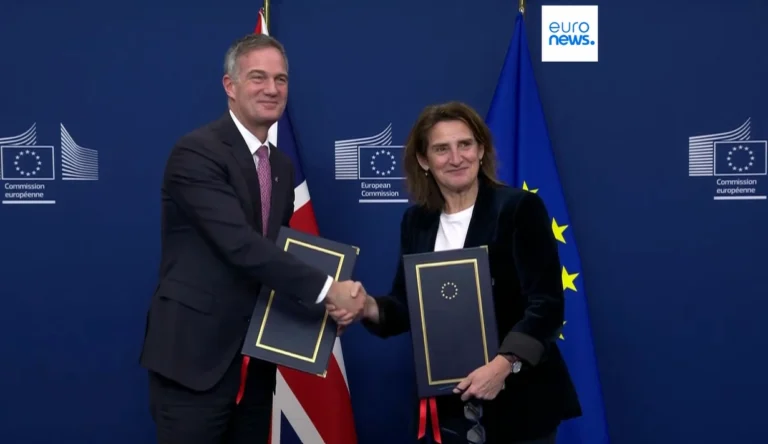
In Switzerland, voters recently weighed a proposal to cap the population. In Japan, a country with one of the world’s fastest-ageing populations, politicians have been tightening immigration even as factories and care homes struggle to find workers, a tension we explored in our earlier article on Japan. In the EU, governments have been arguing over the migration pact, and Britain and the EU recently agreed to discuss cooperation on migration control, as the draft statement of last week’s summit showed.
Britain’s experience adds a particular lesson. A government can bring the number down quickly by changing the rules, but the effects on schools, hospitals, care homes and businesses take time to appear. And the political effect of success may be smaller than expected. Reform UK, which treats migration as a core issue, stands at around 25 percent in the polls, which suggests that voters who care about the issue want more than one statistic.
Three Scenarios
The number keeps falling: More people leave, fewer arrive, and net migration drops below 77,000 next year. The government celebrates, the Conservatives and Reform argue about who deserves the credit, and the pressure shifts to the shortages: care homes, universities and the NHS. Ministers face calls to loosen some rules for key sectors, and they must decide whether to risk the headline figure to keep services running.
The rebound: Emigration slows, the economy recovers and employers press for workers. Net migration drifts back toward the low hundreds of thousands, as the Migration Observatory warns it eventually might. The government has to explain why the number it once treated as a victory is rising again, and the debate resumes with the same arguments.
A rebalancing: The government keeps the headline number low but shifts its focus: more training for British workers, higher pay in care, targeted visas for essential sectors, and a more stable approach to university funding. Net migration settles at a level that neither celebrates nor alarms. This is the quietest outcome, and the one most economists would regard as healthy.
The Bottom Line
A number like 77,000 is not just a figure on a chart. It is the sum of a nurse who did not come, a student who chose another country, a retired couple who moved to the coast of Spain, a young engineer who left for Canada and a care worker who stayed after all. It tells us something about the rules, but it cannot tell us whether those who came were welcomed or those who left were missed.
The government has reached its target. The harder question is what it will do with the success. A country can lower the number and still face a labour shortage, a funding gap in its universities and a population that is getting older. The experts say the dip may not last. The people who depend on care homes, hospitals and classrooms hope that whatever happens next is planned rather than accidental.
Related Articles:
- Ten Years After the Vote: What the EU-UK Summit Means for Ordinary People
- Rising Nationalism and the Foreigner Question: Japan’s Immigration Crisis Explained
- Switzerland Votes on Capping Its Population at 10 Million: What It Means for Europe
- Europe Is Drafting Women Into the Military: Why a Continent Is Arming Half Its Population