On October 31, tens of thousands of young Germans marched in 34 cities for better schools and lower living costs. By night, Frankfurt was in flames. Here is what the Gen Z regelt movement wants and why the wave from France has come to Germany.
The day began with flags, banners and chanting. Hundreds of young people gathered outside Berlin’s Brandenburg Gate, many of them in school uniforms or hoodies, some carrying hand-painted signs. One poster read, in English, that cutting education is cutting democracy. It was the last Saturday of October, and the “Gen Z regelt” movement, which translates roughly as “Gen Z takes charge”, had called a day of action across Germany.
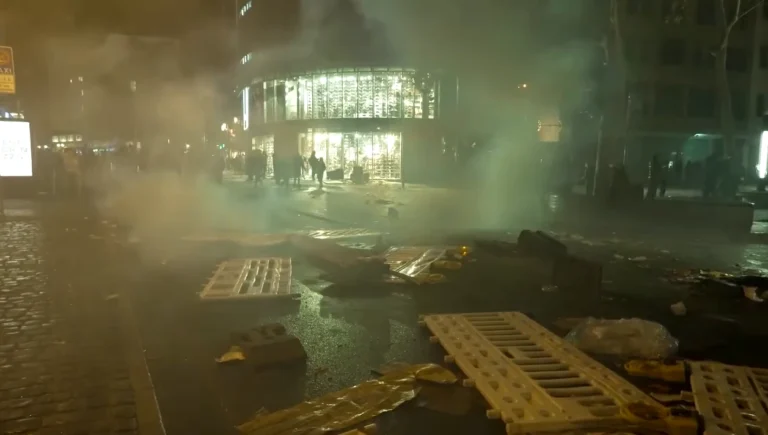
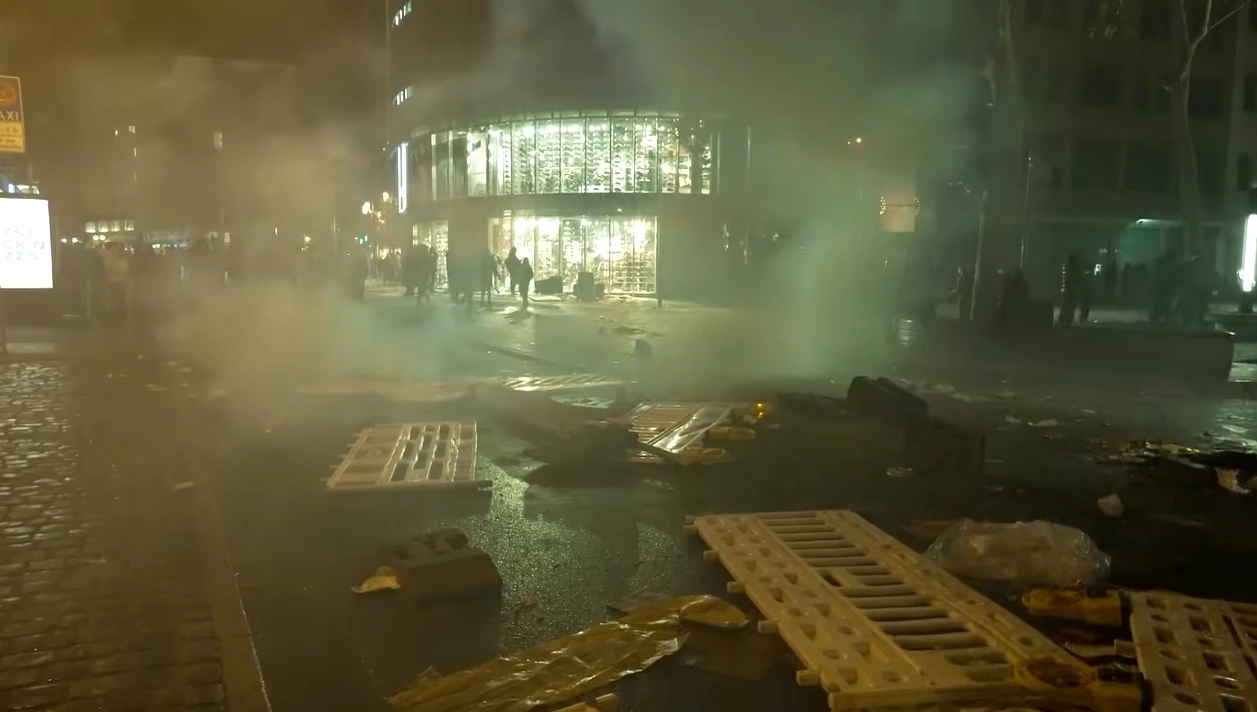
By nightfall, a different picture had taken over the headlines. Fires burnt on the shopping streets of Frankfurt. Shop windows were smashed, a gun shop was attacked, and police were hit with Molotov cocktails. More than 100 officers were injured.
Both pictures are true, and the distance between them is the story. This is an article about what young Germans and young Europeans are asking for, about the violence that hijacked the evening, and about why governments across the continent should be listening to both.
What Happened on Saturday
According to organisers, around 120,000 people took part in protests across 34 German cities, including Berlin, Munich and Frankfurt. The campaign group’s demands were wide: more investment in schools, healthcare, social services, culture and climate protection, lower living expenses, and opposition to plans to bring back mandatory military service.
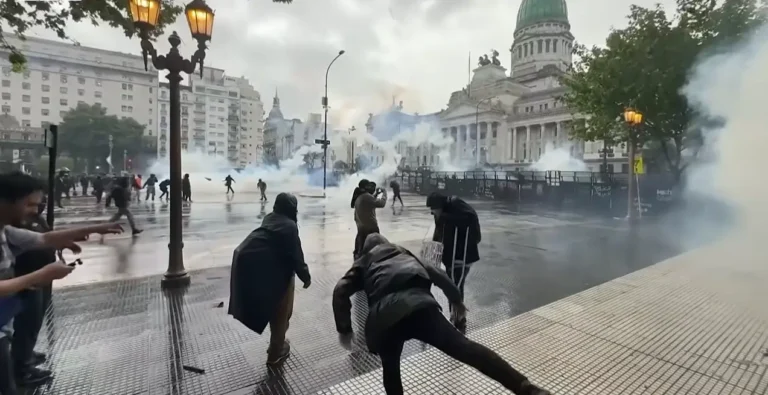
In Frankfurt, about 8,000 people demonstrated, largely peacefully, according to Euronews. Then the mood turned. Hesse’s interior minister, Roman Poseck, told reporters that rioters damaged 17 shops and looted five. Police deployed 1,300 officers, more than 100 were injured, and 54 people were arrested. Their ages ranged from 13 to 29. Disturbances were also reported in Berlin, Cologne and Hamburg, and police used water cannon to put out burning barricades.
A detail worth pausing on: the youngest person arrested was thirteen years old. Whatever else this story is, it involves children.
Two Protests in One
The people who marched in the daytime and the people who rioted at night were largely different.
Gen Z’s spokesperson, Lina Friedrich, framed the movement’s goals in Berlin as peace and freedom rather than war and coercion and said what matters most is better support for health and education. Germany’s national student organization, the BSK, has distanced itself from the initiative and plans its own day of protest on November 20.
Officials gave their own account of the night. Interior Minister Alexander Dobrindt told the tabloid Bild that violent left-wing groups and troublemakers from migrant communities had hijacked the peaceful protests. Poseck said around 100 clearly identified left-wing extremists had infiltrated the Frankfurt march, and, as reported by DW and ANI, said 1,000 to 1,500 people involved in the violence were predominantly from a migrant background. Dobrindt also said border controls had been tightened beforehand for fear that extremists from abroad would exploit the protests. These are the officials’ characterisations. They have not yet been independently verified, and they should be read with care, because the pattern is familiar: when a protest turns violent, it is often convenient to say it was never really the protesters. The truth is usually mixed.
What can be said safely is this: a peaceful movement with legitimate demands was overtaken by a violent crowd, and the result is that the demands are now being discussed as a law and order story. A peaceful movement with legitimate demands was overtaken by a violent crowd, and the result is that the demands are now being discussed as a law and order story.
Not Just Germany: A Continental Wave
Germany is not the first country to see such violence. It is the latest.
France has been at the centre of the storm. Student protests there began in mid-September, grew into the huge nationwide demonstrations of October 17, and were still going on a third straight weekend, now largely peacefully. We covered that moment in detail in our earlier article on France. Geopolitical Futures reported on October 19 that protests over living expenses, unaffordable housing and education had spread across Europe, with clashes in Milan, Brussels and Liege. Euronews described the weekend’s German violence as reminiscent of scenes in France last month.
The pattern is wider than one season. Bulgaria had its Gen Z protests in late 2025, which began over a tax-raising budget and anger at corruption. They forced the withdrawal of the budget and the resignation of the government, and a new party won the parliamentary election this year. Further afield, the protests in Bangladesh in 2024 are widely cited as the first successful Gen Z revolution. Raffie, you will know better than any outside writer what that moment felt like at home.
The causes differ from country to country. The feeling does not. A generation that came of age through a pandemic, a cost-of-living shock and two major wars, and that sees housing out of reach and public services thinning out, has decided that waiting politely is not working.
Three Grievances, One Feeling
When you listen to what young Europeans are actually saying, three themes keep coming back.
Schools and public services. The poster in Berlin said it plainly. Young people look at crowded classrooms, shortages of teachers and crumbling buildings, and they hear that there is no money. In France, student unions put a figure of roughly 11 billion dollars on what they believe is missing from education budgets. In Germany, the demand is the same in spirit: invest in us before you ask anything of us.
The cost of living. Energy and fuel prices have risen sharply since the Iran war began, and housing has become a crushing expense for many. A young person starting out in a European city today often faces a rent that swallows a huge share of a first salary. The idea that hard work leads to a secure life feels less certain than it did for their parents.
War and conscription. This one is new, and it is especially sharp in Germany. As Europe rearms, governments are rebuilding the armies they once shrank. Gen Z regelt’s spokesperson asked for a fairer distribution of the burden of military service. Among young Germans, the thought of being asked to risk their lives for a country that, in their view, has not invested in their schools is a bitter one. As we reported earlier, Denmark began drafting women this summer, and other countries are weighing similar steps. For many young Europeans, this feels like adults making plans for their futures without asking.
Taken together, these grievances share one feeling: that the contract between generations has been quietly rewritten and that the young were not at the table.
The Money Problem Behind the Moral Problem
There is a hard truth under all these grievances, and it is not a comfortable one.
Governments across Europe are feeling the squeeze from every side. Defence spending is rising fast because of the war in Ukraine and pressure from Washington. Energy costs are elevated. Debt is high, and in France it has become a full-blown market worry, with ten-year borrowing costs near a 24-year high. In Germany, economic growth has been difficult to revive. On the weekend of the protests, Kärcher’s chief executive, Hartmut Jenner, told Euronews that Europe and Germany risk deindustrialisation and face what he called a perfect storm, and he called for economic reforms.
So the young are asking for more spending on schools and health at the same time that states are being asked to spend more on weapons and are borrowing at higher rates. This is the real tension. It is not a case of a wicked government ignoring a righteous generation, or of ungrateful young people ignoring the realities of money. It is a genuine collision between competing needs, and it will not be resolved by slogans on either side.
That is why the posters matter. Cutting education is cutting democracy. It is a claim that spending on young people is not a luxury but the foundation of the future that the weapons are meant to defend.
What Governments Are Doing, and What They Might Do
The response so far has been mostly about security. Ministers in Germany threatened tough penalties for looters and rioters, and praised the police for stopping wider violence. Dobrindt said that a strong, multi-site police presence had worked. In France, authorities deployed tens of thousands of police ahead of protest days, according to reports.
Order matters. Nobody should be asked to accept looting and attacks on police, and the officers injured in Frankfurt are also someone’s children. But if the response stops at policing, the underlying anger will not go away. The 2024 to 2026 record, from Bangladesh to Bulgaria to France, suggests that movements driven by a sense of blocked futures tend to return when only their symptoms are treated.
Better responses would include genuine dialogue with the moderate student groups, such as the BSK, before their November 20 protest rather than after it, a clear plan and timetable for school investment even if modest, and an honest public conversation about how military service would work and how any burden would be shared fairly. None of these costs as much as a winter of unrest.
Three Scenarios for the Weeks Ahead
The wave fades. After the shock of Frankfurt, the peaceful majority withdraws from the street to avoid being tied to the violence. Autumn weather and exams do their work. Governments offer small concessions, and Gen Z regelt returns to organising online. The anger stays, but the street goes quiet for a while. This is the most comfortable outcome for politicians, and probably not the most durable.
Dialogue and partial reform. The BSK protest on November 20 is peaceful and large. Ministers, having seen what unrest looks like, open real talks on education funding and on the design of military service. The next budget includes some modest measures. The movement splits between those who accept a seat at the table and those who do not, but the central demands enter mainstream politics. This is the outcome most worth hoping for.
Escalation. This leads to further riots, a cycle of arrests and angry responses, and a hardening of political lines. The far right seizes on the violence and calls for stricter policing and tougher migration rules, while the far left defends the protesters. The majority of young people who only wanted better schools find themselves with no voice, and the movement radicalises. France’s experience, and the political drift described by analysts there, shows how quickly this path can open up.
It is tempting to reduce this story to one image, the burning barricades of Frankfurt. That image is real, and the people who attacked police and looted shops should answer for it. But it is only one part of a Saturday on which tens of thousands of young people marched peacefully with homemade signs, asking a question that every society must be able to answer: what do you owe the generation that will inherit your debts, your climate and your wars?
A continent that spends so much time debating how to defend itself might also ask what exactly it is defending. Part of the answer is sitting in a classroom with a leaking roof, in a flat that costs too much, or in the thought of a draft letter in the post. Listening to those young people, even when their message is delivered badly and sometimes dangerously, may be the cheapest security policy Europe has.
Sources:
- Reuters via Arab News, “Rioters loot stores in Frankfurt as Gen Z-led protests in Germany turn violent,” November 1, 2026
- Euronews, “Germany ‘Gen Z’ protests turn violent as shops looted,” November 1, 2026
- CNN, “Germany blames infiltrators as Gen Z protests turn violent,” November 1, 2026
- ABC News (Australia), “Protesters loot shops, 100 officers injured as riots spread to Germany,” November 2, 2026
Related Articles:
- France Is Burning Again: The Yellow Vests Are Back, and This Time They Brought the Students
- France Is on the Brink: How a Debt Crisis, Street Riots and a Broken Parliament Are Converging
- Europe Is Drafting Women Into the Military: Why a Continent Is Arming Half Its Population
- Europe’s Fuel Crisis Explained: Why Diesel Has Hit €2.24 a Litre