From the real-world lunisolar calendar to Dante’s Inferno, here is exactly why the writers of Netflix’s Dark chose the number 33 for their time-travel matrix.
If you’ve ever found yourself staring at a wall of red string and character portraits trying to map out Netflix’s mind-bending masterpiece, Dark, one question inevitably loops back around: why 33 years? The series makes it clear that time travel isn’t a matter of punching random dates into a dashboard; instead, the Winden cave wormhole binds the past, present, and future in rigid, inescapable 33- and 99-year increments.
While it might feel like a convenient storytelling device, this hyper-specific timeline isn’t just a creative whim. The truth is, creators Baran bo Odar and Jantje Friese anchored the show’s fatalistic universe in a fascinating mix of real-world astronomy, ancient calendar mathematics, and deep-rooted cultural symbolism. Here is the breakdown of why the number 33 is the ultimate cosmic key to unlocking the entire series.
The Scientific Basis: The Lunisolar Cycle
The primary scientific justification used in Dark (and explained in the show by H.G. Tannhaus and Charlotte Doppler) is the 33-year lunisolar synchronization cycle.
- The Math: A standard solar year (Earth orbiting the sun) lasts about 365.24 days. A lunar year (12 full cycles of the moon) lasts roughly 354.36 days. This leaves an approximate 11-day gap between the solar and lunar calendars every single year.
- The Drift: Because of this 11-day disparity, a purely lunar calendar continuously drifts backward through the seasons. (This is why the Islamic Hijri calendar, which is purely lunar, sees holidays like Ramadan rotate through different seasons over time).
- The Realignment: It takes roughly 33 solar years for those 11-day annual gaps to accumulate into a full year, causing the solar calendar and the lunar calendar to completely cycle through and realign on the exact same day.
In the fictional logic of Dark, the wormhole in the Winden caves relies on this specific cosmic alignment. The universe essentially “resets” its planetary and astral positioning every 33 years, creating the exact gravitational or energetic conditions required to bridge the timelines (1953→ 1986→ 2019).
2. What about the number 99?
The number 99 functions as the macro-scale extension of the 33-year rule. Because the wormhole allows travel in precise increments of 33 years, going through the loop multiple times creates a grand matrix spanning three generations:
33 Years x 3 cycles = 99 years
This 99-year span connects the deepest roots of the town’s tragedy (the late 1920s) all the way into the post-apocalyptic future (the late 2020s/2053). Mathematically, it represents three perfect intervals of cosmic realignment.
3. Cultural and Symbolic Significance
Beyond astronomy, the writers of Dark chose 33 because it is deeply tied to human mythology, religion, and literature, fitting the show’s dark, fatalistic themes:
- Religious Motifs: Jesus Christ is historically believed to have been 33 years old when he was crucified and resurrected. In Islamic tradition, the inhabitants of heaven are said to exist eternally at the age of 33, and prayer beads are traditionally grouped in sets of 33 or 99.
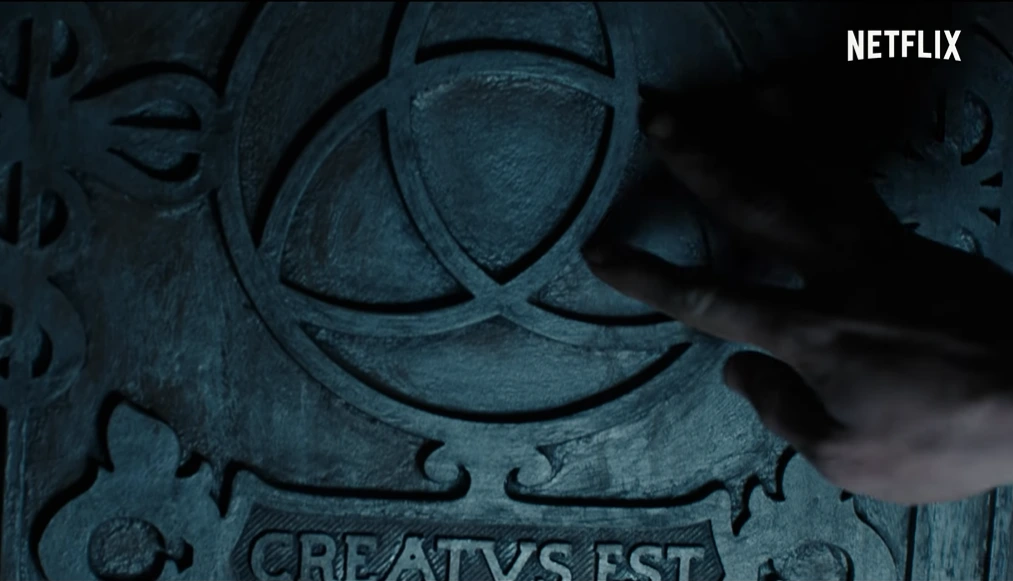
- The Triquetra & Threes: The show revolves around the Triquetra (the Celtic knot representing the trinity). The number 33 visually and numerically emphasizes the rule of three (Past, Present, and Future) existing simultaneously.
- Literature: In Dante Alighieri’s Divine Comedy, a massive structural inspiration for the show’s depiction of hell and cycles, both Purgatorio and Paradiso consist of exactly 33 cantos.