
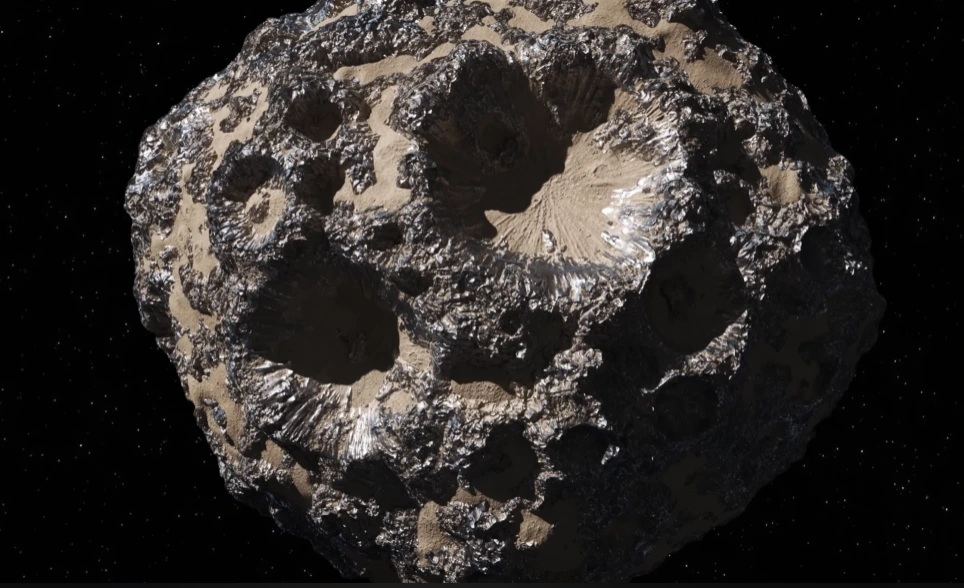
The Psyche spacecraft is currently on its route to the metallic asteroid Psyche after safely completing its flyby of Mars, according to NASA.
NASA continues to make tremendous progress on one of its most interesting projects in recent years. The US space agency reported that the Psyche spacecraft successfully completed a key manoeuvre by passing close to Mars, allowing it to continue its long journey toward the asteroid of the same name, which has piqued the scientific community’s interest due to its high concentration of metals.
The mission’s purpose is far more than just visiting another asteroid. Researchers believe that Psyche might help explain how rocky planets, like our own, originated. As a result, the spaceship will travel for several years before arriving at its final destination in 2029.
What happened during the Psyche spacecraft’s passage through Mars?
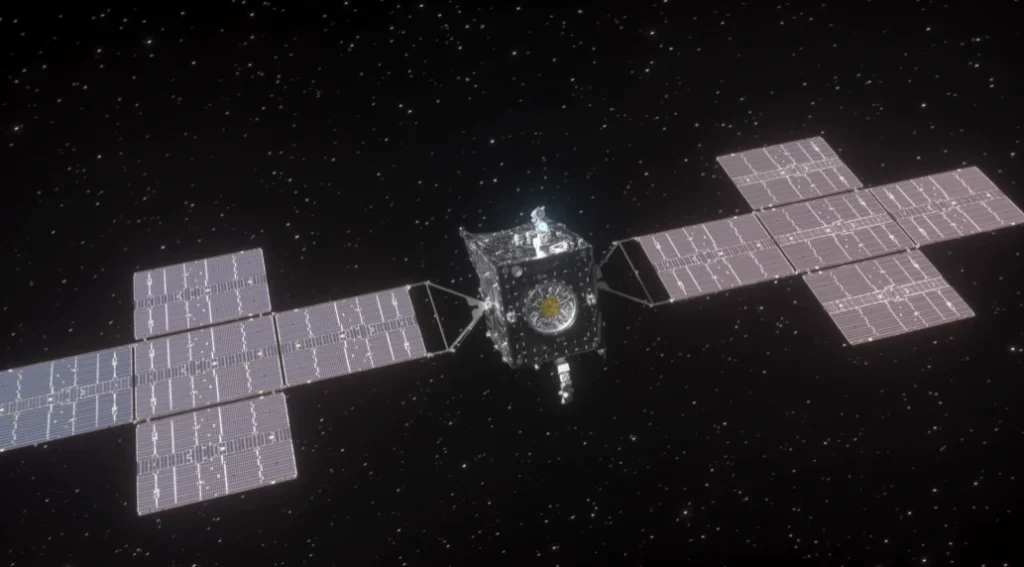
As part of its trip, the spacecraft made a planned approach to the Red Planet to capitalise on its gravitational pull. Thanks to this manoeuvre, the probe was able to boost its speed and alter its course without using a lot of fuel. According to NASA:
“This flyby took advantage of Mars’ gravitational assist to give a crucial boost to the spacecraft’s speed and adjust its orbital plane, thus sending it on its trajectory towards the metal-rich asteroid Psyche.”
During this approach, the spacecraft passed at an approximate distance of 4,609 kilometres from the Martian surface, a proximity that also allowed for important tests to be carried out on its scientific equipment.
While the manoeuvre was underway, the mission’s instruments remained active to verify their functionality. These included specialised cameras, magnetometers, and spectrometers designed to gather valuable information during the journey.
The space agency also explained that the observations made near Mars allowed them to obtain thousands of images of the planet, as well as data related to its atmosphere and space environment.
One of the most remarkable aspects of this operation was the increased speed achieved thanks to Martian gravity. These types of manoeuvres are frequently used in space exploration because they allow for resource conservation and optimise long-distance travel.
What is so special about the asteroid Psyche?
Psyche stands out from other known asteroids due to its high metal concentration. Scientists believe it might be the incomplete core of an old planetesimal, one of the building parts that contributed to planet formation in the early years of the Solar System.
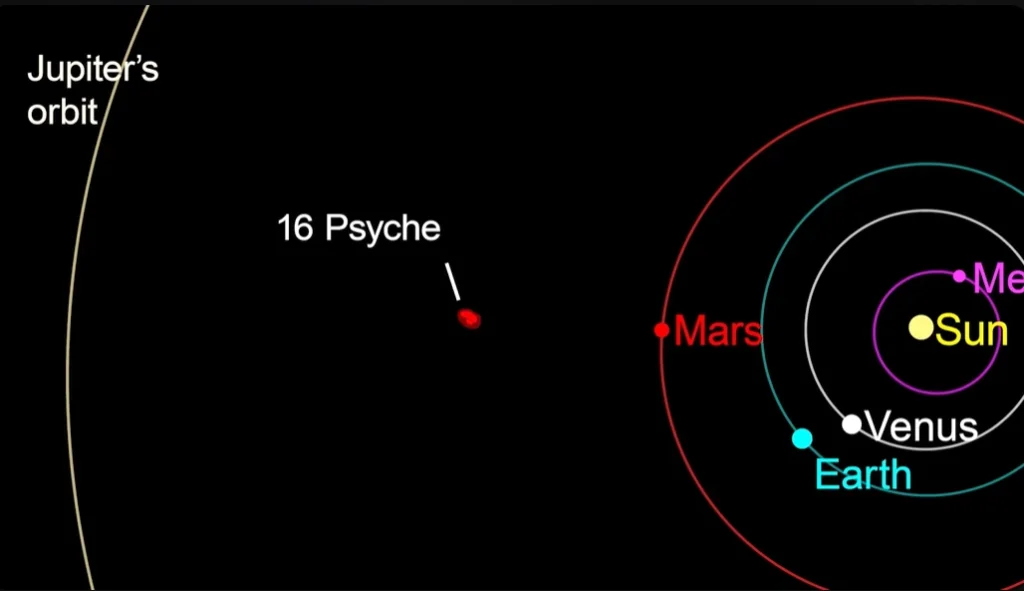
This object is now located in the main asteroid belt, which lies between the orbits of Mars and Jupiter. It has a diameter of roughly 280 km at its widest point.
The mission’s goal will be to thoroughly investigate its surface, generate detailed maps, and learn about its composition. The findings might provide fresh insights into the mechanisms that give rise to rocky planets.
After successfully completing the Martian flyby, the spacecraft will continue its voyage utilising its solar-electric propulsion system. Over the following several years, it will continue to travel millions of km until it reaches the main asteroid belt.
Lindy Elkins-Tanton, the mission’s main investigator, emphasised the importance of this stage in the project.
“We’ve been anticipating the Mars flyby for years, but now it’s complete. We have the Red Planet to thank for giving our spacecraft crucial gravitational assistance to venture even deeper into the solar system.”
The arrival to the asteroid Psyche is scheduled for 2029, assuming all goes smoothly. Once there, the spacecraft will undertake a long observation phase that might aid in better understanding the history of our Solar System and the origins of planets such as Earth.