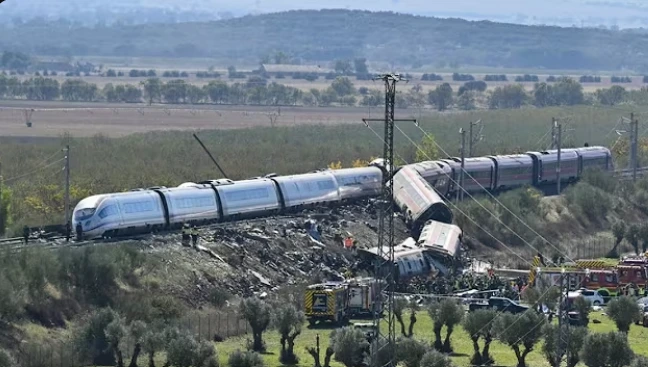
At least 68 people have been killed after two high-speed trains collided in Toledo province, Spain.
At least 68 people have been killed and more than 170 others injured after two high-speed passenger trains collided along the Madrid–Seville corridor in central Spain on Wednesday morning.
The catastrophic rear-end collision occurred at 08:54 CET between the towns of Urda and Los Yébenes in the province of Toledo, roughly 150 kilometres south of the capital. The impact sent two passenger carriages plunging down a steep embankment, leaving wreckage scattered across the tracks and triggering one of the deadliest rail disasters in modern European history.
A Violent Rear-End Impact
According to preliminary manifests released by Spanish rail operator ADIF and private carrier Iryo, a total of 544 passengers were travelling along the high-speed line when the disaster struck.
The sequence began when Iryo Train 6076, bound for Seville with 147 passengers, came to a sudden halt on the tracks due to an automated signalling fault. Just minutes behind it, a Renfe AVE express train carrying 397 passengers slammed directly into the rear of the stationary Iryo convoy at high speed.
Survivors described scenes of utter terror inside the carriages as the force of the collision crumpled metal framework and shattered windows. “We all felt the train abruptly slowing down and then the violent impact,” one passenger recounted to regional radio networks. “Everything went flying: luggage, cell phones, debris. People were thrown from their seats into the aisles.”
Emergency services, including the Military Emergencies Unit (UME), medical evacuation helicopters, and specialised heavy-rescue teams, descended on the rural crash site. Rescuers worked through twisted metal to extract survivors trapped inside the crushed rear coaches. Local authorities converted a sports complex in the nearby town of Urda into a temporary triage shelter and field hospital to process walking wounded and coordinate family reunions.
Investigating an “Inexplicable” Fail-Safe Breakdown
Spanish Minister of Transport and Sustainable Mobility, Óscar Puente, rushed to ADIF’s central command unit in Madrid to oversee the emergency response. Addressing reporters, Puente described the catastrophe as “inexplicable”, questioning how a high-speed train could be authorized to proceed along an occupied block while a stationary train was stopped directly ahead.
The Independent Authority for the Technical Investigation of Accidents and Incidents (AITAT) has taken charge of the formal probe. Initial evidence suggests that after an automated signalling failure occurred along the section, control centre operators transitioned the line to manual operation. Preliminary reports indicate that human error during the manual signalling procedure led controllers to clear the oncoming Renfe AVE train into the path of the stopped Iryo service.
Regional law enforcement confirmed that control personnel on duty during the shift have been brought in for detailed formal questioning as technical teams retrieve the train data recorders (black boxes).
National Mourning and Infrastructure Scrutiny
Spanish Prime Minister Pedro Sánchez issued a statement declaring a period of national mourning, assuring the public that the government will investigate the root causes with the “utmost firmness and transparency.” King Felipe VI and Queen Letizia also released a royal communique offering their heartfelt condolences to the families of the victims and gratitude to first responders.
The disaster marks the second major rail tragedy to hit Spain this year, renewing intense political and public scrutiny over the safety protocols and dispatch automation governing the nation’s sprawling high-speed network.
All high-speed rail traffic between Madrid, Ciudad Real, and Andalusia remains completely suspended as forensic teams clear the structural wreckage and investigators inspect the damaged line. Authorities warned that the death toll may continue to rise as emergency teams complete their search through the impacted carriages and critical care units treat dozens of severely injured survivors.