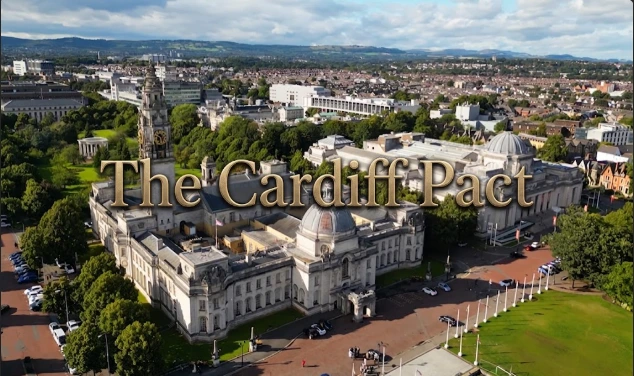
Scotland, Wales, and Northern Ireland have signed the historic Cardiff Pact, forming a unified pro-independence alliance to dismantle the United Kingdom.
In a development that has sent seismic shockwaves through Whitehall and redefined the constitutional calculus of the British Isles, the leaders of Scotland, Wales, and Northern Ireland have formally signed an unprecedented cooperation pact.
Gathered at the luxury St David’s Hotel overlooking Cardiff Bay, Scottish First Minister John Swinney, Welsh First Minister Rhun ap Iorwerth, and Northern Ireland First Minister Michelle O’Neill, joined by Sinn Féin President Mary Lou McDonald, affixed their signatures to a binding memorandum of understanding. Dubbed the “Cardiff Pact“, the agreement establishes a unified, cross-border strategic front explicitly designed to secure the democratic right to hold independence and reunification referendums, marking the most coordinated existential challenge to the United Kingdom since the formalization of devolution.
An Electoral Earthquake and the Collapse of the Westminster Firewall
The convergence in the Welsh capital is the direct consequence of a tectonic shift in regional politics. Following recent electoral cycles that battered the governing Labour Party under Prime Minister Andy Burnham, pro-independence and nationalist forces achieved an unprecedented clean sweep across the UK’s outlying administrations.
Plaid Cymru’s historic surge under Rhun ap Iorwerth shattered a century of Labour hegemony in Wales, while the Scottish National Party (SNP) maintained its dominant administrative footprint at Holyrood, and Sinn Féin consolidated executive control in Stormont. For the first time in British political history, all three devolved governments are headed by parties whose foundational raison d’être is the dismantling of the centralised union state.
Historically, successive UK governments successfully managed separatist pressures by containing them within separate geographic silos, playing off Edinburgh against Belfast or Cardiff. By pooling their political capital into a formal memorandum, the signatories have neutralized that divide-and-conquer strategy, presenting London with a collective challenge that is far more difficult to dismiss or legally outmanoeuvre.
The Architecture of the Cardiff Pact
While framed around broad mutual cooperation, the text of the memorandum of understanding outlines concrete pillars designed to synchronize the dismantling of central UK controls across four critical domains:
- Self-Determination & Democratic Mandates:The core of the pact asserts that Scotland, Wales, and Northern Ireland each possess an inherent democratic right to determine their constitutional futures, explicitly rejecting Westminster’s legal veto power, such as the Supreme Court’s 2022 ruling barring unilateral Scottish votes, as an infringement on regional sovereignty.
- Post-Brexit European Reintegration: All three administrations have committed to aligning their future economic trajectories with the European Union. Scotland and Wales envision re-entering the bloc as independent member states, while Northern Ireland pursues integration through Irish reunification.
- Fiscal and Energy Autonomy: The pact demands sweeping devolution over natural resources, taxation, and regional energy grids. Plaid Cymru, in particular, has leaned heavily into demands for control over the Crown Estate revenues generated by offshore wind installations along the Welsh seabed—funds that currently flow directly to the UK Treasury.
- Coordinated Diplomatic Strategy: The signatories agreed to establish a permanent joint liaison committee to share tactical legal research, coordinate public messaging, and lobby international bodies, including the European Commission and Washington, to recognize their regional democratic mandates.
Tactical Nuances and Divergent Timelines
Despite the unified front presented in Cardiff, the practical mechanics and internal politics of the three constituent nations vary wildly, reflecting distinct historical grievances and legal frameworks.
For Scotland’s John Swinney, the push is urgent. The SNP has weathered intense domestic scrutiny over economic performance and voter fatigue, making a section 30 referendum transfer an indispensable rallying cry. Swinney seized headlines on the eve of the summit by warning that Prime Minister Burnham is “facing up to the idea that he will go down in history as the final prime minister of the United Kingdom”.
In Wales, Rhun ap Iorwerth has adopted a more measured, pragmatic cadence. Conscious of public caution regarding immediate upheaval, ap Iorwerth emphasized that the coalition’s primary goal is addressing systemic economic inequality, fair funding formulas, and resource equity.Plaid Cymru has maintained that a formal Welsh independence referendum will not be rushed, leaving a serious plebiscite off the table until structural white papers are completed toward the end of the decade.
Meanwhile, Northern Ireland operates under the rigid, legally binding architecture of the Good Friday Agreement. A border poll does not rest solely on local assembly votes but requires the Secretary of State for Northern Ireland to objectively determine that a majority are likely to vote in favor of unification. Sinn Féin’s inclusion in the Cardiff Pact ensures that Irish reunification remains a synchronized talking point alongside Scottish and Welsh ambitions, even if its legal realization depends on demographic shifts and future electoral tipping points.
The International Dimension: Washington’s Uninvited Intervention
Compounding the pressure on Whitehall, the Cardiff summit unfolded in the immediate shadow of a provocative diplomatic intervention from across the Atlantic.
During a high-profile visit to Dublin just days prior, US President Donald Trump publicly endorsed the concept of a united Ireland, telling reporters that unification “is going to happen eventually” and asserting that “it may as well happen now”. While Trump demurred on the subject of Scottish or Welsh secession, his casual dismissal of the unionist status quo provided an immense psychological boost to nationalist delegates gathering in Wales, injecting an unpredictable external variable into the domestic UK debate.
Whitehall’s Dilemma: Confrontation Versus Concession
For Prime Minister Andy Burnham, the Cardiff Pact presents a punishing strategic dilemma.
In recent remarks to Parliament, Burnham momentarily opened the door to dialogue, suggesting that a future referendum could theoretically proceed if a “clear consensus” emerged—a remark he hastily walked back amid fierce backlash from traditionalist backbenchers. Downing Street’s official posture remains firmly rooted in the defence of the union, arguing that regional administrations were elected to manage localised public services, not to execute constitutional fragmentation.
However, relying purely on legal blockades and flat rejections risks playing directly into nationalist hands, validating the narrative of an inflexible, authoritarian central state in London. By formalizing their alliance in the Cardiff Accord, Scotland, Wales, and Northern Ireland have transformed what were once disparate local grievances into a synchronised, transnational campaign. As the ink dries on the memorandum of understanding, the foundational myth of an unbreakable British state enters its most perilous and uncertain era.