
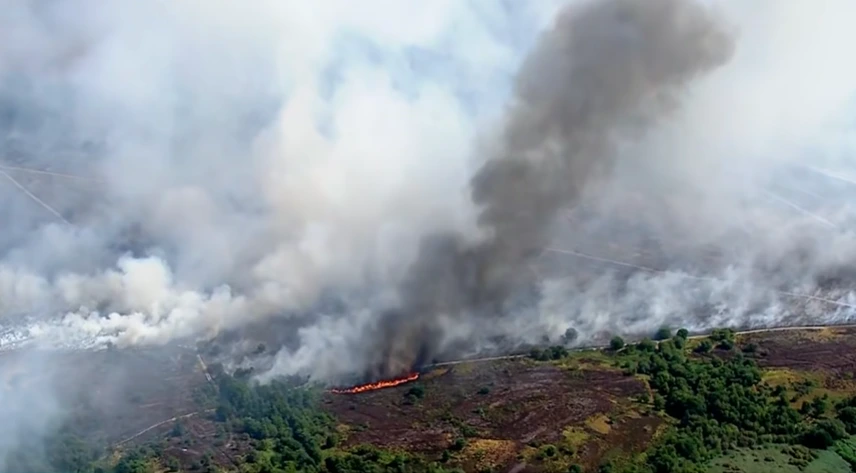
A major incident has been declared in Suffolk after a massive wildfire swept across Dunwich Heath, forcing evacuations and placing the nearby Sizewell B nuclear power station on high alert.
Emergency services in the East of England declared a major incident on Thursday as over 100 firefighters battled an aggressive, wind-driven wildfire raging across the vulnerable coastal heathlands of Dunwich Heath. The rapidly expanding blaze, fueled by severe drought conditions and scorching mid-summer temperatures, forced the precautionary evacuation of hundreds of residents and holidaymakers, while putting nearby critical energy infrastructure on high alert.
The fire broke out shortly after 5:30 p.m. on Wednesday near Leiston, tearing through tinder-dry vegetation across an area that has expanded to roughly 100 hectares. Plumes of thick, dark smoke drifted out toward the North Sea, while local authorities scrambled to secure the perimeter. Approximately 18 fire engines and specialized crews from across the region were deployed to combat the flames, with incident commanders warning that suppressing the complex blaze will likely require another 24 to 48 hours of intense effort.
Proximity to Sizewell Infrastructure
The gravity of the situation escalated due to the fire’s close proximity to the vital Sizewell nuclear complex. Located roughly four miles (6.4 kilometers) away from the heart of the blaze, the operational Sizewell B nuclear power station—alongside the adjacent construction footprint for the new Sizewell C project—was placed on high alert.
Operators and safety regulators closely monitored wind directions, expressing initial concern that a sudden shift toward the facility could pull dense smoke and particulate matter into the plant’s heating, ventilation, and air conditioning (HVAC) systems. However, representatives for EDF confirmed that routine operations at Sizewell B remained unaffected, noting that robust on-site emergency protocols are permanently maintained to address environmental threats, including nearby wildfires. Sizewell C construction officials likewise reported a low immediate risk given local watercourse barriers, though traffic management measures were implemented to keep access roads clear for priority emergency vehicles.
Devastation of a Protected Ecosystem
As ground crews focused on containment lines, the human and environmental toll of the disaster became increasingly apparent. Local authorities completely evacuated the Cliff House Holiday Park, displacing roughly 200 caravan owners and summer visitors, alongside several residential properties in the path of the smoke.
The fire heavily impacted parts of the prestigious RSPB Minsmere nature reserve and National Trust lands, scorching centuries-old pine canopies and destroying delicate heathland habitats. Conservation managers described the ecological destruction as unprecedented in living memory, wiping out critical breeding grounds for rare ground-nesting bird populations, including nightjars, Dartford warblers, and nightingales. Experts estimate that the localized ecosystem will require well over a decade to fully recover from the catastrophe.
A Parched Continent on Edge
The emergency in Suffolk unfolds against the backdrop of a broader climate crisis gripping the United Kingdom. Just a day prior to the outbreak, the Environment Agency officially declared a drought across half of England following record-low cumulative rainfall and sustained heatwaves. The UK Health Security Agency issued active amber heat-health alerts across multiple regions, warning that parched landscapes have turned rural Britain into a literal powder keg.
Prime Minister Andy Burnham addressed the crisis during a public briefing, confirming that the central government is closely monitoring the situation and standing ready to deploy supplementary mutual aid resources to support local response teams. For now, residents in neighboring villages have been urged to keep doors and windows firmly shut as firefighters work tirelessly to tame a blaze that has starkly underscored the escalating vulnerability of Britain’s natural and industrial landscape to extreme weather.