
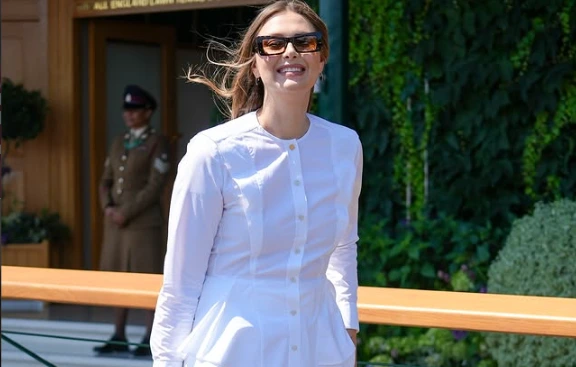
Maria Sharapova returned to Wimbledon on July 11, 2026, appearing in the Royal Box for the women’s final in a butter yellow outfit that turned heads worldwide. Here is a full look at her career, her transformation, and why the world cannot stop watching her.
Twenty-two years after she walked onto Centre Court as a 17-year-old unknown and walked off as the Wimbledon champion, Maria Sharapova returned to the All England Club on July 11, 2026, and managed to do what she has always done with effortless consistency: command every room she enters.
The five-time Grand Slam winner returned to the All England Lawn Tennis Club for the 2026 Wimbledon women’s final, where she turned heads with an elegant Royal Box appearance and showcased a very different look from the one fans remember from her playing days. The former world number one, now 39 years old and six years retired from professional tennis, sat in one of sport’s most prestigious vantage points alongside Princess Kate; fellow former champions Simona Halep and Petra Kvitová; and a galaxy of celebrities, including Anna Wintour, Hannah Waddingham, Lily Collins, and Jodie Foster.
She watched Czech star Linda Nosková defeat Karolína Muchová in an all-Czech final to claim her first Grand Slam title. But before the trophy was lifted, Sharapova was among the biggest talking points inside Centre Court.
The Look That Stopped the Internet
Sharapova sharpened the style conversation at Wimbledon 2026 by showing up in the stands in a butter-yellow midi-length skirt and a white cardigan-meets-blouse. Black slingback pumps, oversized sunglasses, and a black monogrammed Louis Vuitton Alma Trunk with gold accents completed the look.
But it was not the outfit alone that generated the reaction. It was the hair. Since retiring from tennis in 2020, Sharapova has undergone a dramatic transformation, swapping her famous blonde locks for a brunette style that has left fans describing her as “unrecognisable“.
For a generation of tennis fans who grew up watching Sharapova’s blonde ponytail and powerful baseline game define the sport for fifteen years, the new look arrived as a genuine surprise. Social media lit up with reactions ranging from admiration to disbelief, with many fans genuinely struggling to place the woman in the Royal Box until the cameras held on her long enough for recognition to click.
The black monogrammed Louis Vuitton Alma Trunk with gold accents did more than complete Sharapova’s outfit. It linked her appearance to the kind of accessory choice that signals intention, not convenience. This was not an accidental appearance by a retired athlete. It was a studied, deliberate return to one of the world’s great stages, and it landed exactly as intended.
Sharapova returned to Wimbledon the following day for the men’s final between Jannik Sinner and Alexander Zverev, once again drawing attention from fans who watched her dominate Centre Court more than 20 years earlier.
The 17-Year-Old Who Changed Everything
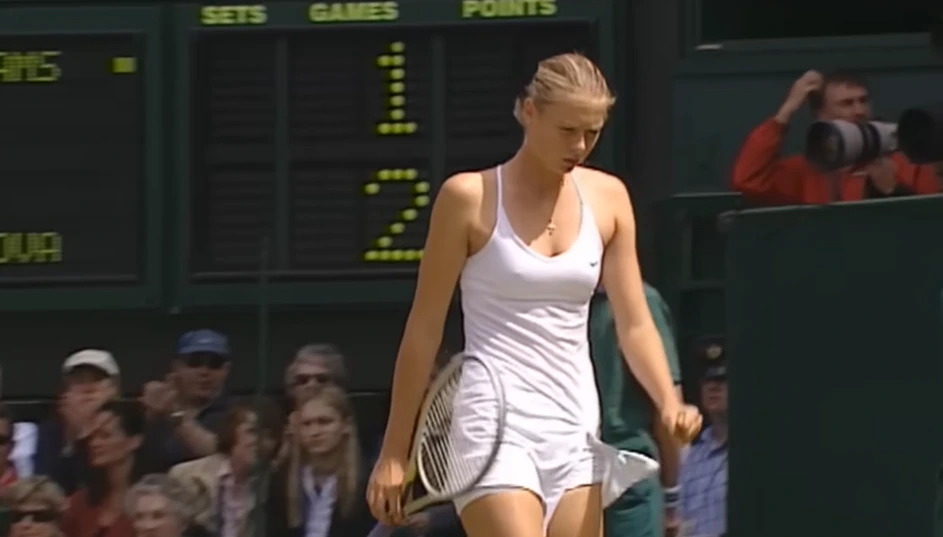
To understand why Sharapova’s return to Wimbledon generates the reaction it does, you have to go back to where it all began.
Sharapova’s Wimbledon connection began in 2004 when, at just 17 years old, she defeated two-time defending champion Serena Williams in the final to win her first Grand Slam title. The victory turned Sharapova into one of tennis’ biggest stars overnight, with her powerful game and trademark blonde hair becoming instantly recognisable around the world.
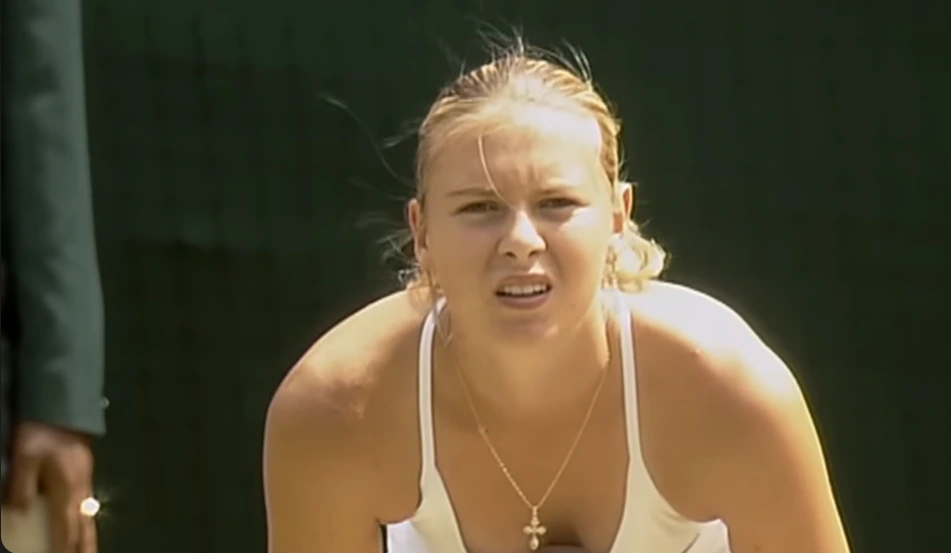
The victory was stunning not just for its result but for how it was achieved. Sharapova played with a fearlessness that belied her age, refusing to be intimidated by Williams’s dominance and serving out the match with icy composure on one of sport’s biggest stages. She was born in Nyagan, Russia, in April 1987 and had moved to the United States at the age of seven with her father, Yuri, to train at the Nick Bollettieri Tennis Academy in Florida, leaving her mother behind in Russia for two years while the family scraped together resources to fund her training. That backstory of sacrifice and grit would become central to how Sharapova understood and presented herself throughout her career.
The Wimbledon title announced her. What followed made her a legend.
Five Grand Slams and a Place Among Tennis’s Greatest
Sharapova’s career saw her complete one of tennis’ greatest achievements by winning all four Grand Slam titles. After Wimbledon, she added the US Open in 2006, the Australian Open in 2008, and two French Open titles in 2012 and 2014.
Winning the Career Grand Slam, all four major titles across all four Grand Slam surfaces, places Sharapova in a group of only ten women in the Open Era who have achieved the feat. The French Open titles were perhaps the most remarkable of her five majors, coming as they did on clay, a surface that does not naturally suit the flat, powerful baseline game she built her career around.
Her 2012 Roland Garros title in particular came after she had been written off by much of the tennis world, having spent 18 months recovering from a shoulder injury that required surgery and had threatened to end her career entirely. She returned, won Roland Garros, and reclaimed the world number one ranking that she had first achieved in 2005.
She held the world number one ranking five separate times across her career, a measure of sustained excellence that speaks to far more than a single peak. At her best, Sharapova was one of the most complete players in women’s tennis: a ferocious first serve, exceptional footwork, extraordinary mental strength under pressure, and a competitive will that her contemporaries consistently described as the most formidable they had ever encountered.
Off the court, Sharapova built something equally significant. Maxim magazine named her the hottest athlete in the world for a fourth consecutive year in 2006, a title that reflected her crossover appeal far beyond the boundaries of tennis. Endorsement deals with Nike, Tag Heuer, Porsche, and Evian followed, along with her own confectionery brand, Sugarpova, launched in 2012. Forbes ranked her among the highest-paid female athletes in the world for over a decade, a reflection of both her sporting success and her extraordinary commercial instincts.
The Doping Ban That Defined Her Final Chapter
No account of Sharapova’s career can be complete without addressing the event that overshadowed its final years. In March 2016, she announced that she had failed a drug test at the Australian Open in January, testing positive for meldonium, a heart medication she had been prescribed and had taken for ten years to manage health conditions. Meldonium had been added to the World Anti-Doping Agency’s banned substances list on January 1, 2016, and Sharapova said she had not been aware of the change.
The Court of Arbitration for Sport reduced her initial two-year ban to fifteen months after accepting that she bore some reduced fault for her inadvertent use of a banned substance. She returned to professional tennis in April 2017 and played until February 2020, when persistent shoulder problems finally led her to announce her retirement. She was 32 years old.
The ban was a defining controversy, and it reshaped the final act of her career, denying her the clean farewell that her talent deserved. But it did not define what she built over the fifteen years that preceded it, and it has not, by any measure, diminished the esteem in which she is now held as her post-playing life continues to generate consistent headlines.
Life After Tennis: Business, Family and a New Chapter
Sharapova retired from professional tennis in February 2020, announcing her decision in an essay for Vogue and Vanity Fair in which she asked: “How do you leave behind the only life you’ve ever known?” The question was rhetorical, but the answer she has given over the past six years is clear: by building the next chapter with the same discipline and ambition that built the first one.
Sugarpova, the premium candy brand she launched in 2012, has expanded significantly since her retirement. She has invested in early-stage companies through her investment portfolio and has been active in the business community in ways that extend well beyond the typical retired athlete’s ambassador role. She sits on the board of various entrepreneurial ventures and has spoken publicly about her ambition to build a business legacy that outlasts her tennis one.
She and her partner, British art entrepreneur Alexander Gilkes, welcomed their first child together in 2022, a development Sharapova chose to share publicly after a period of deliberate privacy, offering a glimpse into a domestic life that stands in deliberate contrast to the relentless public exposure of her playing years.
The brunette look that surprised Wimbledon is, by her own account, not a recent change. It is simply one that the public is only now fully registering now that she has returned to the kind of high-profile setting where cameras and column inches follow her every appearance.
Why Wimbledon 2026 Matters Beyond a Dress
Maria Sharapova at Wimbledon 2026 is a clean example of how a retired athlete can still command attention without taking a swing.
There is something telling about the fact that Sharapova’s appearance in the Royal Box generated more social media traffic than most of the matches being played on the outside courts that same day. It reflects something genuinely unusual about her place in the culture of sport: the combination of extraordinary athletic achievement, sustained commercial relevance, physical transformation, and the mythology of her original Wimbledon story creates a figure who transcends the normal category of the retired sportsperson.
Most athletes retire and gradually fade from public consciousness, returning occasionally for anniversary events and nostalgic features. Sharapova at 39 generates the kind of reaction usually reserved for active players at the peak of their powers, and she generates it simply by sitting in the stands in a yellow skirt with a designer handbag.
She was also present at Wimbledon for a reason that goes beyond nostalgia. Tennis legend Serena Williams makes a surprise appearance to induct Maria Sharapova into the International Tennis Hall of Fame on August 23. The Hall of Fame induction, to be conducted by the very player she defeated in the 2004 Wimbledon final to launch her global career, is the kind of full-circle story that sport occasionally produces and that no scriptwriter could improve on.
The girl who arrived at the All England Club as a 17-year-old and left as a champion returns at 39, watches from the Royal Box, and is inducted into the Hall of Fame by the opponent whose defeat made her famous. If that is not the architecture of a great sporting life, it is difficult to say what would be.
Related Articles:





[…] Maria Sharapova Returns to Wimbledon at 39 and Steals the Show All Over Again […]