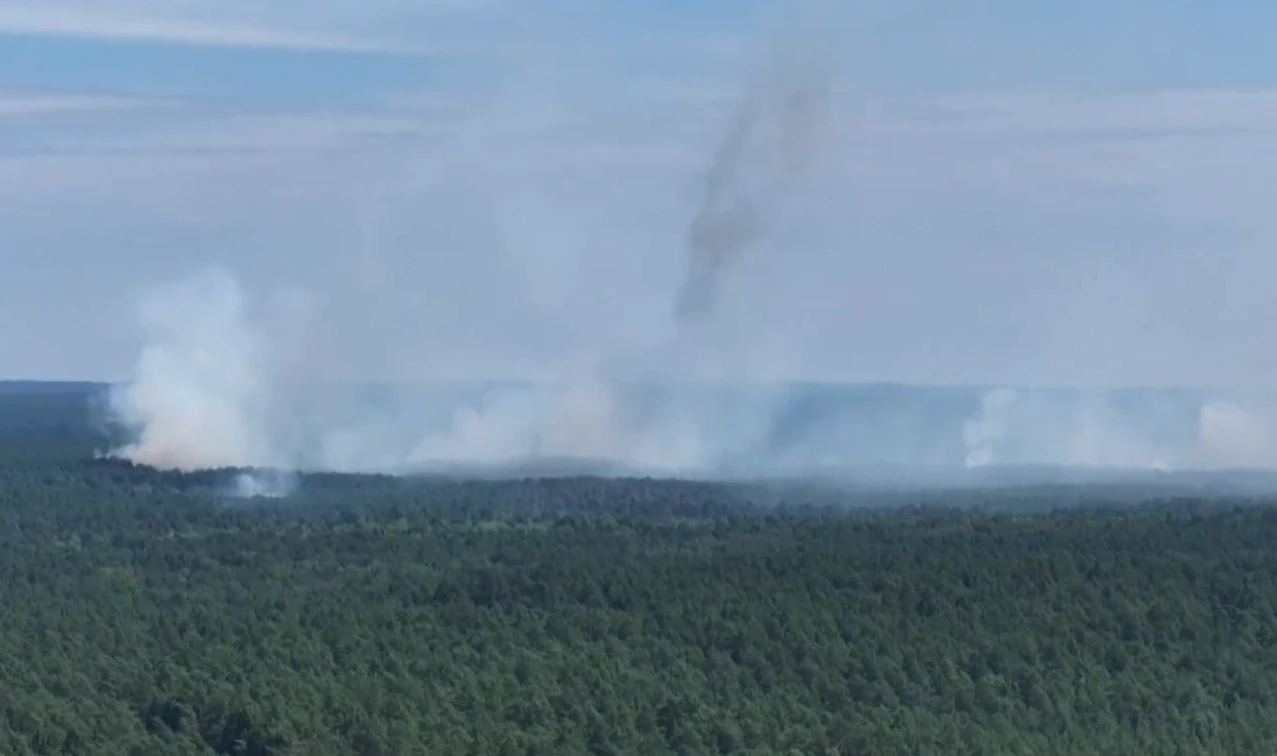
A wildfire in Müritz National Park continues to spread, with firefighters unable to reach the source due to unexploded WWII munitions.
MECKLENBURG-WESTERN POMERANIA, GERMANY — A challenging wildfire continues to burn within the heart of Müritz National Park, as emergency responders battle not only the flames but also the hidden dangers of the region’s volatile past.
The fire, which first broke out on July 13 in a former military training ground, remains largely uncontained as specialised teams navigate terrain heavily contaminated with unexploded World War II-era ordnance.
As of Thursday, the blaze has spread across approximately 318 hectares, fuelled by shifting winds and the dry conditions of a record-breaking summer. The situation reached a critical point earlier this week when changing wind patterns necessitated the second round of evacuations for the nearby villages of Granzin and Granziner Mühle.
While residents have been allowed to return periodically, local authorities remain on high alert, advising them to stay in temporary accommodation as a precautionary measure.
The “Invisible” Obstacle
The primary difficulty facing the 370 firefighters currently on the scene is the presence of buried anti-tank grenades and other munitions. Because the heat and proximity of fire suppression activities could trigger explosions, ground crews are strictly prohibited from entering the most affected zones.
“We are essentially fighting with one hand tied behind our back,” a district spokesperson noted. “Safety protocols require a 1,000-metre exclusion zone, which makes it impossible to use traditional firefighting techniques like direct water application or heavy machinery in the heart of the blaze.”
Instead, crews have adopted a containment strategy, focusing on “defence lines” around the perimeter. By ploughing fields between the forest and nearby settlements and installing sprinkler systems to keep vegetation wet, responders are working to halt the fire’s progress toward populated areas. Additional support has arrived from across Germany, including specialised firefighting equipment from Bavaria and high-capacity hoses designed for long-distance water transport.
A Tense Standoff with Nature
Environmental officials, including Till Backhaus, the Minister of the Environment for Mecklenburg-Western Pomerania, have confirmed that the fire is under observation. While the situation is contained enough that a formal state of emergency has not been declared, the prospect of extinguishing the fire remains distant.
Authorities estimate that the area contains thousands of hectares of contaminated soil, making this one of the most complex firefighting operations in recent German history.
As the smoke persists, air quality warnings remain in effect for the surrounding districts, and residents are urged to keep doors and windows closed. The Müritz fire has once again highlighted the enduring ecological and safety risks posed by historic military sites, particularly as climate change increases the frequency and intensity of wildfires across the continent.
For the visitors and residents of one of Germany’s most treasured natural landscapes, the coming days will be defined by a slow, defensive wait. For now, the forest floor remains a minefield, and the priority remains the safety of the local communities until the winds settle and the flames burn themselves out within the controlled containment zones.