
Best Gaming Console Options in Europe 2026: Which Gaming System Is Right for You? A Comprehensive Guide to Navigating Price Hikes, Platform Ecosystems, and the Handheld Revolution
The European gaming console market in 2026 presents consumers with a landscape fundamentally transformed by relentless price escalation, platform ecosystem consolidation, and the emergence of handheld PC gaming as a legitimate alternative to traditional home consoles. With Sony’s PlayStation 5 Pro approaching the €900 threshold, Microsoft’s Xbox Series X climbing to €800, and Nintendo’s Switch 2 set to increase to €500 by September, gaming has become an increasingly expensive hobby that demands careful financial consideration
Yet beneath the sticker shock lies a more nuanced reality. The European market valued at approximately €4.8 billion in 2025 and projected to grow at a 2.1% compound annual rate through 2035 offers diverse options tailored to different gaming preferences, budgets, and lifestyle requirements. From the PlayStation 5’s dominant market position to the Nintendo Switch 2’s explosive early sales, from the Xbox Game Pass value proposition to the Steam Deck’s PC gaming portability, European consumers face choices that extend far beyond hardware specifications.
This analysis examines each major platform’s strengths, weaknesses, and value proposition within the European context, incorporating regional pricing variations, exclusive content libraries, subscription ecosystem dynamics, and the emerging handheld PC category that is reshaping portable gaming.
I. The Price Crisis: Understanding the 2026 Console Market
The Great Console Price Escalation
The gaming industry has undergone a dramatic pricing transformation since the 2020 launch of the current console generation. What began as a €500 entry point for flagship hardware has evolved into a tiered pricing structure that places premium consoles firmly in luxury goods territory. The financial trajectory is stark:
| Console | Original Launch Price (2020-2025) | Current European Price (Mid-2026) | Upcoming Price Change |
|---|---|---|---|
| PlayStation 5 Digital | €400 | €600 | — |
| PlayStation 5 Disc | €500 | €650 | — |
| PlayStation 5 Pro | €700 (Nov 2024) | €900 | — |
| Xbox Series S (512GB) | €300 | €400 | €500 (Aug 2026) |
| Xbox Series X (1TB) | €500 | €650 | €800 (Aug 2026) |
| Nintendo Switch 2 | €450 (Jun 2025) | €450 | €500 (Sep 2026) |
| Nintendo Switch OLED | €350 | €400 | — |
| Nintendo Switch Lite | €200 | €230 | — |
Sources: GameSpot, Pure Xbox, regional retailer data
Microsoft has implemented three separate price increases for its Xbox lineup, with a fourth potentially on the horizon. Sony’s PS5 Pro, launched at €700 in November 2024, now commands €900—approaching the psychological threshold of €1,000 that would place it in an entirely different consumer category. Even Nintendo, historically the value-orientated platform holder, has announced a €50 increase for the Switch 2 effective September 1, 2026.
These increases are attributed to the ongoing components crisis, global economic factors, and currency fluctuations affecting European markets. The result is a market where the “budget” Xbox Series S now costs more than the flagship PlayStation 5 did at launch—a reality that fundamentally alters consumer value calculations.
The European Pricing Premium
European consumers face additional cost burdens beyond base hardware prices. Value-added tax (VAT) rates ranging from 17% to 27% across EU member states inflate retail prices significantly compared to North American markets. Import duties, regulatory compliance costs, and regional localization requirements further compound the premium. The United Kingdom, post-Brexit, operates under distinct pricing structures that often diverge from continental European norms.
For context, the PlayStation 5 Pro’s €900 European price translates to approximately $975 at current exchange rates—substantially above the $900 U.S. retail price. This disparity, while partially explained by VAT inclusion in European pricing (versus U.S. sales tax added at checkout), represents a genuine cost burden that European consumers must factor into purchasing decisions.
II. Platform Analysis: The Contenders
PlayStation 5: Europe’s Undisputed Champion
Market Dominance and Cultural Resonance
Sony’s PlayStation 5 maintains commanding market leadership in Europe, a position built on three decades of brand cultivation since the original PlayStation’s 1994 European launch. Cumulative sell-through reached 77.8 million units globally as of December 2024, with European sales consistently representing approximately 25-30% of global volume. In the UK specifically—the largest individual European market—PlayStation holds 60-70% of dedicated home console unit sales, with Xbox trailing at 30-40%.
This dominance extends beyond hardware sales into cultural penetration. Over 68% of EU households with individuals aged 16-34 own a dedicated gaming console, with PlayStation representing the plurality preference. The brand’s association with premium gaming experiences, exclusive content, and technological innovation has created loyalty that transcends mere hardware specifications.
The Hardware Spectrum
Sony offers three distinct PS5 SKUs in the European market, each targeting different consumer segments:
PlayStation 5 Slim (€600 Digital / €650 Disc)
The standard bearer of the current generation, the PS5 Slim represents Sony’s refinement of the original launch design. The “Slim” moniker is somewhat misleading—this is not a dramatic size reduction in the tradition of previous PlayStation hardware revisions, but rather a more efficient manufacturing iteration that reduces production costs while maintaining performance parity.
The disc-equipped variant (€650) retains 4K UHD Blu-ray playback capability, enabling physical game ownership, media consumption, and backward compatibility with PS4 disc libraries. The digital edition (€600) sacrifices the optical drive for a €50 price reduction—a modest saving that eliminates resale value, pre-owned purchasing, and physical media collecting. For most European consumers, the disc variant represents superior long-term value despite the higher upfront cost.
PlayStation 5 Pro (€900)
Launched in November 2024, the PS5 Pro targets enthusiasts willing to pay a substantial premium for enhanced performance. Key differentiators include the following:
- GPU Upgrade: Approximately 45% faster rendering through increased compute units and higher clock speeds
- Advanced Ray Tracing: Improved real-time lighting, reflections, and shadows
- AI Upscaling (PSSR): PlayStation Spectral Super Resolution, Sony’s proprietary machine learning upscaling technology that reconstructs lower-resolution renders to near-native 4K quality with minimal performance cost
- 8K Support: Future-proofing for next-generation display standards, though native 8K gaming remains impractical for current content
- 2TB Storage: Double the standard PS5’s capacity, addressing the persistent storage management frustrations of the base model
The €900 price point positions the PS5 Pro as a luxury product—a “halo device” that generates brand prestige while driving standard PS5 sales through comparative value perception. For consumers with 4K televisions seeking the definitive console experience, the Pro delivers measurable improvements. For those gaming on 1080p displays or prioritizing budget consciousness, the standard PS5 Slim provides indistinguishable performance at substantially lower cost.
Exclusive Content: Sony’s Competitive Moat
PlayStation’s enduring European dominance rests fundamentally on exclusive software. Titles such as Marvel’s Spider-Man 2, God of War Ragnarök, The Last of Us Part II, Horizon Forbidden West, and Stellar Blade represent narrative-driven, visually spectacular experiences unavailable on competing platforms. These exclusives leverage the DualSense controller’s haptic feedback and adaptive triggers—technologies that create tactile immersion impossible to replicate through standard vibration.
The DualSense controller itself merits consideration as a purchase factor. Its haptic feedback system translates in-game actions into nuanced physical sensations—raindrops pattering across the controller surface, the tension of drawing a bowstring, the granular texture of different terrain underfoot. While gimmicky to some, this technology represents a genuine evolution in controller design that enhances immersion in supported titles.
PlayStation Plus: The Subscription Evolution
Sony’s subscription service has undergone significant restructuring, now offering tiered options:
- Essential (€8/month): Online multiplayer access, monthly free games, cloud storage
- Extra (€14/month): Essential benefits plus access to a catalog of 400+ downloadable PS4 and PS5 titles
- Premium (€17/month): Extra benefits plus classic PS1/PS2/PSP game streaming, time-limited game trials
The Extra tier represents the value sweet spot for most consumers, providing access to substantial libraries without the premium pricing of the top tier. However, Sony’s catalog lacks the day-one first-party releases that distinguish Microsoft’s Game Pass, representing a strategic divergence in subscription philosophy.
Xbox Series X|S: The Subscription-First Platform
The Value Proposition Under Siege
Microsoft’s Xbox platform entered the current generation with a compelling value narrative: the Series S as an affordable entry point, the Series X as a technical powerhouse, and Game Pass as the ultimate subscription service. That narrative has eroded under the pressure of repeated price increases.
The Xbox Series S, once the “best deal in gaming” at €300, now commands €400 with an impending increase to €500—eliminating its primary competitive advantage. The Series X, positioned as a technical equal to the PS5, will reach €800 in August 2026, surpassing even the PS5 Pro’s current pricing.
These increases reflect Microsoft’s strategic pivot. Having failed to achieve hardware sales parity with PlayStation—the Xbox Series X|S has sold an estimated 30-35 million units globally versus PS5’s 77.8 million—Microsoft has shifted focus toward content and services revenue. Hardware profitability, rather than market share, appears to be the new priority.
Xbox Game Pass: The Ecosystem’s Centerpiece
Despite hardware pricing challenges, Xbox Game Pass remains the industry’s most compelling subscription offering. The service provides:
- Day-one access to first-party titles: All Microsoft-published games, including Halo, Forza, Starfield, and Bethesda acquisitions, are available at launch without additional purchase
- EA Play integration: Access to Electronic Arts’ back catalog and new releases
- Cloud gaming: Stream titles to mobile devices, tablets, and browsers without console ownership
- PC Game Pass: Cross-platform access for PC gamers
At approximately €11-17 per month depending on tier, Game Pass Ultimate delivers exceptional value for consumers who play multiple new releases annually. The math is compelling: three full-price AAA games (€70 each = €210) exceed two years of Ultimate subscription cost, while providing access to hundreds of additional titles.
For European consumers prioritizing budget and game variety over exclusive content, the Game Pass ecosystem—combined with a Series S at current pricing—still represents rational value. However, the impending August price increases will force recalculation.
The Handheld Expansion: ROG Xbox Ally
Microsoft’s February 2026 partnership with ASUS to produce the ROG Xbox Ally handheld—running Windows and Xbox software—represents an acknowledgment that dedicated console hardware is no longer sufficient. This device blurs the line between Xbox console and PC gaming, potentially attracting handheld enthusiasts who might otherwise choose Steam Deck or Nintendo Switch.
Nintendo Switch 2: The Hybrid Revolution Continues
Explosive European Debut
Nintendo’s Switch 2, launched in June 2025, has achieved remarkable commercial success. With 19.86 million units sold globally through March 2026 and 4.4 million in Europe alone, the platform demonstrates that Nintendo’s hybrid concept—seamless transition between handheld and docked television play—resonates powerfully with consumers.
The Switch 2 improves upon its predecessor with:
- 4K resolution in docked mode (up from 1080p)
- 1080p handheld display (up from 720p)
- Enhanced Joy-Con controllers with improved ergonomics and haptic feedback
- Backward compatibility with the original Switch’s vast software library
- Mario Kart World bundle offering immediate flagship content
At €450 (rising to €500 in September), the Switch 2 occupies a mid-market position—more expensive than the aging original Switch variants but substantially cheaper than PlayStation and Xbox flagships. This pricing, combined with Nintendo’s family-friendly content library and portable versatility, creates a distinct market segment that Sony and Microsoft do not directly address.
The Install Base Advantage
Nintendo’s combined Switch ecosystem—155.92 million original Switch units plus 19.86 million Switch 2 units—represents the largest active dedicated-platform install base of any console vendor globally . This massive user base attracts third-party developers, ensures robust software support, and creates network effects that reinforce platform loyalty.
For European families, casual gamers, and those prioritizing portable play, the Switch 2 offers unmatched versatility. The ability to play Zelda, Mario, or Animal Crossing on a commute, then dock for living-room multiplayer, addresses use cases that stationary consoles cannot satisfy.
The Handheld PC Revolution: Steam Deck, ROG Ally, and Beyond
Steam Deck OLED: PC Gaming Goes Portable
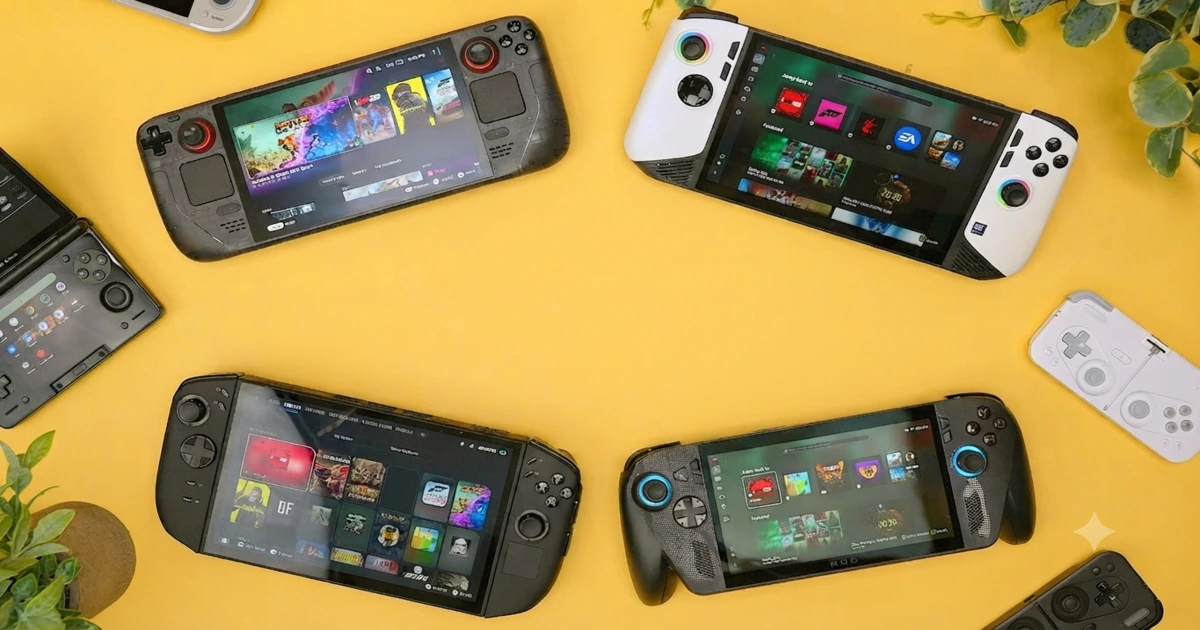
Valve’s Steam Deck OLED, released in late 2023, has established itself as the definitive handheld PC gaming device. With prices ranging from €419 (256GB) to €679 (1TB), it occupies a competitive position against dedicated consoles while offering fundamentally different capabilities.
The Steam Deck runs a Linux-based operating system (SteamOS) optimized for handheld play, with compatibility for the vast majority of titles in the Steam library—thousands of games spanning decades of PC gaming history. The OLED display delivers vibrant colors and deep blacks superior to LCD-based competitors, while the device’s ergonomic design enables comfortable extended play sessions.
For European PC gamers with existing Steam libraries, the Deck represents exceptional value—access to purchased content without additional software costs. For console gamers, it offers entry into PC gaming’s extensive catalog of strategy titles, simulation games, and indie productions unavailable on PlayStation or Xbox.
ASUS ROG Ally: Windows Handheld Power
The ROG Ally and its successor, the ROG Ally X, run full Windows 11, enabling compatibility with any PC application—game launchers, productivity software, emulators, and streaming services. This flexibility comes at the cost of battery life and interface optimization; Windows is not designed for handheld gaming, resulting in occasional usability frustrations.
The Ally’s superior raw performance compared to Steam Deck appeals to enthusiasts seeking maximum graphical fidelity in portable form. However, the Windows ecosystem’s power inefficiency limits practical battery life to 2-3 hours for demanding titles, versus 4-6 hours for the Steam Deck OLED.
The Handheld Market’s European Growth
Handheld consoles represent the fastest-growing segment of the European gaming console market, with hybrid devices projected to achieve an 11.2% compound annual growth rate through 2034. This growth reflects changing lifestyle patterns—commuter gaming, travel entertainment, and flexible play environments—that stationary consoles cannot address.
For European consumers debating between a dedicated handheld and a hybrid console like the Switch 2, the decision hinges on content preferences. Nintendo’s exclusive franchises and family-oriented software appeal to broad demographics, while Steam Deck and ROG Ally cater to PC gaming enthusiasts seeking portable access to their existing libraries.
III. The European Market Landscape: Regional Variations
Market Structure and Leading Territories
The European gaming console market, valued at approximately €8.42 billion in 2025, exhibits significant regional variation in preferences, pricing, and growth dynamics.
United Kingdom (19.8% market share)
The UK’s mature gaming ecosystem, strong esports presence, and high adoption of premium consoles make it Europe’s largest individual market. British consumers demonstrate particular affinity for PlayStation, with the brand holding dominant market share. The UK’s distinct regulatory environment—evidenced by the Competition and Markets Authority’s (CMA) intervention in Microsoft’s Activision Blizzard acquisition—creates unique market conditions affecting platform competition.
Germany (15.4% market share)
Germany’s large gaming community, substantial purchasing power, and preference for high-end hardware establish it as the second-largest European market. German consumers show strong adoption of both PlayStation and PC gaming, with a notable esports culture centered in cities like Berlin and Cologne. Regulatory restrictions on game content (the USK rating system) occasionally affect release timelines and content availability.
France
France’s vibrant youth population, government-supported digital culture initiatives, and rising digital content consumption drive steady market growth. French consumers demonstrate balanced platform preferences, with particular strength in Nintendo’s family-oriented offerings.
Eastern Europe (Poland, Czech Republic)
Emerging as significant growth contributors, Eastern European markets are characterized by high-speed internet adoption, esports popularity, and preference for affordable mid-tier consoles. The Xbox Series S has historically performed relatively well in these price-sensitive markets, though recent price increases may alter this dynamic.
Retail and Distribution Evolution
European console distribution has shifted decisively toward online channels, though physical retail retains importance for gift purchases, impulse buys, and collector editions. Major retailers including MediaMarkt (Germany, Netherlands, Spain), FNAC (France), Game (UK), and Amazon’s European operations dominate hardware sales.
Digital game sales now represent the majority of software revenue across all platforms, with subscription services (PlayStation Plus, Xbox Game Pass, Nintendo Switch Online) capturing increasing consumer spending. This shift reduces the importance of physical retail for software distribution while increasing platform holder control over pricing and availability.
IV. Decision Framework: Choosing Your Console
The Budget-Conscious Gamer (Under €400)
For consumers with strict budget constraints, the options have narrowed uncomfortably. The Xbox Series S at €400 (increasing to €500) remains the only current-generation console under €400, though its 1440p resolution limitation and 512GB storage (quickly exhausted by modern game sizes) represent significant compromises.
Alternatively, the Nintendo Switch Lite at €230 offers genuine current-generation gaming with an extensive software library, albeit without television output capability. For portable-only gaming, this represents exceptional value.
The used market provides additional options—original PS5 and Xbox Series X units, now superseded by Slim and revised models, trade at significant discounts. However, warranty considerations and hardware wear necessitate careful evaluation.
The All-Around Gamer (€400-€700)
This bracket encompasses the core European console market. The PlayStation 5 Slim (€650 disc / €600 digital) offers the best balance of performance, exclusive content, and future-proofing. For consumers with 4K televisions seeking premium gaming experiences, this is the default recommendation.
The Nintendo Switch 2 at €450 (€500 from September) offers a different value proposition—versatility over raw power, exclusive Nintendo franchises over multiplatform blockbusters. For families, portable gaming enthusiasts, or those seeking complementarity to an existing PC or PlayStation, the Switch 2 is compelling.
The Enthusiast (€700+)
The PlayStation 5 Pro at €900 represents the pinnacle of console gaming performance, with enhanced ray tracing, AI upscaling, and expanded storage. For consumers with 4K or 8K displays who prioritize visual fidelity and own extensive PlayStation libraries, the Pro justifies its premium.
The Xbox Series X at €800 (post-August pricing) offers technical parity with the standard PS5 but lacks the Pro’s enhancements. Its value proposition rests entirely on Game Pass subscription integration; without Game Pass, the Series X struggles to justify its price against PlayStation competition.
The PC Gamer Seeking Portability
For existing PC gamers with Steam libraries, the Steam Deck OLED (€419-€679) provides unparalleled access to purchased content in portable form. The ROG Ally offers greater performance flexibility at the cost of battery life and Windows interface compromises.
These devices do not replace home consoles for exclusive content but complement PC gaming setups with portable capability.
V. The Subscription Factor: Total Cost of Ownership
Hardware pricing, while attention-grabbing, represents only a portion of total gaming expenditure. Subscription services fundamentally alter cost calculations:
| Service | Monthly Cost (Europe) | Annual Cost | Key Value Proposition |
|---|---|---|---|
| PlayStation Plus Essential | €8 | €96 | Online multiplayer, monthly games |
| PlayStation Plus Extra | €14 | €168 | 400+ game catalog |
| PlayStation Plus Premium | €17 | €204 | Classic games, streaming, trials |
| Xbox Game Pass Ultimate | ~€15 | ~€180 | Day-one first-party, EA Play, cloud |
| Nintendo Switch Online | €4 | €20 | Online play, NES/SNES classics |
| Nintendo Switch Online + Expansion | €8 | €80 | N64, Game Boy, DLC included |
For consumers purchasing 4-6 new games annually at €70 each (€280-420), subscription services offer substantial savings. Xbox Game Pass Ultimate’s day-one first-party access is particularly compelling for consumers who would otherwise purchase Microsoft-published titles at full price.
However, subscription dependency creates platform lock-in. A consumer invested in PlayStation Plus Extra’s game catalog faces significant switching costs when considering Xbox migration. This dynamic reinforces platform loyalty and reduces competitive pressure on hardware pricing.
VI. Future Outlook: What to Expect
The 2026-2027 Horizon
Several developments will reshape the European console market in the coming 18 months:
Nintendo Switch 2 Price Increase (September 2026)
The announced €50 increase to €500 will test consumer price sensitivity. Nintendo’s historically resilient demand suggests limited sales impact, but the increase positions the Switch 2 closer to PlayStation 5 Slim pricing, potentially narrowing its perceived value advantage.
Xbox Price Increases (August 2026)
Microsoft’s Series S and X price hikes will further marginalize Xbox hardware competitiveness in Europe. The company’s strategic emphasis on content and services revenue suggests these increases are sustainable from a business perspective, but they risk accelerating the platform’s market share decline in price-sensitive European territories.
PlayStation 5 Pro Adoption
As the Pro establishes itself in the market, Sony will likely introduce bundle promotions and limited-edition variants to maintain momentum. The standard PS5 Slim may see selective price reductions to clear inventory, creating opportunities for budget-conscious consumers.
Handheld PC Evolution
Valve’s Steam Deck successor, anticipated in 2027, will likely address current limitations—battery life, performance, and storage—while maintaining competitive pricing. ASUS and other manufacturers will continue refining Windows handhelds, potentially achieving the battery efficiency that current devices lack.
Cloud Gaming and Streaming
Microsoft’s xCloud and Sony’s PlayStation Now streaming capabilities will mature, potentially reducing hardware dependency for casual gamers. However, European broadband infrastructure variation—excellent in Nordic countries and urban centers, less reliable in rural Southern and Eastern Europe—limits streaming viability for significant market segments.
Conclusion: Making the Right Choice
The European gaming console market in 2026 demands that consumers make difficult trade-offs between budget, performance, content access, and flexibility. There is no universally “best” console—only the best console for specific needs and circumstances.
Choose PlayStation 5 Slim if: You prioritize exclusive content, seek the best balance of performance and price, value the DualSense controller’s innovations, and want access to the largest current-generation game library.
Choose PlayStation 5 Pro if: You own a 4K/8K display, demand maximum visual fidelity, have the budget for premium hardware, and are already invested in the PlayStation ecosystem.
Choose Xbox Series X|S if: You value Game Pass subscription access to day-one releases, play across PC and console, and prioritize software value over exclusive content. Consider carefully whether impending price increases alter this calculation.
Choose Nintendo Switch 2 if: You prioritize portable gaming, value Nintendo’s exclusive franchises, seek family-friendly content, or want a versatile secondary console complementing a primary PlayStation or PC setup.
Choose Steam Deck OLED if: You are an existing PC gamer with a substantial Steam library, want portable access to PC-exclusive genres (strategy, simulation, indie), and value open-platform flexibility over exclusive content.
The console wars are not won through hardware specifications alone, but through ecosystems, content, and value propositions that resonate with individual consumers. In an era of escalating prices, making an informed choice has never been more important—or more financially consequential.