
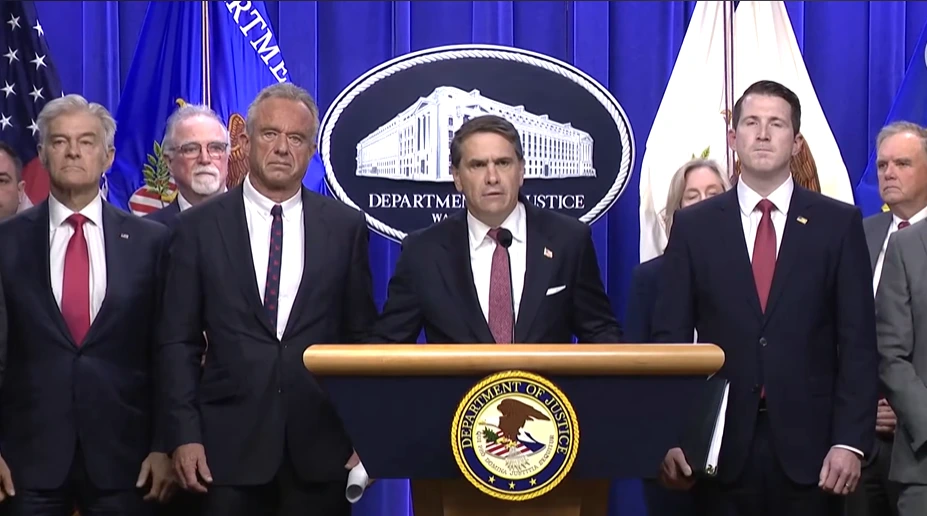
The Justice Department has charged 455 people, including 90 medical professionals, in a $6.5 billion healthcare fraud takedown spanning 45 states. Seized assets include Ferraris, a Rolls-Royce, an $865,000 necklace and a Philippine beach resort.
A nurse practitioner who billed Medicare more than a million dollars per patient for skin grafts. A cardiovascular testing scheme that scanned a teenager’s heart for eleven seconds, missed a fatal abnormality, and collected government money for the failure. A hospice owner who bought the identities of dead Medicare beneficiaries and billed the government for treating them. And scattered throughout the indictments, the unmistakable trail of fraud proceeds: Ferraris, a Rolls-Royce Phantom, an $865,000 custom Bulgari necklace, and a $4.6 million beach resort under construction in the Philippines.
The Justice Department on Tuesday unveiled the 2026 National Health Care Fraud Takedown, one of the largest coordinated healthcare fraud enforcement operations in American history, charging 455 defendants across nearly every state in the country with schemes that allegedly syphoned more than $6.5 billion from American taxpayers through Medicare, Medicaid, and other federal health programmes.
The Scale of the Takedown
The Justice Department’s 2026 National Health Care Fraud Takedown resulted in charges against 455 defendants, including 90 doctors and other licensed medical professionals, for their alleged participation in health care fraud and opioid abuse schemes involving over $6.5 billion in false claims and significant patient harm, including death. The Department described the operation as representing a new era in federal, state, and international cooperation to combat health care fraud, with cases spanning 56 federal districts and 45 U.S. states and territories, and 50 state Medicaid Fraud Control Units participating, the most in Department history.
Acting Attorney General Todd Blanche told reporters at a news conference that the Department had charged a record 455 people with defrauding the government through various billing schemes over the preceding two weeks. “This announcement marks the greatest combined federal and state effort in combating healthcare fraud in history,” Blanche said. “Thanks to the leadership of President Trump and the vice president, and all those folks standing behind me and next to me, we are more united than ever.”
Blanche struck a warning tone aimed squarely at would-be fraudsters. “This is just the beginning. Fraudsters can no longer rip off American taxpayers,” he said.
The Ferraris, the Necklace, and the Beach Resort
The case that has captured the most public attention, and given the takedown its most viral details, involves a nurse practitioner in the Southern District of Texas.
In the Southern District of Texas, a nurse practitioner was charged for a $906 million scheme in which she applied medically unnecessary allografts and billed Medicare more than $1 million per patient on average. As alleged, the defendant used the fraud proceeds to purchase high-end vehicles, real estate, and luxury jewellery and to fund the construction of a $4.6 million beach resort in the Philippines.
The government said the defendant used the fraud proceeds to purchase a nearly $600,000 Ferrari, an $865,000 Bulgari necklace, and a multimillion-dollar home in Hawaii, in addition to funding the Philippine beach resort. In total, the government seized over $30 million in bank accounts, a $594,000 Ferrari 296 GTS, seven other high-end vehicles, the $865,000 custom Bulgari necklace, and $1 million worth of other luxury jewellery.
Dr. Mehmet Oz, the administrator of the Centers for Medicare and Medicaid Services, did not mince words describing the scheme. “She was using human beings, American citizens, as living piggy banks,” he said, explaining that she then used the proceeds from those “living piggy banks” to purchase the $865,000 necklace that the department subsequently seized, along with the nearly $500,000 Ferrari.
Officials also disclosed the seizure of a Rolls-Royce Phantom in connection with other schemes uncovered during the operation, underscoring just how frequently luxury vehicle purchases have become a signature, almost predictable, feature of large-scale healthcare fraud prosecutions in recent years.
A Pattern That Keeps Repeating
The Texas case is striking, but it is far from an isolated example of fraud proceeds being funnelled into exotic cars. Healthcare fraud cases involving Ferraris purchased with stolen Medicare and Medicaid funds have become a recurring feature of Justice Department enforcement actions, appearing again and again across entirely separate cases and jurisdictions.
In a separate case out of the District of Massachusetts, the owner of two durable medical equipment companies was charged in a nearly $30 million fraud scheme involving medically unnecessary orthotics such as back and knee braces. According to the charging documents, the defendant made substantial profits from the alleged fraud, which he used to purchase two Ferraris, a Mercedes-Benz S-Class, and at least three Rolex watches, with the court issuing seizure warrants for all of the luxury goods. FBI Special Agent in Charge Jodi Cohen remarked at the time that the defendant “apparently thought he had hit upon a surefire moneymaker,” warning that “health care fraud isn’t some quick and easy way to bulk up your bank account. It’s a costly, consequential federal crime that strains the system and cheats the taxpayers who fund it.”
In a related Arizona wound care case from earlier in 2026, defendants Tyler Kontos, Joel “Max” Kupetz, and Jorge Kinds were charged in a $1 billion wound care fraud scheme, allegedly laundering their fraud proceeds through luxury purchases and cryptocurrency, with prosecutors seizing over $7.2 million in assets to date.
The Predatory Heart Scan Scheme
Beyond the headline-grabbing luxury seizures, some of the most disturbing allegations in this year’s takedown involve a fraudulent cardiovascular testing operation that prosecutors say put real patients, including children, directly in harm’s way.
One of the companies charged in the fraud sting billed the government $90 million for providing heart scans. The cardiovascular testing company hired doctors to scan echocardiograms marketed to parents of student athletes.
The human cost of the scheme, according to officials, was lethal. Dr. Oz described one case in which a teenage athlete’s EKG was scanned for only 11 seconds and failed to identify a significantly enlarged heart. “The October EKG was read as normal. The kid was dead a month later. This was not a diagnostic company. It’s a predatory scheme dressed up in medical clothing, and we’re going to treat it as such,” he said.
That case illustrates a theme officials returned to repeatedly throughout Tuesday’s announcement: that healthcare fraud is not a victimless financial crime but one that frequently endangers, and in some cases kills, the very patients these programs exist to protect.
Hospices, Dead Patients, and Stolen Identities
Other cases unveiled in the takedown reveal a darker and more macabre category of fraud: billing the government for treating patients who were no longer alive.
Tuesday’s indictment includes a hospice owner in Los Angeles who paid illegal kickbacks for the identities of dead Medicare beneficiaries, whom he then billed as patients. The crackdown connected to this case has led to the closure of 800 hospice facilities in the Los Angeles area alone. Officials said the fraudsters more broadly billed for services provided to dead people and ran what was described as a macabre skin grafting therapy that victimised elderly nursing home patients.
Much of the illegal activity stems from fraudulent Medicaid payments associated with hospice care and other services that target the elderly and medically vulnerable, a pattern that officials say has become one of the most exploited weaknesses in the federal healthcare payment system.
CMS Touts a “Fraud War Room”
Beyond the criminal charges themselves, officials spent much of Tuesday’s announcement detailing how the Centers for Medicare and Medicaid Services have overhauled their internal systems to catch fraudulent billing before payments ever leave government accounts.
CMS Administrator Mehmet Oz said his department set up a “fraud war room,” which led to the agency revoking Medicare billing privileges for 1,400 fraudulent providers and suspending payments for services deemed illegitimate. Oz said that in the first quarter of 2025 the United States revoked 1,006 fraudulent providers’ billing privileges, while during the same period in 2026 that figure rose to 1,400 revocations, a 40 percent increase. He added that in the first half of 2026 the U.S. made 1,000 Medicaid payment suspensions, with 800 of those occurring in California alone, which he described as a 500 percent increase compared with the same period the previous year.
“We are closing loopholes that fraudsters have avoided and been exploiting for years,” Oz said. “Those days are over. Fraudsters, your time is up.” Oz separately framed the philosophy behind the strategy: “Prosecuting criminals who steal from American patients is necessary, but stopping them before a single dollar leaves the building is smarter. CMS is done playing catch-up. We’re deploying advanced data analytics to expose fraud networks, freeze suspicious payments, and shut down bad actors before they can do damage to the programmes that millions of Americans depend on.”
The Allograft Problem
One specific and previously obscure corner of Medicare billing, wound allografts, emerged as a major driver of fraud losses in this year’s takedown and forced a significant policy change at CMS.
The Health Care Fraud Unit’s Data Analytics Team detected a spike in payments for allografts, leading directly to several of this year’s prosecutions. In response, CMS separately realigned its payment structure, reducing Medicare’s payment to $127 per square centimetre starting on January 1, 2026. Officials noted that if CMS had not taken action to address the unprecedented spending on allografts, the resulting Part B premium increase would have cost every Medicare beneficiary in the country an extra $11 a month.
That detail is a useful illustration of how healthcare fraud, even when it does not directly harm an individual patient, ultimately drains resources from the broader system and indirectly raises costs for every honest beneficiary enrolled in the programme.
The Full Tally of Enforcement Actions
Beyond the 455 criminal defendants, Tuesday’s announcement detailed a sweeping set of parallel administrative and civil enforcement actions. These included actions by CMS to suspend 1,079 providers and revoke billing privileges for 1,403 providers, 48 Civil Monetary Payment settlements amounting to over $73 million, more than 1,400 provider exclusions, and 25 actions by the HHS Office of Inspector General under the Civil Monetary Penalties Law seeking more than $10 billion in payments to the Medicare Trust Fund from claims that CMS caught and suspended before any funds were paid out.
The Department also announced civil charges against 13 defendants for $14.8 million in healthcare fraud schemes, civil settlements with 31 defendants totalling $23 million, and 928 administrative actions by the Drug Enforcement Administration seeking to revoke authority to handle or prescribe controlled substances since October 1, 2025.
A Political Dimension to the Crackdown
The administration was careful to push back on the suggestion that this year’s enforcement effort had been politically targeted. Some Democrats have labelled the Trump administration’s war on fraud as a war on blue states, but officials pointed out Tuesday that 18 of the states that participated in the latest fraud crackdown have Democratic governors.
The crackdown is described by the administration as a centrepiece of its “full-scale war on fraud”, announced earlier this year, which spans all government agencies and is headed by Vice President JD Vance. FBI Director Kash Patel also weighed in on the announcement, stating plainly that “fraud is no longer being tolerated”.
How This Year Compares to the Record-Setting 2025 Takedown
To fully appreciate the scale of this year’s operation, it helps to look back at last year’s takedown, which remains the largest in Justice Department history by dollar value.
The 2025 National Health Care Fraud Takedown resulted in 324 defendants charged in connection with over $14.6 billion in alleged fraud, more than doubling the prior record of $6 billion and standing as the largest Justice Department health care fraud takedown in history at the time. That operation included a $10.6 billion transnational Medicare fraud scheme and a $650 million Medicaid scam in Arizona and introduced a Health Care Fraud Data Fusion Center using artificial intelligence and cloud computing to enhance inter-agency collaboration.
In one of the most elaborate schemes from that takedown, an organisation used a network of foreign straw owners, including individuals sent into the United States from abroad and directed via encrypted messaging using assumed identities, to strategically buy dozens of medical supply companies across the country. They then rapidly submitted $10.6 billion in fraudulent claims to Medicare for urinary catheters and other durable medical equipment by exploiting the stolen identities of over one million Americans across all 50 states. Defendants in that case were apprehended as far away as Estonia, as well as at U.S. airports and the U.S.-Mexico border, and were found to have allegedly used artificial intelligence to generate fake audio recordings of Medicare beneficiaries purportedly consenting to receive products they had never requested.
While this year’s $6.5 billion figure is considerably smaller than the extraordinary $14.6 billion uncovered in 2025, officials this year framed the 455 defendants charged and the unprecedented level of state-federal coordination, with 50 state Medicaid Fraud Control Units involved, as evidence of a maturing and increasingly sophisticated enforcement apparatus, rather than as any indication that fraud itself is becoming less prevalent.
Why This Matters Beyond America’s Borders
For readers in Europe, the scale and audacity of these schemes offer a striking case study in the vulnerabilities of large, decentralised, claims-based public health insurance systems, an issue not entirely foreign to European national health systems and social insurance schemes, which similarly process enormous volumes of claims and have, in various countries, faced their own high-profile fraud scandals in recent years.
The methods on display here – shell companies, stolen patient identities, AI-generated fake consent recordings, and offshore laundering through cryptocurrency – are increasingly global techniques rather than uniquely American ones, and European regulators and health insurers are watching this enforcement trend closely as a preview of challenges that increasingly sophisticated fraud networks may bring to their own systems.
For American taxpayers and Medicare beneficiaries, the message from officials on Tuesday was unambiguous. As Blanche put it: “We’re taking back the money, the luxury cars, and the jewellery, and these alleged fraudsters will face justice.”








[…] DOJ Charges 455 in $6.5 Billion Medicare Fraud Takedown: Ferraris, Necklaces and Fake Heart Scans […]