

Jungle Salimpur: A Criminology Case Study on State Failure, Territorial Crime, and the Rise of Parallel Governance in Bangladesh
Deep in the hilly terrain of Sitakunda, on the outskirts of Chattogram, Bangladesh‘s second-largest city, lies a 3,100-acre territory that has become one of South Asia’s most instructive case studies in criminology. Jungle Salimpur, also known as Jangal Salimpur, is not merely a crime hotspot. It is a self-contained polity where armed criminal networks have established what scholars of state failure would recognise as a “parallel system of authority”, one that has successfully resisted the Bangladeshi state for over two decades.
The events of January 19, 2026 when Rapid Action Battalion (RAB) officer Motaleb Hossain Bhuiyan was killed and three colleagues taken hostage during an arms recovery operation, and the subsequent March 9, 2026 massive joint force operation involving 3,183 personnel, 15 armoured personnel carriers, three helicopters, and 12 drones have thrust this enclave into national and international focus.
This case study examines Jungle Salimpur through multiple criminological lenses: state failure theory, organised crime territorial control, environmental criminology, and the political-criminal nexus. It asks a question fundamental to criminology in the Global South: how does a territory within a functioning democracy become a “state within a state”, and what does its persistence reveal about the fragility of formal governance?
The Anatomy of a Criminal Enclave: Geography and Demographics
Jungle Salimpur sprawls across approximately 12.55 square kilometres of government-owned khas land—hill tracts and forest reserves legally belonging to the state. Its population is estimated at 150,000, yielding a population density of roughly 11,957 per square kilometre, extraordinarily high for a hilly, forested area.
The territory sits at a jurisdictional crossroads: bordered by Sitakunda upazila to the north, Chattogram City Corporation to the south, Hathazari upazila to the east, and the Bay of Bengal’s Sandwip Channel to the west. This geographical positioning is not accidental; it creates an administrative grey zone where urban police, district administration, and upazila authorities share fragmented responsibility—and where criminals can slip between jurisdictions in 10–20 minutes via hill paths.
The terrain itself constitutes what environmental criminologists call a “crime generator”. Rugged hills provide natural fortifications. Dense vegetation conceals movement. Narrow access points allow surveillance and ambush. The area’s remoteness. roughly 35 kilometres from Sitakunda town proper, combined with poor road infrastructure and fragile telecommunications networks, hinders swift administrative action. As one assistant commissioner noted, “The occupiers have informants from the very entrance.”
The economic stakes are staggering. At current market rates, encroached government lands are valued at BDT 80–100 billion (approximately $2.3–2.6 billion USD). Individual plots now sell for BDT 900,000–1,000,000 per shotok (roughly 40.47 square metres). This vast economic stake transforms hill-cutting and land-grabbing from petty crime into organised enterprise, creating what economist Hernando de Soto might recognise as an extralegal property market, one that operates entirely outside formal land administration.
Theoretical Framework I: State Failure and the Monopoly of Violence

The Brookings Institution’s framework for state failure identifies several indicators directly observable in Jungle Salimpur. First, the state’s inability to establish security nationwide becomes obvious when “rebel groups and other contenders threaten residents… and overwhelm demoralised government contingents”. In Salimpur, criminal factions led by Mohammad Yasin, Rokon Uddin (also known as Rokon Member), and Ridwan have carved out defined territorial zones with their own hideouts, weapons depots, and surveillance networks.
Second, the growth of criminal violence as state authority weakens. The Business Standard reports that “criminal gangs take over the streets… arms and drug trafficking become more common… ordinary police forces become paralysed”. In Salimpur, this has manifested through a weapons factory uncovered in August 2025 , arms trafficking networks with supply lines extending far beyond the enclave, and the stockpiling of 7.62mm, 9mm, and .22-bore ammunition typically used near the Myanmar border.
Third, citizens are turning to non-state actors for protection. A former Sitakunda police inspector told The Business Standard, “Jungle Salimpur is a different state where they have their own law. Disputes get settled internally, police intervention is discouraged, and some crimes never even get reported.”
This represents what criminologist Charles Tilly would identify as the emergence of a “protection racket”, where armed groups provide governance functions (dispute resolution, internal security, and medical care for injured members) in exchange for loyalty and economic extraction.
The Bangladeshi state’s monopoly on violence has been physically contested. Since 2019, Department of Environment officers, district administrators, police, RAB personnel, executive magistrates, and journalists have all been attacked during operations.
On September 14, 2023, over 100 law enforcement personnel and a dozen magistrates were repelled by women armed with crude weapons.
The January 19, 2026 attack, where 400–500 miscreants ambushed a RAB team, killing one officer and abducting three others, represents not merely criminal resistance but an act of insurgency against state authority.
Theoretical Framework II: Organised Crime and Territorial Control
Jungle Salimpur exemplifies what criminologists call “territorial organised crime”—where criminal groups establish physical control over geographic space and extract resources from it. The OC Index on Bangladesh identifies “mafia-style groups known as mastan” that are “deeply embedded in the political and social infrastructure… having authority over large areas and controlling public services and employment opportunities”.
The Salimpur criminal structure demonstrates classic features of organised crime territoriality:
Hierarchical factionalism: The original criminal entrepreneur, Ali Akkas, began hill-cutting in the 1990s and formed an armed group to protect his turf. After his death in a reported RAB gunfight, his associates—Kazi Mashiur Rahman, Yasin Mia, Gafur Member, and Gazi Sadek—split into separate factions that now control distinct zones. Yasin’s faction dominates Alinagar; Kazi Mashiur’s group controls the Salimpur section. This fragmentation into competing yet coordinated factions mirrors the organisational structure of Italian ‘Ndrangheta or Mexican cartels.
Economic diversification: Beneath a modest informal economy lies a complex criminal enterprise. Revenue streams include illegal land sales on non-judicial stamps; hill-cutting and soil trading; extortion through tolls and protection fees; illegal electricity and water connections; arms trafficking; and narcotics distribution. The groups maintain an underground cash economy that bypasses formal banking entirely.
Social control mechanisms: Armed guards man every entry point. Residents carry identity cards. Outsiders are stopped, verified, and often refused entry without escort . CCTV cameras blanket the hills, providing surveillance over a kilometre away. The “Chhinnamul Samabay Samity” (Displaced Cooperative Society) serves as a front organisation that collects regular fees under the pretext of providing electricity, water, education, and healthcare .
Internal governance: Medical care is internalised, with injured members treated discreetly within the territory. Disputes are settled internally. The January 2026 video of Yasin warning of “major public outbursts” should authorities intervene demonstrates what criminologists term “performance crime”, public displays of power designed to deter state action.
Theoretical Framework III: The Political-Criminal Nexus
Perhaps the most troubling criminological dimension of Jungle Salimpur is the documented collusion between criminal networks and political actors. The OC Index notes that in Bangladesh, “political actors collude with criminal actors… some gangs are under the patronage of the two rival parties, the Awami League and the Bangladesh National Party”.
The Salimpur case reveals this nexus with disturbing clarity. During the previous Awami League government, Yasin was a follower of Sitakunda MP and Awami League leader SM Al Mamun . Following the August 5, 2024 political changeover, Yasin publicly claimed allegiance to BNP leader Aslam Chowdhury. Former BNP joint convener and current Home Minister Kazi Salah Uddin acknowledged that “the gangs in Jungle Salimpur try to take shelter of the party whoever comes to power”.
This “political sheltering” transforms criminal groups from purely economic actors into political instruments. The January 19, 2026 attack on RAB occurred in front of a local BNP office, with hostages held inside . Whether this represents operational coordination or merely spatial coincidence remains unclear, but it illustrates how criminal territories become entangled with partisan politics.
The OC Index further notes that criminal actors “influence democratic processes through state corruption” . In Salimpur, this manifests through forged land papers, bypassed government policies, and independent land documentation and transfer activities . The criminal networks have effectively privatised state functions, land administration, dispute resolution, taxation (through protection fees), and security while maintaining political connections that shield them from accountability.
Theoretical Framework IV: Routine Activity Theory and Crime Opportunity
Cohen and Felson’s Routine Activity Theory posits that crime occurs when a motivated offender, suitable target, and absence of capable guardianship converge in time and space. Jungle Salimpur represents a near-perfect storm of these conditions.
Motivated offenders: Displacement from coastal erosion (particularly from Sandwip upazila) created a population of landless, economically desperate individuals vulnerable to criminal recruitment . Poverty and lack of employment opportunity, exacerbated by the COVID-19 pandemic, allow criminal gangs to flourish by recruiting young children.
Suitable targets: Government khas land, unoccupied, unguarded, and legally ambiguous provided ideal targets for occupation. The completion of the Bayezid-Faujdarhat Link Road dramatically increased land values, transforming cheap squatter settlements into lucrative real estate.
Absence of capable guardianship: The state’s guardianship failed at multiple levels. Police cannot enter without military support. District administration operations are telegraphed in advance through intelligence leaks. Executive magistrates lack sufficient force protection. Environmental department officials were attacked in 2019; district administrators were obstructed in 2022; over 20 officials were injured in 2023 .
The 2022 inquiry committee minutes reveal systemic guardianship failure. Despite 11 recommendations from the environment department—including eviction drives, cutting utility services, amending land classifications, creating hill databases, and filing prompt cases—”Chattogram’s administration has largely failed to implement these recommendations in the years since.”
A Prime Minister’s Office meeting in early 2022 approved directives including land reclamation within 15 days, formation of a task force, and establishment of a hill management office with barracks. These measures “have still not been implemented”.
The March 2026 Operation: Tactical Success, Strategic Uncertainty

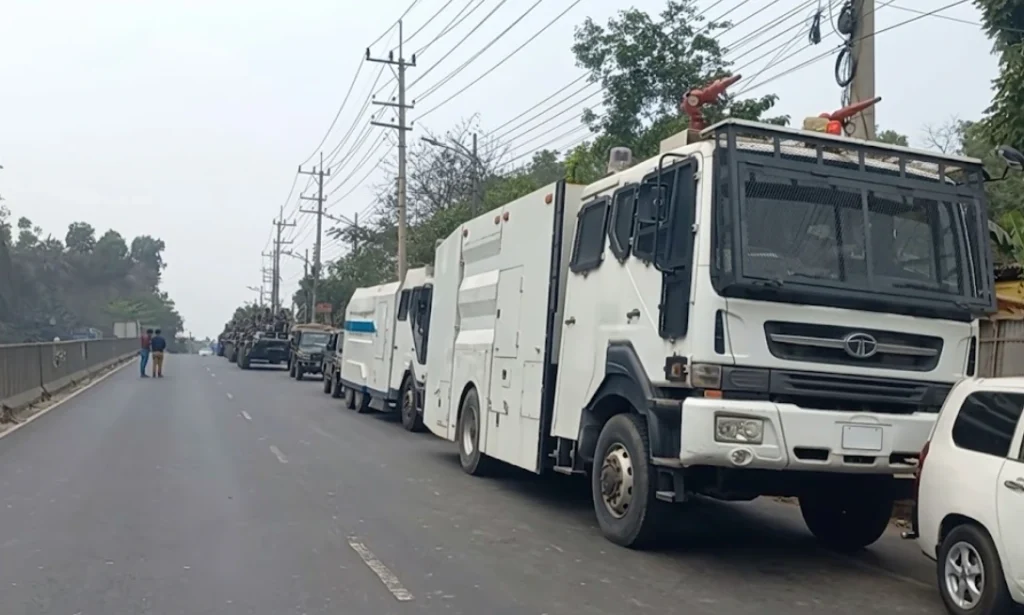
On March 9, 2026, Bangladesh’s largest coordinated security operation in recent memory targeted Jungle Salimpur. The scale was unprecedented: 3,183 personnel from the Army, district police, Chattogram Metropolitan Police, Range Reserve Force, Feni district police, hill district contingents, APBn, BGB, and RAB, supported by seven executive magistrates, three helicopters, 15 APCs, three dog squads, and 12 drones.
The operation recovered three pistols, 27 pipe guns, 30 pistol magazines, 61 cartridges, 1,113 rounds of bullets, 11 cocktails, arms-making materials, and pipe gun manufacturing machines . Twelve to twenty-two individuals were arrested . Two temporary police camps were established at Chhinnamul and Alinagar. The Chattogram Range DIG declared that “law enforcement agencies had established control in the area”.
Yet criminological scepticism is warranted. Previous operations, 2019; 2022 (multiple); 2023; and August 2025 all temporarily disrupted criminal activity without achieving lasting control. The March 2026 raid’s tactical sophistication (aerial surveillance, armoured vehicles, canine units) may not translate into strategic victory if the underlying conditions remain unaddressed.
As one expert quoted by The Business Standard observed: “This cannot be achieved by the district administration alone. A coordinated joint operation involving multiple agencies and ministries will be required.” The DIG’s own assessment that “setting up a police station or outpost is not our priority; our goal is to bring the entire area under administrative control” acknowledges that physical presence alone is insufficient.
Comparative Context: Salimpur in Global Criminology
Jungle Salimpur invites comparison with other territories where criminal governance has supplanted state authority. The favelas of Rio de Janeiro, where drug trafficking factions maintain territorial control and provide alternative governance, share Salimpur’s features of armed territoriality, political collusion, and resistance to state penetration. The “no-go zones” of European cities, often exaggerated in political discourse, nonetheless represent milder forms of the same phenomenon, areas where state services are weak and informal authority structures emerge.
What distinguishes Salimpur is its explicit rejection of state legitimacy. When Yasin demanded that arrest operations disclose names and addresses in advance, he was not merely negotiating operational constraints; he was asserting sovereign authority over criminal procedure. When he warned that “if anyone causes trouble by stepping into these crime traps, it will lead to a major public outburst”, he invoked the language of popular legitimacy that states themselves employ .
This represents what political scientist Robert Jackson termed “quasi-statehood”—entities that possess populations and territories but lack the institutional capacity and international recognition of full states. Salimpur’s criminal networks have achieved quasi-state functions without quasi-state status.
Policy Implications and Criminological Recommendations
From a criminological perspective, addressing Jungle Salimpur requires moving beyond the “enforcement swamping” approach, overwhelming force applied periodically, to sustained “guardianship thickening” that addresses all three vertices of the crime triangle simultaneously.
Reducing motivated offending: Economic development programmes targeting displaced coastal populations, legitimate employment creation, and youth diversion from gang recruitment. The OC Index notes that “poverty and a lack of employment opportunity… allow criminal gangs to flourish, in particular by recruiting young children.”
Reducing target suitability: Digital land registries, satellite monitoring of hill-cutting, and legal pathways for landless populations to access legitimate housing. The 2022 recommendation to “create a hill database and contour maps, cataloguing the scale of cutting and those responsible” remains unimplemented.
Increasing capable guardianship: Permanent state presence, not temporary camp, through integrated police-magistrate-administration outposts, improved road infrastructure, telecommunications coverage, and community policing that builds relationships with non-criminal residents.
Breaking the political-criminal nexus: Prosecuting patronage networks, investigating political party links to criminal groups, and establishing independent oversight of land administration. The OC Index’s finding that “criminal actors influence democratic processes through state corruption” suggests that political reform is a prerequisite to criminal justice success.
Conclusion: The Criminological Significance of Jungle Salimpur
Jungle Salimpur is not an aberration. It is an extreme manifestation of governance failures observable across the Global South—where rapid urbanisation, environmental displacement, weak land administration, and political corruption create spaces that criminal entrepreneurs can capture and hold. Its persistence for over two decades, despite repeated state intervention, demonstrates that criminal governance can achieve remarkable resilience when embedded in social, economic, and political structures.
The case study offers several contributions to criminological theory. It extends state failure frameworks from national to sub-national analysis, demonstrating that “failed” governance can exist within otherwise functioning states. It illustrates how environmental criminology—terrain, access, and surveillance—interacts with social and political factors to create durable criminal territories. It documents the operational mechanics of political-criminal collusion in a competitive party system. And it tests the limits of enforcement-led responses to entrenched criminal governance.
For Bangladesh, the March 2026 operation may represent a turning point—or merely another chapter in a long history of temporary state reassertion followed by criminal regrouping. The criminological question is not whether force can temporarily displace armed groups but whether governance can be sustained in a territory where, for two decades, the state has been absent, criminal networks have been present, and 150,000 people have learnt to live in a parallel system of authority.
Sources: New Age Bangladesh, BSS News, The Business Standard, Bonik Barta, Prothom Alo, Daily Sun, bdnews24, Brookings Institution, OC Index