UK Prime Minister Andy Burnham and EU leaders have sealed a landmark post-Brexit reset deal on food trade, carbon markets, and youth mobility. Discover how the 2026 Brussels summit reshapes UK-EU relations and what unresolved hurdles remain.
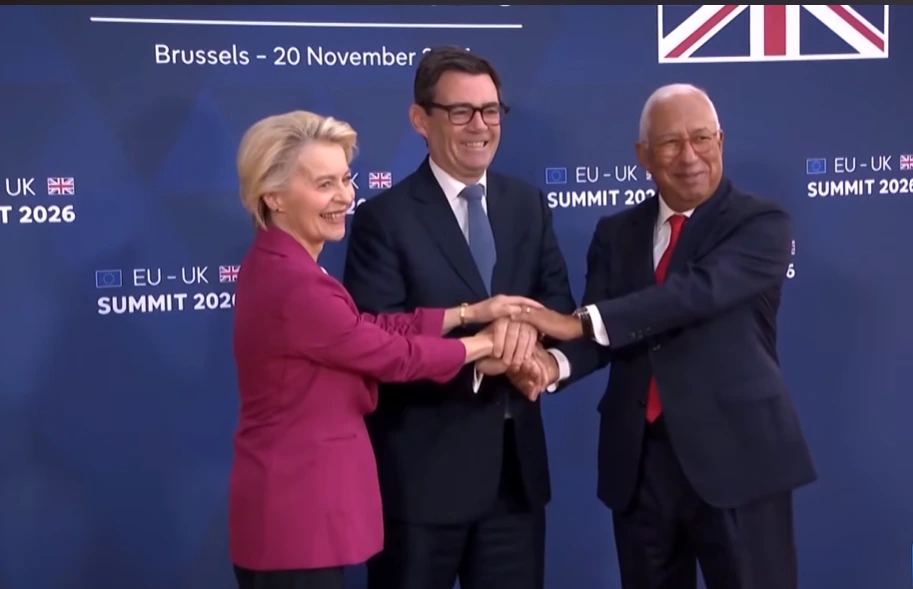
Ten years after the United Kingdom voted to leave the European Union, the diplomatic freeze between London and Brussels has officially begun to thaw. Following intense negotiations that culminated at a landmark summit in Brussels on November 20, 2026, UK Prime Minister Andy Burnham, European Commission President Ursula von der Leyen, and European Council President António Costa sealed a sweeping post-Brexit reset package.
Framed by Downing Street as a pragmatic effort to cut consumer costs and rebuild broken economic ties, the 12-page joint statement establishes concrete pathways for closer cooperation across three major policy pillars: agrifood trade, carbon markets, and youth mobility. While the British government has firmly ruled out rejoining the EU single market, customs union, or restoring uncapped freedom of movement, the agreement represents the most significant realignment in UK-EU relations since the original Trade and Cooperation Agreement took effect.
Pillar One: Dismantling Border Friction on Food and Drink
For nearly a decade, British exporters and European supermarkets have wrestled with costly veterinary checks, customs paperwork, and supply chain delays on agricultural goods. The centerpiece of the November 2026 summit is a comprehensive Sanitary and Phytosanitary (SPS) agreement designed to eliminate the vast majority of routine border controls on animal and plant products moving between Great Britain and the European Union.
Scheduled to take effect by March 1, 2028, following legal ratification, the deal offers immediate relief to producers of meat, dairy, seafood, and cut flowers.Crucially, it also removes the requirement for British food products to carry “Not for EU” warning labels, stripping away a major layer of internal trade friction between Great Britain and Northern Ireland.
In exchange for seamless market access, the United Kingdom has agreed to dynamic alignment with European Union food safety and plant health standards.While Britain will not hold voting rights in Brussels, northern European allies helped secure an observer mechanism allowing British officials into the room when future rules are drafted regarding emergencies of specific relevance to the UK, such as animal disease outbreaks.
Pillar Two: Shielding Industry Through Linked Carbon Markets
Beyond supermarket shelves, the summit delivered a major structural breakthrough for heavy industry and green energy. Both sides agreed to relink the United Kingdom and European Union Emissions Trading Schemes (ETS), with implementation targeted for 2028.
Without this linkage, British exporters of steel, aluminum, cement, and fertilizers faced steep financial penalties under the EU’s Carbon Border Adjustment Mechanism (CBAM), which entered full force earlier in 2026. According to official British government assessments published in the UK-EU Summit Package Factsheet, linking the carbon markets protects roughly £6.5 billion in British industrial exports from EU border carbon levies and could add up to £3.8 billion annually to the UK economy.
Looking ahead to 2027, London and Brussels also committed to negotiating Britain’s integration into the EU’s internal electricity market.Backed strongly by Germany, Belgium, the Netherlands, Denmark, and Luxembourg, this next phase aims to unlock cross-border clean energy trading and accelerate offshore wind development across the North Sea.
Pillar Three: A Capped Youth Experience Scheme
Perhaps the most emotionally resonant element of the Brussels summit is the creation of a reciprocal Youth Experience Scheme. Once operational by 2030 at the latest, the programme will allow up to 100,000 British citizens each year to live, work, study, and travel across the European Union for up to three years, with an identical quota granted to young Europeans heading to the United Kingdom.
Downing Street has stressed that the programme differs fundamentally from pre-Brexit freedom of movement because it is strictly capped, visa-controlled, and time-limited.Nonetheless, European Commission President Ursula von der Leyen—who studied in London during her youth—hailed the breakthrough as a vital step toward restoring cultural and educational exchange for a generation that came of age after the 2016 referendum.
The Unresolved Sticking Point: University Tuition Fees
Despite celebratory rhetoric in Brussels, the reset deal did not clear every diplomatic hurdle. The most contentious unresolved issue centres on university tuition fees. European negotiators pushed hard for young Europeans participating in the exchange scheme to pay domestic British tuition rates, currently capped at £9,790 per academic year, rather than international student fees, which can run four to five times higher.
Facing intense financial pressure across Britain’s higher education sector, the UK government resisted making that concession at the summit. As detailed in The Guardian’s breakdown of the UK-EU summit negotiations, European leaders issued an accompanying statement noting they would withhold final sign-off on the three core agreements until a satisfactory compromise on equal tuition treatment is reached within the next six months.
Political Fallout and the Road to 2028
Back in Westminster, the summit immediately reignited familiar ideological battles. While business groups, farmers, and universities largely welcomed the reduction in trade barriers, opposition figures attacked the dynamic alignment clauses. Reform UK leader Nigel Farage accused Prime Minister Burnham of allowing Brussels to strong-arm Britain into accepting European regulations without a formal vote.
Ultimately, the November 2026 Brussels summit reflects a mature, unsentimental realism on both sides of the English Channel. Confronted with global supply chain shocks, energy security challenges, and shifting geopolitical alliances, London and Brussels have concluded that managed regulatory alignment is vastly preferable to permanent economic friction. If negotiators successfully resolve the tuition fee dispute over the coming spring, the foundation laid in Brussels will define European trade and mobility well into the 2030s.
EU-UK Summit Explained: Burnham’s Brexit Reset, Youth Scheme, Carbon Deal and the Electricity Bill