
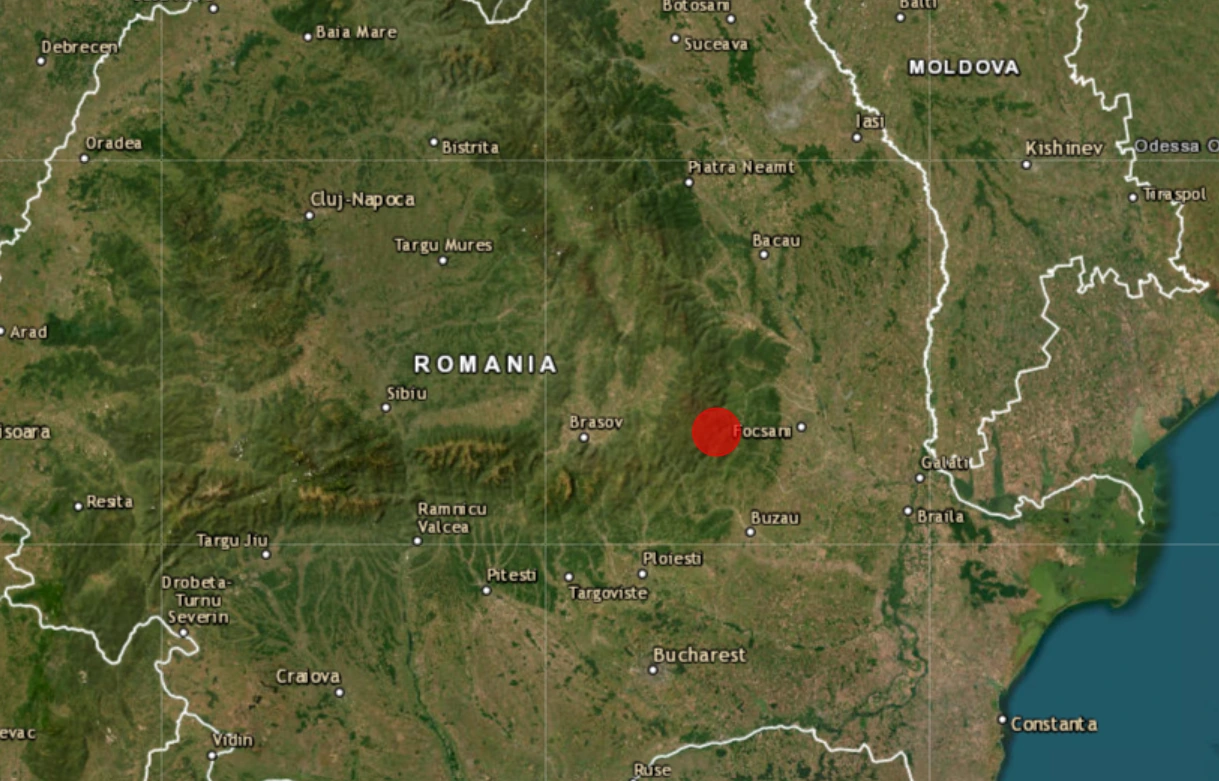
A strong 5.3-magnitude earthquake struck Romania’s Vrancea seismic zone early Wednesday, injuring two people and sending tremors into Moldova and Ukraine.
Two people were injured and thousands of residents across Eastern Europe were jolted awake early Wednesday morning after a significant earthquake struck Romania’s volatile Vrancea seismic zone.
The tremor, which international agencies including the U.S. Geological Survey (USGS) and the European-Mediterranean Seismological Centre (EMSC) measured at a magnitude of 5.3 (with Romania’s National Institute of Earth Physics initially registering a local magnitude of 5.7), hit at approximately 02:48 a.m. local time (00:48 UTC).
Deep-Focus Tremor Felt Across Borders
According to seismological telemetry, the earthquake’s epicenter was situated in the Eastern Carpathians, roughly 13 to 16 kilometers west of the commune of Nereju Mic in Vrancea County and approximately 65 kilometers northwest of the city of Buzău.
Crucially, the hypocenter was located at a depth of roughly 131 to 140 kilometres. Because deep-focus earthquakes in the Vrancea zone transmit seismic energy across vast distances with minimal attenuation, shaking was felt not only in Bucharest and across eastern Romania but also across international borders into Moldova and Ukraine, including in Odesa, Vinnytsia, Cherkasy, and as far north as Kyiv.
Two Injured by Falling Furniture, Widespread Panic Alerts
Romania’s Civil Protection Agency and Department for Emergency Situations (DSU) confirmed that two individuals sustained injuries inside their homes when heavy furniture toppled over during the shaking.
Emergency dispatchers also logged a surge in calls from residents experiencing acute panic attacks—a response amplified by automated early-warning alerts sent directly to Android smartphones seconds before the primary seismic waves arrived. Local emergency authorities clarified that the loud audio alarms originated from Google’s accelerometer-based alert system rather than the national state RO-ALERT network, which does not issue pre-tremor warnings.
Following widespread structural checks across Brăila, Buzău, Covasna, Galați, Iași, Neamț, Vrancea, and Vaslui counties, as well as the capital Bucharest, emergency inspectors confirmed that no significant material or structural damage had been recorded.
A Familiar Seismic Threat
The overnight event represents the strongest earthquake to rattle Romania since October 2018. The Vrancea seismic zone—located at the sharp bend of the Eastern Carpathians, is one of Europe’s most active deep-crustal seismic regions, notoriously responsible for the catastrophic 7.4-magnitude earthquake in March 1977 that claimed more than 1,500 lives and devastated parts of Bucharest.
While civil defense officials urged residents to remain calm and review household safety protocols in case of minor aftershocks, rail, energy, and municipal infrastructure across southeastern Romania continued operating normally by morning.