
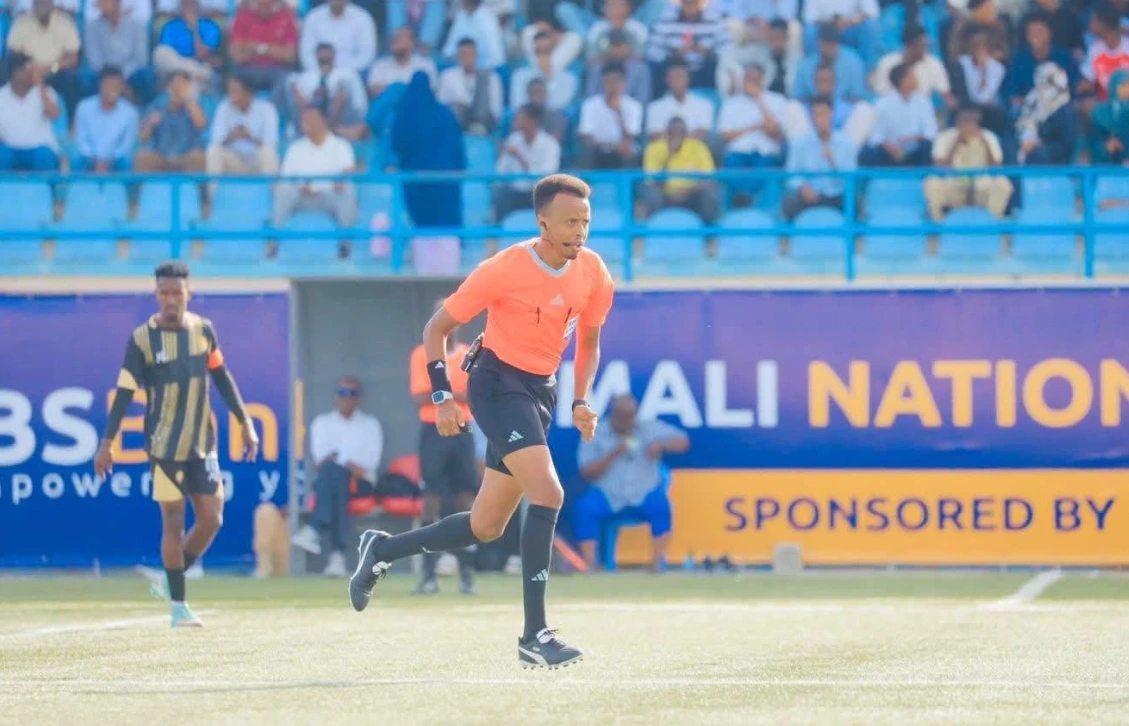
Somalia’s Omar Artan, barred from the FIFA World Cup 2026 after being denied entry at Miami Airport, has been appointed by UEFA to officiate the Super Cup between PSG and Aston Villa in Salzburg on August 12.
In one of the most remarkable stories to emerge from the opening week of the FIFA World Cup 2026, Somali referee Omar Artan has gone from being turned away at a Miami airport to being handed one of European football’s most prestigious officiating appointments.
UEFA confirmed on Thursday that Artan, 34, will referee the 2026 UEFA Super Cup between Champions League winners Paris Saint-Germain and Europa League winners Aston Villa in Salzburg, Austria on August 12, just days after he was stripped of his World Cup position following a visa denial that sent shockwaves through world football.
The Miami Airport Incident That Shocked the Football World
Artan was set to make history as the first Somali referee to officiate at a World Cup, but his dream debut ended at Miami airport, where he was denied entry into the country and flown back to Istanbul, despite having a valid US visa and all required documents.
Artan told the New York Times he was interviewed at Miami airport for 11 hours by border officials, who asked him why he had travelled to the United States and questioned him about Somali politics and the al-Shabab militant group that is fighting an insurgency against the Somali government. He presented his FIFA documentation, photographs from his decade-long career as a professional referee, and proof of his tournament appointment. None of it was enough.
US Customs and Border Protection said in a statement that he was “determined to be inadmissible due to vetting concerns and was denied entry.” After the 11-hour interrogation, he was placed in a holding cell and put on a plane back to Istanbul.
A US official later told reporters, speaking anonymously due to visa privacy laws, that Artan was refused admission due to “association with suspected members of terror organizations.” Andrew Giuliani, the executive director of the White House FIFA Task Force, defended the decision and said officials wanted to make sure the wrong people were not allowed into the country, but declined to offer further details.
Artan firmly rejected any such suggestion. In an interview, he said: “I had the right papers and everything. I had the right visa. I am just simply a referee who is trying to live his dream.” He added: “I think that they have a problem with my country.”
FIFA Washes Its Hands of the Situation
FIFA confirmed in a statement that Artan would be unable to officiate at the World Cup, saying the organisation is not involved in host country immigration processes. “In line with previous FIFA events, a host government ultimately determines who receives a visa and who is admitted into their country,” the statement read.
The response drew criticism given that FIFA president Gianni Infantino had previously given assurances that the World Cup would be open to all. Infantino had told journalists just months earlier that “everyone will be welcome in Canada, Mexico and the United States for the FIFA World Cup,” adding: “We are working exactly for that.”
When pressed on the issue at a news conference in Mexico City on the eve of the tournament, Infantino said that FIFA is focused on being a “sports organisation” and would not intervene in helping the US determine entry approvals. He told reporters to “chill and relax” when asked about FIFA’s failure to resolve the situation.
Many Somalis urged Canada to grant Artan a visa so he could officiate at World Cup games in Canadian host cities, but FIFA ruled this out because all referees are required to attend a centralised training hub in Florida. Without access to that hub, participation in the tournament was impossible regardless of where individual matches were being played.
Critics also pointed to FIFA’s own recent history of intervention in similar matters. In 2023, FIFA stripped Indonesia of hosting the U-20 World Cup after the governor of Bali requested to ban Israel’s youth team from playing on the island. The governing body acted swiftly then. Its inaction in Artan’s case struck many observers as inconsistent.
Who Is Omar Artan?
Before this week, Artan was best known in football circles as the finest referee to emerge from Somalia and one of the top officials in Africa. Born in Mogadishu in 1992, he became a FIFA-listed referee in 2018 and made history in January 2024 as the first Somali to officiate at the Africa Cup of Nations, overseeing the Group E match between Tunisia and Namibia.
He received the CAF Men’s Referee of the Year Award in 2025, and among the most notable matches he has officiated is the second leg of the 2025/26 CAF Champions League final. He was one of 52 officials selected by FIFA for the expanded World Cup, an increase of 16 from the 2022 tournament in Qatar due to the growth to 48 teams and 104 matches.
Somalia’s footballing landscape has faced enormous challenges due to decades of instability and conflict, but recent efforts to restore peace have created opportunities for football’s revival. FIFA played a pivotal role in that revival by offering training to Somali referees and young players. Artan’s rise to the global stage was seen across the continent as proof that talent and dedication could overcome even the most difficult national circumstances.
CAF President Patrice Motsepe said Artan had “made Somalia and the entire people of the African continent extremely proud.”
UEFA Steps In: The Super Cup Appointment
While FIFA and the United States traded statements and deflections, UEFA moved decisively. UEFA president Aleksander Ceferin poured praise on the Somali referee in a statement released on Thursday, describing him as “an excellent young but already experienced referee, who has proven himself at the highest level.”
UEFA’s statement confirmed that the appointment was made in the framework of a Memorandum of Understanding between UEFA and CAF to encourage cooperation between the two confederations, with the governing body noting that “UEFA and CAF are united by a shared commitment to developing football at all levels and promoting the core values of unity, equality and non-discrimination.”
The Super Cup, scheduled for August 12 at Stadion Salzburg in Austria, will see PSG face Aston Villa in one of the most anticipated matches of the European football calendar. PSG claimed the Champions League title this season, while Aston Villa completed a stunning run to win the Europa League. Artan will now be in the centre circle for that showpiece occasion, a far more prominent appointment than many of the group stage matches he had been assigned at the World Cup.
The timing of the announcement was pointed. UEFA released it just hours before the World Cup’s opening ceremony, drawing an unmistakable contrast with FIFA’s handling of the situation.
A Broader Pattern: The World Cup’s Visa Crisis
Artan’s case is not an isolated incident. He is the latest victim of stringent US travel policies that have affected a range of World Cup participants, with the Iranian squad’s visas also delayed ahead of the tournament.
The visa denials come in the context of President Donald Trump’s June 2025 executive order establishing travel restrictions for citizens of 12 countries, including Somalia and Iran. The order includes exemptions for athletes, coaches, and support staff travelling for the World Cup, but those exemptions have not consistently been applied or honoured at the border.
The situation has cast a shadow over what was meant to be a celebration of global football. The United States, Canada, and Mexico are co-hosting a 48-team tournament designed to project an image of inclusion and openness to the world. The treatment of Artan at Miami airport and FIFA’s refusal to fight for him have become one of the defining stories of the tournament’s opening days.
A Hero’s Welcome in Mogadishu
Artan returned home to a hero’s welcome in Mogadishu on June 10, the day before UEFA made their announcement. Whatever the United States border officials thought of him, his country had no doubts. Somalia’s government issued a formal statement expressing pride in their most celebrated football official, and footage of his arrival at Mogadishu’s airport showed crowds gathering to receive him.
By Thursday morning, the news of the Super Cup appointment had reached home. The man who was turned away from Miami with his FIFA credentials and career photographs spread across an airport inspection table will now walk onto the pitch at Stadion Salzburg in August, whistle in hand, as the man in charge of one of European football’s biggest nights.
It is, by any measure, a remarkable turnaround.
Europeans24 will continue to follow the Omar Artan story and the wider World Cup 2026 visa controversy. Follow us for the latest on European football, UEFA competitions, and the politics of world sport.






+ There are no comments
Add yours