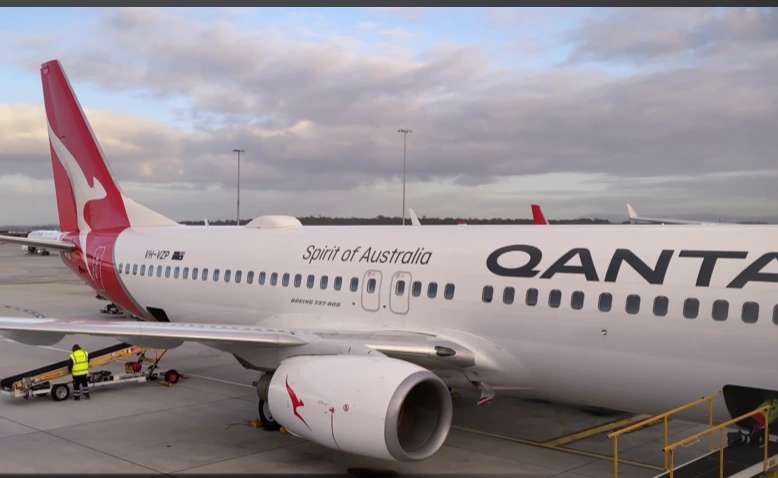
Qantas 737 Engine Failure: The ATSB report honours Qantas pilots for saving 181 people after a dramatic engine failure and explosion in Sydney.
In the high stakes world of commercial aviation, a few seconds can mean the difference between a routine departure and a catastrophe. On Wednesday, the Australian Transport Safety Bureau (ATSB) released a final report that reads less like a technical document and more like a tribute to human composure under extreme pressure.
The report praises the flight crew of Qantas flight QF520 for their “quick and decisive” actions that ensured the safety of 181 people during a dramatic engine failure and subsequent explosion on the runway.
The incident, which occurred during a departure for Brisbane, saw the Boeing 737–800 reach its most vulnerable moment just as the right engine suffered a catastrophic malfunction. What could have been a tragedy was instead a masterclass in professional training and nerves of steel.
The Critical “V1” Decision
The crisis began with a sound described by passengers as a “large bang” that jolted the entire aircraft. At that exact moment, the plane had reached “V1,” the critical speed beyond which a takeoff cannot safely be aborted. Pilots are trained that once this threshold is crossed, they must take the damaged machine into the air, regardless of the failure.
ATSB Chief Commissioner Angus Mitchell noted that the engine failure occurred at the worst possible moment during a critical phase of flight. Instead of panicking, the crew adhered strictly to their procedures: they continued the takeoff with one working engine, declared a “mayday” emergency, and began the delicate process of circling back to Sydney Airport.
“The flight crew responded quickly and decisively, continuing the take-off, declaring an emergency, and conducting relevant checklists while planning a return to Sydney,” Mitchell stated in the report.
Fire on the Ground and Fear in the Air
While the pilots worked to stabilize the aircraft, the drama was visible to those on the ground. Hot fragments expelled from the rear of the failing engine ignited a significant grass fire alongside runway 34R. Thick smoke rose from the airfield as emergency services rushed to the scene, even as the crippled jet laboured to gain altitude above the city.
Inside the cabin, the 174 passengers and six additional crew members felt the plane struggle. An ABC reporter on board described the shudder as making their “blood run cold,” noting the plane’s urgent struggle to find its footing in the sky.
Despite the terror, the cabin crew worked alongside an off-duty pilot to photograph the engine from a passenger window, providing the cockpit with vital information that there was no visible fire or structural damage to the wing.
A Safe Return to Earth
About 30 minutes after the initial explosion, the pilots executed a perfect single-engine landing. Aviation Rescue Fire Fighting Service personnel met the aircraft on the runway to assess the fire risk before the plane taxied back to the gate under its own power. All 181 people disembarked safely, many only then realizing how close they had come to a different outcome.
The ATSB report serves as a reminder of the silent sentinels of safety: the rigorous training and effective procedures that turn a mid-air nightmare into a manageable emergency. For the 181 people who walked off that plane, the skill of those in the cockpit remains the ultimate reason they made it home.