
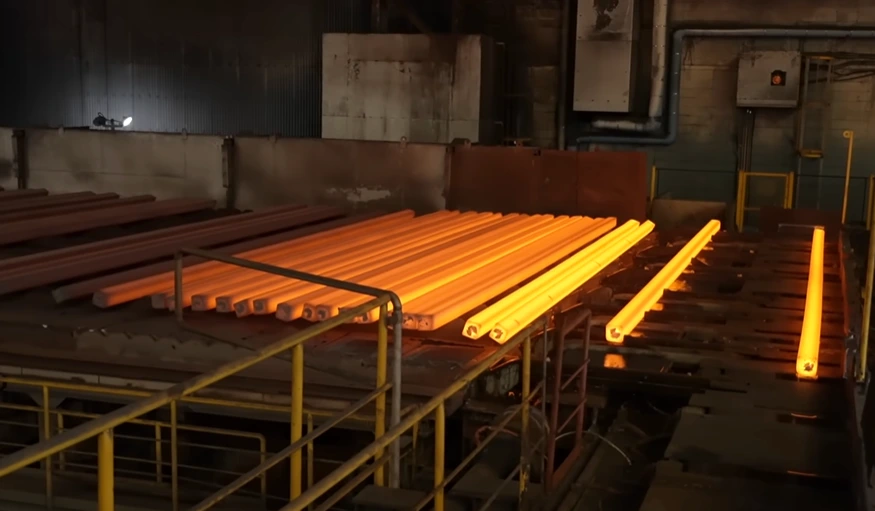
The European Parliament and Council have struck an agreement on a new law that also commits to prohibiting imports from Russia. Metsola, President of the Parliament, stated that “Geopolitical uncertainty makes a strong steel industry essential for the bloc’s resilience.”
The European Union is trying to protect its steel output from global competition, which is fuelled by overproduction in numerous nations. This week, the European Parliament and the Council of the European Union agreed on new legislation to preserve the bloc’s steel market.
The primary steps include reducing duty-free imports, raising quota tariffs to 50%, and implementing new traceability regulations for imported steel. The institutions also agreed to gradually phase out Russian steel, opening the market to Ukrainian manufacture instead.
“It is critical to counteract the negative effects on trade caused by global overcapacity in the EU steel market,” stressed Parliament negotiator Karin Karlsbro, a Swedish Liberal. “Geopolitical uncertainty makes a strong steel industry essential for Europe’s resilience”, and the accord negotiated ensures “a competitive future for European steel”, offering “the tools to defend it from unfair competition”, added Parliament President Roberta Metsola.
The agreement must now be legally ratified by both institutions; a vote in the European Parliament plenary session is likely in May, with the rule set to take effect on July 1, 2026.
Why is this intervention being implemented?
In response to Washington’s 25% steel and aluminium tariffs, the EU implemented steel safeguard measures in 2018, during Donald Trump’s first term as US President. That decision shifted a sizable share of world exports to the more open and less protected European markets.
The safeguard measures, implemented under the World Trade Organization’s (WTO) Safeguards Agreement, established duty-free import quotas and imposed a 25% tax over specified levels.
However, global output overcapacity has continued to rise and is expected to reach 721 million tonnes by 2027, more than five times the total annual consumption of the European Union. Furthermore, during his second term, Trump slapped 50% tariffs on steel and aluminium, intensifying the strain on imports into Europe.
European steel mill utilisation has dropped to 65 percent, significantly below the 80 percent level considered sustainable, with an estimated 100,000 job losses since 2008. In 2024, Turkey, South Korea, Indonesia, China, India, Ukraine, and Taiwan were the top steel exporters to the EU.
To solve this problem, the European Commission proposed a new tool in October, in part because WTO rules prohibit safeguard measures from being prolonged for more than eight years. The present ones, which were introduced in 2018, are set to expire on June 30.
Reduced rates
The core of the new regulation is the revision of the system of so-called Tariff-Rate Quotas (TRQs), or tariff quotas: a mechanism that allows imports of a certain quantity of goods at zero (or reduced) duty, while applying higher tariffs on imports exceeding that threshold. It is a widespread tool in international trade, ensuring minimal market access while protecting domestic production from excessive flows.
The new regulation sets the total volume of duty-free imports at 18.3 million tonnes per year, a 47 percent reduction compared to the quotas in force in 2024. Above this threshold, a 50 percent duty will apply, compared to the current 25 percent. The regulation covers 30 categories of steel products, from hot-rolled to cold-rolled, from coated to tubes.
“We have succeeded in securing the rapid extension of the list of products covered by the safeguard, including downstream sectors, protecting strategic supply chains such as automotive, mechanical engineering, household appliances, construction, and shipbuilding,” said Brando Benifei, Coordinator of the Socialists and Democrats in the International Trade Committee and negotiator of the new steel safeguard instrument. Benifei said he was “particularly pleased to have secured an accelerated timetable for the inclusion of four key products across the entire value chain: alloy and stainless steel wire, forged bars, cast iron tubes, pipes, and hollow sections.”
For the first twelve months of application, unused quotas in a quarter may be carried forward to the following quarter for all products. From the second year onwards, the Commission will assess on a case-by-case basis whether to allow this mechanism for specific categories, taking into account the level of import pressure, the rate of quota utilization, and the availability of supplies for industries that use steel as a raw material.
The origin of steel
One of the most significant changes concerns the traceability of imported steel. The regulation introduces the “melt and pour” principle, a criterion that identifies the country where the steel was originally melted in a furnace and then cast into its first solid form, regardless of where it is subsequently processed or transformed. In practice, it doesn’t just matter where a steel tube or sheet was manufactured or rolled, but also where the material was first produced in its liquid state.
This criterion serves to prevent so-called “triangulation”: Chinese or Russian steel shipped to a third country, minimally processed, and then re-exported to the EU with a different origin, thus circumventing tariffs. The agreement establishes that the country of smelting and casting will be one of the factors used to allocate tariff quotas to exporting states.
Within two years of its entry into force, the Commission will then have to evaluate whether to make this criterion the exclusive basis for allocations and, if necessary, submit a new legislative proposal.
Russia out, Ukraine in
On the geopolitical level, the regulation contains two opposing provisions. In a joint statement attached to the text, the Parliament, the Council, and the Commission “reaffirm their commitment to reducing economic dependencies on Russia”, with the aim of completing the elimination of imports of Russian steel products by September 2028. This is a weakening of the Parliament’s demands, which would have called for a binding commitment, but it is nevertheless a signal.
Over the years, the EU has adopted a series of economic sanctions against Moscow in response to its invasion of Ukraine. Among these measures, since March 2022, Brussels has included a ban on the import of iron and steel products originating in Russia.
However, under the current sanctions framework, not all Russian steel flows are automatically blocked permanently: some semi-finished products and raw materials can still be imported or transited through third countries unless they specifically fall within the prohibited categories or are rigorously proven to contain material of Russian origin. Thus, in 2025 alone, approximately 3.7 million tonnes of steel slabs arrived in the EU from Russia.
Conversely, the agreement provides that Ukraine, as an EU candidate country facing “an exceptional and immediate security situation”, namely, an invasion by Vladimir Putin’s Russia, will have access to a duty-free quota system for import allocation.
Higher duties
Under the current system, a Turkish steel mill that exports to the EU beyond its annual quota pays a 25 per cent duty on the value of the goods. Starting July 1, 2026, that same steel mill will pay 50 per cent: a measure that should make bulk exports to the European market less profitable and favour local producers. The stated goal is to restore European plant utilization to 80 per cent.
The agreement also introduces an accelerated review mechanism: within six months of entry into force, the Commission will be required to assess whether to extend the scope of the regulation to products not currently covered, such as tubes, pipes, and certain types of forged bars.
Within twelve months, a second review may extend coverage to products containing a significant amount of steel to prevent them from being used as an alternative route to circumvent the measures. Subsequent reviews are scheduled every two years.
Author: Alfonso Bianchi | Source: Today.it


[…] READ MORE: Russia Out, Ukraine In: The EU’s Final Push for Steel Market Sovereignty […]