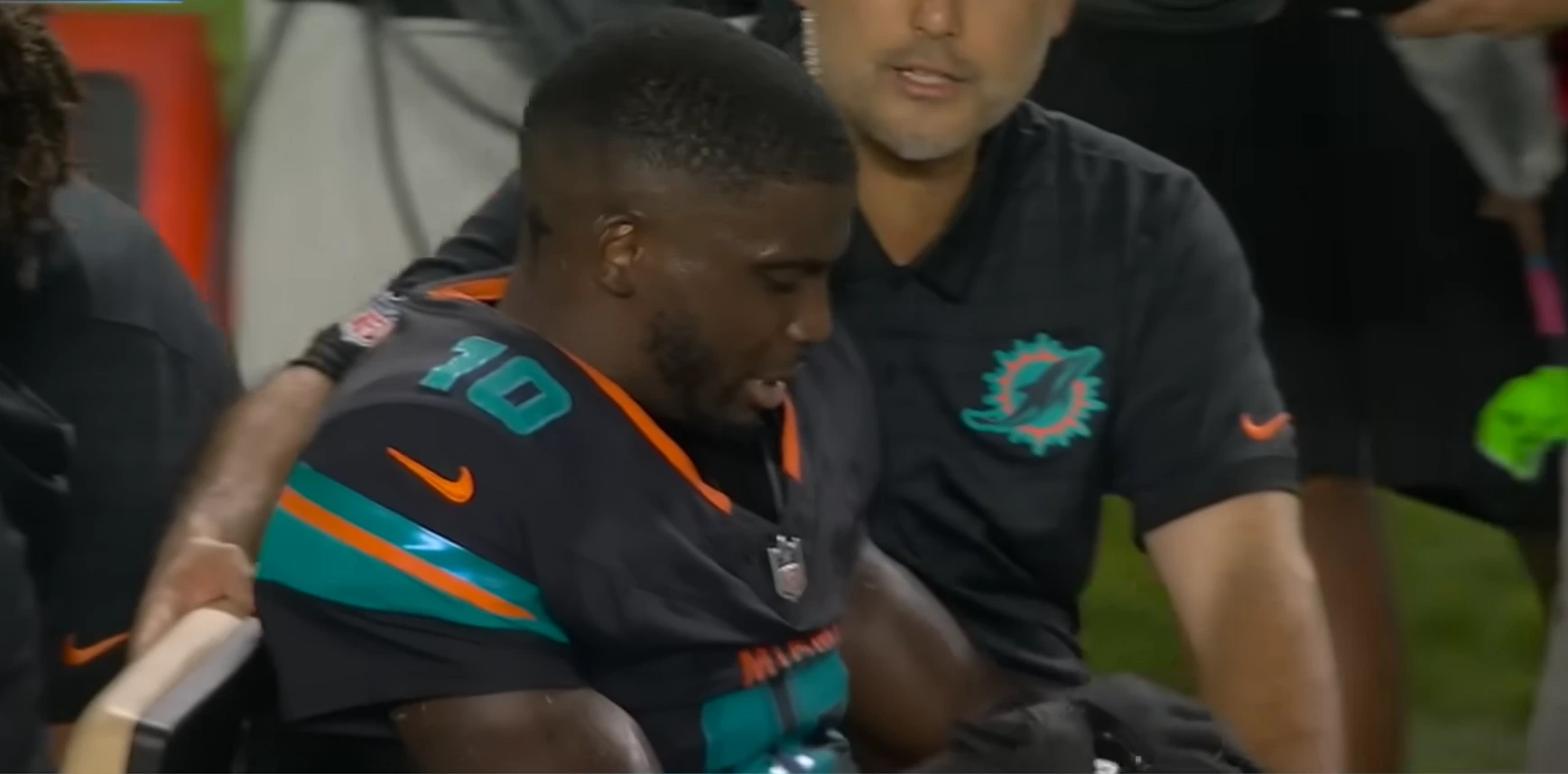
Star wide receiver Tyreek Hill suffered a horrifying left leg injury during the Miami Dolphins’ Monday Night Football matchup against the New York Jets, immediately throwing a shadow over the team’s entire season.
The graphic nature of the incident, which saw Hill’s leg bend awkwardly beneath a tackler, forced him to be carted off the field and rushed to a local hospital for urgent evaluation.
Initial reports from the team and multiple sources indicate a fear of a dislocated knee, an injury that is not only severe for an athlete but also carries serious risks for the long-term health of the leg.
The Defining Play and Immediate Aftermath
The injury occurred early in the third quarter after Hill had converted a key third-down catch from quarterback Tua Tagovailoa along the sideline.
As Hill was being tackled by Jets defensive back Malachi Moore, his left leg became pinned and twisted at an unnatural angle.
The immediate reaction was one of shock and concern:
- Medical Response: Training staffs from both the Dolphins and Jets rushed to his side. They worked quickly to cut off his cleat and apply an air cast to stabilize the leg—a protocol for potentially catastrophic injuries like a dislocation.
- Player Reaction: Players from both teams knelt in solemn concern, highlighting the severity of the moment.
- Exit: Hill, showing remarkable resolve, managed to wave to the crowd as he was carted off, but the sight of his leg in a brace and the immediate transportation to the hospital confirmed the gravity of the situation.
The Feared Prognosis: Dislocated Knee
While an official diagnosis is pending the results of the hospital imaging and evaluation, the primary concern is a dislocated knee. This injury is a major blow because:
- Ligament Damage: A knee dislocation almost always involves significant damage to multiple ligaments, such as the ACL, MCL, and PCL. The recovery timeline for this level of repair often spans 9 to 12 months, putting his return for the current season, and potentially the start of the next, in serious doubt.
- Vascular Risk: Crucially, there is a risk of damage to the popliteal artery, which supplies blood to the lower leg. The immediate focus of the medical team is to rule out this dangerous complication.
Impact on the Dolphins’ Season
Hill, at 31, remains one of the most explosive and productive receivers in the NFL, and his loss is devastating for Miami’s offense.
- Offensive Void: Hill was a centerpiece of the Dolphins’ offensive strategy, often demanding a double-team and opening up opportunities for other receivers. His departure removes a top-tier playmaker who was on pace for another strong season (six catches for 67 yards before the injury).
- Next Man Up: The injury immediately elevates the roles of other players. Jaylen Waddle will become the undisputed WR1, likely commanding a huge target share. Tight end Darren Waller and running back De’Von Achane will also need to step up to compensate for Hill’s missing production.
- Contractual Uncertainty: The severity of the injury could also factor into his future with the team. Hill is in the second year of a large extension, and his long-term recovery will be a key factor as the team evaluates his contract status next off-season.
The team and fans now anxiously await the results of the hospital tests to determine the true extent of the injury and the outlook for the remainder of the season.
The severity of the injury was captured by the broadcast as Tyreek Hill was carted off the field, a moment of profound concern for all involved. Tyreek Hill acknowledges Miami crowd while being carted off due to injury | NFL on ESPN