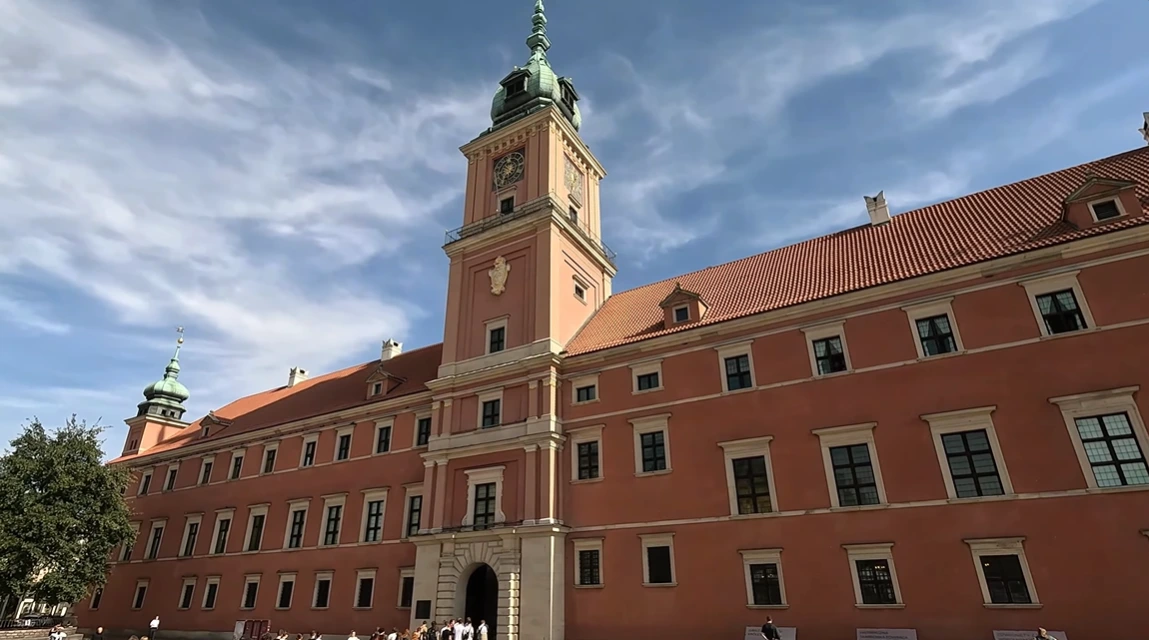
Destroyed by German explosives in 1944, the Royal Castle in Warsaw was rebuilt brick by brick through public donations and salvaged art. The history of Poland’s iconic UNESCO World Heritage palace and what to see inside today.
Stand in Warsaw’s Castle Square on a crisp morning, and the building in front of you looks effortlessly ancient. Its warm terracotta facade, steep copper roofs, and central clock tower anchor the southern edge of the Old Town with the quiet authority of a residence that has watched centuries of European history unfold. Tourists pause beside Sigismund’s Column to take photographs, school groups file through the wrought-iron gates, and the Vistula River flows steadily just below the castle gardens.
Yet almost none of the brickwork you see from the square is more than fifty years old.
In September 1944, German demolition squads drilled thousands of holes into the castle’s load-bearing walls, packed them with dynamite, and blew the entire complex into a mountain of ash and broken stone. For nearly three decades afterward, an empty lot covered in concrete, flowerbeds, and a nearby bus loop marked the spot where Polish kings once ruled. The story of the Royal Castle in Warsaw is not simply a tale of royal architecture or museum collections. It is the story of a nation that refused to let its memory be erased, rebuilding a lost palace brick by brick through public donations, salvaged fragments, and 18th-century paintings.
From Wooden Stronghold to the Seat of Kings
Long before Warsaw became Poland’s capital, the high escarpment overlooking the Vistula River served as a strategic defensive outpost. At the end of the 13th century, Duke Conrad II of Masovia established a fortified wooden and earthen settlement here, known in Latin records as the Curia Minor, or Small Manor. By the mid-14th century, his successors began replacing timber with brick, raising the Great Tower (later known as the Grodzka Tower), whose lower foundations remain the oldest surviving fabric of the castle today.
Between 1407 and 1410, Duke Janusz I the Elder constructed the Gothic Curia Maior, or Big Manor. Its scale and grandeur transformed the stronghold from a regional fortress into a true princely residence. When the Duchy of Masovia was incorporated into the Kingdom of Poland in 1526, the castle entered the orbit of the Polish crown. Queen Bona Sforza lived within its walls, and following the 1569 Union of Lublin that united Poland and Lithuania into a single Commonwealth, the castle became the regular meeting place of the national parliament, the Sejm.
The decisive turning point arrived at the end of the 16th century. King Sigismund III Vasa, seeking a capital better positioned for travel between Poland and his native Sweden, moved the royal court from Kraków to Warsaw. Between 1598 and 1619, Italian architects Giovanni Trevano and Giacomo Rodondo expanded the mediaeval buildings into a five-winged early Baroque palace surrounding a central pentagonal courtyard.
Enlightenment Splendour and the Constitution of 1791
Over the next two centuries, the castle absorbed the triumphs and catastrophes of Polish statehood. Swedish invasions in the mid-17th and early 18th centuries left the palace looted and battered, with royal halls briefly converted into military hospitals and stables. Saxon monarchs Augustus II and Augustus III later repaired the damage and added a late Baroque wing facing the Vistula River.
However, the castle’s artistic golden age belonged to Poland’s last king, Stanisław August Poniatowski, who reigned from 1764 to 1795. A passionate patron of the Enlightenment, Stanisław August commissioned architects Jakub Fontana and Domenico Merlini to redesign the royal apartments in refined Neoclassical style. He filled the rooms with gilded stucco, marble, crimson silk damask, and canvases by court painters Marcello Bacciarelli and Bernardo Bellotto, the Venetian master widely known as Canaletto.
On May 3, 1791, the castle hosted one of Europe’s defining political milestones. Inside the Senators’ Chamber, lawmakers adopted the Constitution of May 3, widely recognized as Europe’s first modern codified national constitution and the second in the world after the United States.
Four years later, neighboring empires carved Poland off the map of Europe through the Third Partition. Throughout the 19th century, the castle became a seat of foreign occupation, briefly hosting Napoleon Bonaparte in 1806 before serving as an administrative headquarters for Russian imperial governors. Only when Poland regained independence in 1918 did the castle return to Polish hands as the official residence of the President of the Republic.
The Deliberate Erasure of 1939 to 1944
That interwar renewal lasted barely twenty years. On September 17, 1939, Luftwaffe bombs struck the castle, igniting a fire that collapsed the roof and destroyed the painted ceiling of the Great Assembly Hall.
As German troops occupied Warsaw, museum curators and art historians risked their lives to save what they could. Led by Professor Stanisław Lorentz, director of the National Museum, teams slipped into the damaged rooms under the noses of occupation authorities. They pried loose marble fireplaces, rolled up priceless canvases, dismantled carved wooden panelling, and smuggled thousands of architectural fragments into secret storage across the city.
Their urgency was well founded. Adolf Hitler had ordered the castle’s complete obliteration to permanently break Warsaw’s cultural identity. Following the suppression of the Warsaw Uprising in late summer 1944, German sappers systematically mined the surviving walls and detonated them in September. By the time Soviet forces entered the ruined city in January 1945, only two small fragments of the castle still stood: a section of the Gothic cellars and a sliver of the library wing.
A Citizens’ Crusade to Rebuild the Impossible
While Warsaw’s Old Town was rebuilt remarkably quickly in the early 1950s, the Royal Castle remained an empty scar. Poland’s postwar communist authorities viewed a royal palace with deep ideological suspicion, floating plans to replace it with a socialist-realist cultural hall or leave the site permanently bare. For twenty-six years, the castle existed only in the memories of older residents and in the street grid engineers quietly curved around its missing footprint.
Political upheaval in late 1970 finally broke the stalemate. In January 1971, following intense lobbying by Stanisław Lorentz and Polish intellectuals, the government authorized the castle’s reconstruction. There was one catch: the state refused to pay for it, stipulating that the project had to be funded through voluntary public donations.
What followed became one of the most extraordinary civic campaigns in modern European history. Poles at home and across the global diaspora poured money, gold rings, family heirlooms, and volunteer labour into the Civic Committee for the Reconstruction of the Royal Castle. Over 27,000 citizens volunteered their physical labour on the construction site without pay.
| Reconstruction Phase | Key Dates | Major Milestones |
| Wartime Salvage | 1939–1944 | Curators rescue paintings, sculptures, stuccos, and architectural fragments before demolition. |
| Political Approval | January 1971 | Civic Committee formed; nationwide fundraising campaign begins across Poland and the diaspora. |
| Structural Shell | 1971–1974 | Exterior walls raised; Sigismund’s Tower clock restarted at 11:15 AM, honoring the moment bombs first hit in 1939. |
| UNESCO Recognition | October 1980 | Warsaw’s Historic Centre and Royal Castle inscribed on the UNESCO World Heritage List. |
| Grand Opening | August 1984 | Reconstructed royal apartments and state rooms officially open to the public. |
| Gardens & Arcades | 1995–2019 | Restoration of the Kubicki Arcades and Upper and Lower Castle Gardens overlooking the Vistula. |
Architects led by Jan Zachwatowicz treated the rebuilding like a forensic puzzle. They matched the thousands of salvaged stone moldings and wooden carvings rescued during the war with pre-1939 architectural surveys. Where photographs lacked color or fine detail, restorers turned to Canaletto’s 18th-century cityscapes, which had captured Warsaw’s streets and facades with near-photographic precision. In historic textile workshops in Łódź and Milanówek, weavers reproduced 18th-century silk wall coverings thread for thread.
On July 19, 1974, the clock on Sigismund’s Tower began ticking again. Its hands had been deliberately frozen at 11:15 AM for thirty-five years to mark the exact minute German shells shattered the dial in September 1939.
Inside the Reborn Palace Today
Today, the Royal Castle stands as Poland’s second most visited art museum and a living stage for statecraft. Stepping across its threshold offers a walk through centuries of salvaged artistry seamlessly woven into modern craftsmanship:
- The Great Assembly Hall (Ballroom): The largest and most opulent room in the castle, dazzling with white and gold Corinthian columns, crystal chandeliers, and ceiling frescoes recreated from surviving oil sketches by Marcello Bacciarelli.
- The Canaletto Room: Home to twenty-two original 18th-century views of Warsaw painted by Bernardo Bellotto, the very works that allowed postwar architects to rebuild the surrounding city.
- The Throne Room: Decorated in crimson velvet embroidered with silver Polish eagles, anchored by original salvaged elements from King Stanisław August’s personal quarters.
- The Lanckoroński Collection: A remarkable gallery housing two genuine Rembrandt paintings, Girl in a Picture Frame and Scholar at His Writing Table, donated to the castle in 1994 by Countess Karolina Lanckorońska.
- The Kubicki Arcades and Gardens: Descending toward the Vistula River, these restored 19th-century vaulted galleries and terraced geometric gardens reconnect the palace to the riverbank below.
In 1980, UNESCO added Warsaw’s Historic Centre, including the Royal Castle, to the World Heritage List. Ordinarily, UNESCO avoids listing reconstructed buildings, yet the committee made a historic exception. The castle’s value lies not merely in its Baroque proportions or Neoclassical salons, but in what its existence proves: that a community’s determination to remember can outlast even the most ruthless effort to make it disappear.