An artificial intelligence (AI) analysed over 2 million seismic recordings, revealing six unrecorded zones near the Earth’s core-mantle border.
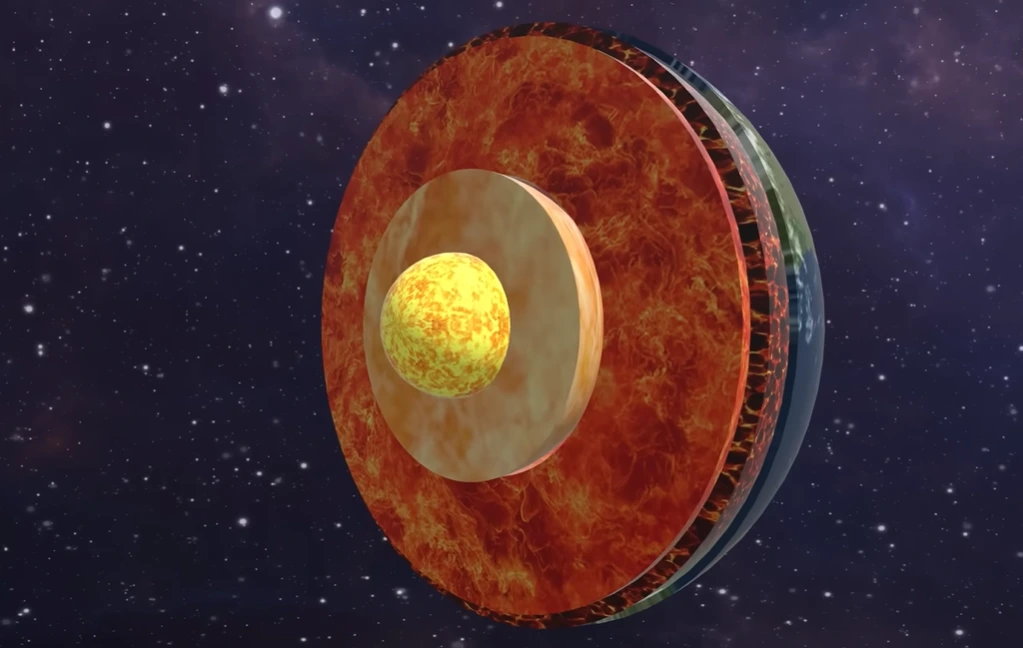
Nearly 2,900 kilometres under the surface, where Earth’s solid mantle meets the liquid outer core, artificial intelligence helped disclose signals that had previously been impossible to detect on a broad scale.
A team of researchers from the Chinese Academy of Sciences created a deep learning system to analyse over 2 million seismic waveforms recorded between 1990 and 2024. The objective was to detect tiny signals called PKP precursors, which can show anomalies near the core-mantle border.
The result was a catalogue of 174,929 precursors, more than ten times the number compiled by previous studies. With this volume of data, the team was able to construct one of the most comprehensive maps to date of possible small structures deep within the Earth.
What did artificial intelligence find beneath the Earth?
The study, published in Journal of Geophysical Research: Solid Earth, identified six new areas with a high probability of containing seismic dispersion structures that had not been previously documented.
These regions were named in the paper as B1, B2, B3, B4, B5 and B6 , and are located near the boundary between the Earth’s core and mantle.
In simple terms, these are not structures directly observed as if a camera had reached them. They are zones inferred from the way certain seismic waves travel, scatter, or are deflected as they pass through the Earth’s interior.
What are PKP precursors?
PKP precursors are weak seismic signals that arrive before other, more intense waves after an earthquake shakes the planet.
According to the study, these signals scatter when they encounter small heterogeneities near the core-mantle boundary, thus functioning as a kind of indirect tool for studying hidden features of the Earth’s interior.
The problem is that identifying them is not easy. For years, reviewing these records involved manually observing seismograms, a slow, specialized process subject to interpretation.
Therefore, the use of deep learning made it possible to process an amount of information that would have been very difficult to review solely with human work.
AI changed the map of the mantle floor
Prior to this analysis, maps constructed with PKP precursors showed isolated areas, as if the deep mantle irregularities were scattered patches.
With the new catalog, researchers observed that some of these regions might form more continuous and extensive bands than previously thought. The study notes that the expanded data allowed them to connect areas that previously appeared separate, such as those beneath Panamerica.
This change is important because it helps to better understand how the bottom of the mantle is organized, a key area for studying the planet’s internal dynamics.
What could these structures be?
The researchers point out that several of the identified areas correspond to what is known in geophysics as ultra-low velocity zones, or ULVZ .
These regions are so named because seismic waves travel more slowly as they pass through them, suggesting that they have different physical or chemical properties than the material surrounding them.
According to the study, these structures could be related to thermochemical accumulations formed by a combination of remnants of ancient subducted tectonic plates, localised partial melting, and interactions with large low shear rate provinces, known as LLVPs.
In other words, they could be remnants or accumulations of very old material, trapped for millions of years near the boundary between the mantle and the core.
Why is it important to study the boundary between the core and the mantle?
The boundary between the core and the mantle is one of the most difficult regions to study on Earth but also one of the most important.
At this depth, part of the heat transfer between the metallic core and the rocky mantle occurs, a process related to the planet’s internal circulation and the evolution of its deep structure. The study itself indicates that this boundary is key to understanding heat transfer and the cycling of materials within the Earth.
A better understanding of this area can help explain processes that, although they occur thousands of kilometers beneath our feet, are connected to the planet’s geological activity.