
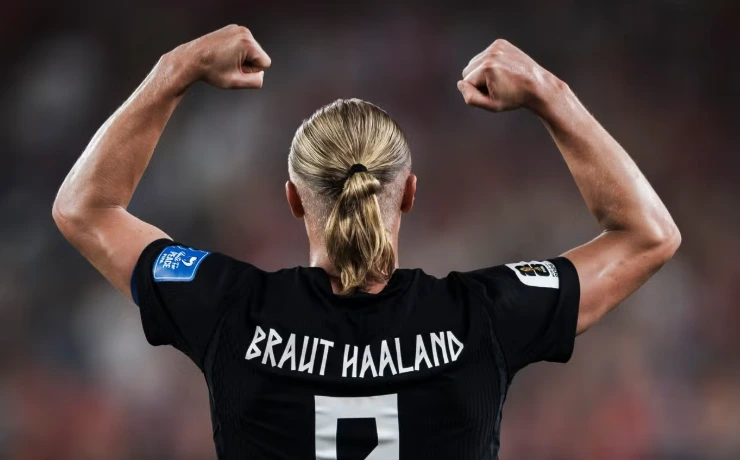
Erling Haaland’s Norway jersey reads “Braut Haaland” rather than just “Haaland” at the 2026 World Cup. Here is the family story and Norwegian naming tradition behind the choice.
Fans tuning into Norway’s 2026 FIFA World Cup matches have noticed something different on the back of Erling Haaland’s shirt. Instead of the familiar single word seen on his Manchester City jersey, the Norway striker carries two names into battle at the biggest tournament on earth: Braut Haaland.
It is not a branding exercise or a quirk of tournament regulations. It is a gesture of the heart for his family, especially his mother.
The Story Behind the Name
Haaland’s full name is Erling Braut Haaland. “Braut” comes from his mother, former Norwegian heptathlete Gry Marita Braut, while “Haaland” comes from his father, former Norway international and Premier League midfielder Alf-Inge Haaland. Norway’s Football Association confirmed in 2025 that the striker had chosen to wear both family names on his national-team jersey.
Haaland adopted the change in late August 2025 to follow tradition in his home country and to display his full family name. The Norwegian Football Federation confirmed the change ahead of the September 2025 international window, with his first matches in the updated jersey coming in a friendly against Finland and during Norway’s qualifying campaign. Many casual fans only noticed the switch during the World Cup because Norway had not appeared in the tournament since 1998.
The name “Braut” also carries geographical significance, originating from the farm near Bryne in southwestern Norway where he was born. Under traditional Norwegian naming customs, family names have historically been linked to farms or places of origin, giving them a deeper connection to local heritage.
A Tribute to His Mother
In previous interviews, Haaland said that he wanted to pay tribute to both sides of his family, so that his mother’s name is always with him when he is on the pitch.
The renewed focus on Haaland’s jersey has also shone a spotlight on his mother, whose sporting achievements have often been overshadowed by those of his father. While Alf-Inge Haaland enjoyed a well-documented football career with Nottingham Forest, Leeds United and Manchester City, Gry Marita Braut was an accomplished track-and-field athlete who won the Norwegian national heptathlon title in the 1990s, competing across seven demanding disciplines that require speed, strength, endurance and technical versatility. Many observers have long credited Haaland’s extraordinary athleticism to both sides of his family, with his mother’s multi-event background frequently cited as a key part of his physical profile.
The Norwegian striker has frequently attributed his football knowledge to his father and his athletic background and competitive spirit to his mother. By carrying both names onto the pitch, he is acknowledging publicly that the machine-like finishing and relentless physical drive the football world admires in him did not come from one parent alone.
Club vs Country
At club level, the distinction is largely commercial. Shorter names are easier to recognise and promote, and his Manchester City shirts have always carried only “Haaland.” Erling continues to wear only “Haaland” for Manchester City because he has chosen to reserve “Braut Haaland” for international duty with Norway, allowing him to honour his family heritage in the context that feels most personal.
Among Norwegian supporters, he has long been affectionately known as “Brauten,” roughly translating to “The Braut.” The World Cup has simply given that name its largest stage yet.
For City fans, he is simply Haaland, the ruthless No. 9 in sky blue. For Norway at the World Cup, he is Braut Haaland, carrying both sides of his family name while trying to carry his country through the group stage.
Europeans24 is covering the FIFA World Cup 2026 throughout the tournament. Follow us for the latest on Norway, Erling Haaland, and all 16 European nations competing in North America.








+ There are no comments
Add yours