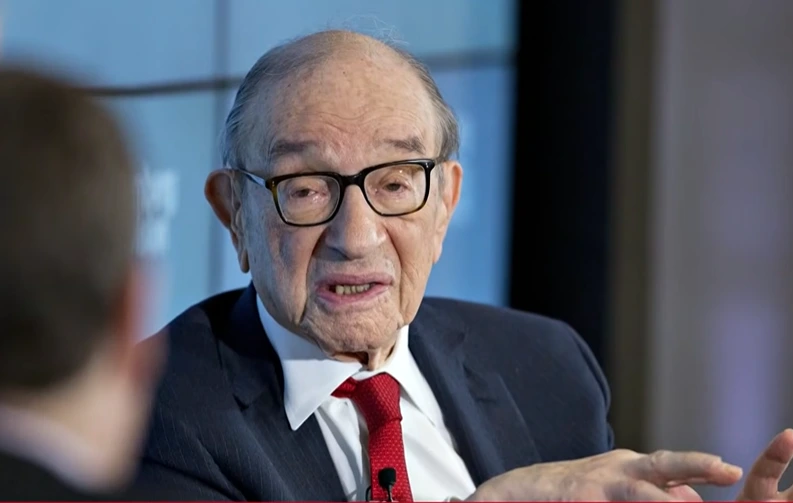
Alan Greenspan, the economist who served as chairman of the Federal Reserve for five terms under four different US presidents and helped create US monetary policy, died at the age of 100.
According to NBC News, former Federal Reserve Chairman Alan Greenspan died at home on Monday from Parkinson’s disease complications.
Greenspan’s 18-year stint as Fed chairman, from 1987 until his departure in early 2006, was characterised by a spike in stock markets and low unemployment. More than the four chairman or seven Treasury Secretaries he worked with, Greenspan was seen as a ‘chief’ who kept the economy afloat.
Roger Ferguson, who served as Vice Chairman of the Fed from 1999 to 2006, said, “Alan Greenspan deserves to be remembered as one of the greatest central bankers of the second half of the 20th century, not only at the Fed but also globally.” Ferguson noted that Greenspan was “one of the first in the U.S. to recognize the impact of technology on increasing productivity and enabled the economy to grow faster than anticipated without inflation.”
Greenspan had become a worldwide banking legend thanks to his broadcast speeches and congressional testimony, which affected global markets.
Greenspan’s tenure was the second-longest of any Federal Reserve chairman, after only William McChesney Martin Jr.
This ten-year era coincided with a recession that ended in March 1991—the longest steady period of economic development since the central bank’s inception in 1913—and a second recession that began March 2001.
During this period, the Standard & Poor’s 500 Index nearly quadrupled, while the US economy grew at an average annual rate of 3.5 percent.
The unemployment rate averaged 5.5 percent, falling to 3.8 percent in April 2000, the lowest level since 1969.
However, fiscal pressures were mounting in the final years of Greenspan’s term. High-risk mortgage loans were approved for some homebuyers they couldn’t afford. In 2005, the minutes of Fed policy meetings showed that central bank staff and officials had identified a housing bubble.
Greenspan stated that “whatever bubble there was in the housing market, it was contained at this stage, and that this containment was largely due to the rise in mortgage interest rates and their beginning to take effect.”
In mid-2007, interbank lending came to a standstill, triggering the events that culminated in the collapse of Lehman Brothers in September 2008. This crisis pushed the Fed and Greenspan’s successor as chairman, Ben Bernanke, into uncharted territory.
Greenspan, long praised for his success in managing the economy, found himself in an unusual position: he had to fend off critics who argued that his approach of not intervening in financial markets and bubbles—particularly the housing bubble that was inflating when he left office—had set the stage for the worst economic collapse since the Great Depression.
Paul Kasriel, a former Fed official and then-employee at Northern Trust Co. in Chicago, stated in 2010 that Greenspan, by promoting productivity growth as a sign of a so-called new economy, “aided and abetted the biggest stock market bubble in this country’s history.”
Greenspan was first nominated by then-US President Ronald Reagan and began his term as Chairman of the Federal Reserve in 1987. In July 1991, President George H.W. Bush nominated Alan Greenspan for a second four-year term as Fed Chairman.
Greenspan began his third and fourth terms after being nominated by President Bill Clinton. President George W. Bush nominated Greenspan for his fifth and final term in 2004.