
In the heart of Australia’s cities, anti-immigration rallies fueled by social tensions and political rhetoric have erupted, sparking clashes with counter-protesters.
SYDNEY, Australia — The streets of Australia’s major cities, from the bustling heart of Sydney to the political core of Canberra, were the site of a tense and deeply polarized day on Sunday.
Across the country, under the banner of a “March for Australia”, groups of anti-immigration protesters took to the streets to rally against what they describe as “mass migration,” drawing an equally vocal response from counter-protesters and widespread condemnation from the federal government.
The demonstrations, orchestrated by a loose coalition of organizers, have been a lightning rod for controversy in recent weeks, with accusations of being a front for far-right and neo-Nazi ideologies.
While organisers maintained the marches were about a nationalistic plea to “take our country back”, the event has laid bare the simmering social tensions and ideological divides that underscore Australia’s complex relationship with its multicultural identity.
A Tale of Two Cities: Protests and Clashes in Melbourne and Sydney
In Melbourne, the mood was volatile from the start. A large crowd of anti-immigration protesters gathered in the city centre, met by a fierce and determined counter-protest. Chants of “Nazis out!” and “racist scum” rang out as activists from both sides confronted each other.
Despite a heavy police presence and a designated “exclusion zone” established by Victoria Police to search for weapons, tensions boiled over. Police were forced to use pepper spray to separate the groups, with angry scenes unfolding as protesters attempted to circumvent police lines.
The use of police force in a designated area was a stark and sobering illustration of the potential for violence at the heart of the debate.
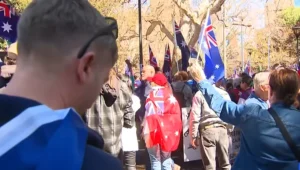
Meanwhile, in Sydney, the day was marked by sheer numbers and a palpable sense of friction. An estimated 5,000 to 8,000 people attended the “March for Australia” rally, with many draped in Australian flags and carrying signs calling for an end to immigration.
Nearby, a smaller but passionate counter-protest, organized by groups like the Refugee Action Coalition, gathered to voice their opposition.
The presence of a pro-Palestine rally and the ongoing Sydney Marathon further complicated the urban landscape, requiring a massive police operation with more than 1,000 officers deployed to keep the groups separate and maintain order.
Across the country, smaller but equally potent demonstrations took place. In Canberra, the rally was attended by prominent political figures, including One Nation Senators Pauline Hanson and Malcolm Roberts, as well as federal MP Bob Katter, who was captured on camera leading a rally in Townsville.
Their presence at these marches has been widely scrutinized and has brought the fringe movement to the very center of political debate.
The Political Condemnation: “Nothing Could Be Less Australian”
The federal government has been unequivocal in its condemnation of the rallies. Senior ministers have been front and center, calling out the events as “un-Australian”.
Home Affairs Minister Tony Burke stated there was “no place in our country for people who seek to divide and undermine our social cohesion,” adding that “nothing could be less Australian” than these protests. Similarly, Multicultural Affairs Minister Anne Aly described the rallies as “far-right activism grounded in racism and ethnocentrism.”
The government’s strong stance reflects a growing concern that these movements, often fueled by online misinformation, are seeking to mainstream hateful ideologies.
The “March for Australia” organizers, while distancing themselves from the more extreme elements, have been openly promoted by neo-Nazi figures, leading many to question the rally’s true intent.
The Fear in the Community
The public debate has had a tangible and frightening impact on Australia’s diverse communities. Leading up to the rallies, community leaders and social media influencers from various migrant backgrounds issued public warnings, urging people of color to “stay inside” and avoid protest areas for their own safety.
These warnings, which were widely circulated on platforms like TikTok and Instagram, highlight a real fear of violence and discrimination.
As one community leader put it, the rallies send a “dangerous” and “un-Australian” message, and the fear that they could escalate into racially motivated attacks is a grim reminder of the stakes involved.
The fact that many immigrants felt a need to alter their daily routines out of a legitimate fear of their safety is a testament to the palpable tension that these protests have created.
A Nation’s Identity in Flux
The “March for Australia” is more than just a passing protest; it is a symptom of a deeper national conversation about identity, borders, and belonging.
While Australia is one of the most successful multicultural societies in the world, with one in two people either born overseas or having a parent who was, the debate over immigration remains a potent and often-divisive issue.
The rallies tap into legitimate public concerns about issues like a housing shortage and strained infrastructure, but they frame these problems as a result of “mass migration.”
This narrative, while powerful, is rejected by a majority of Australians who see immigration as a core part of the nation’s success and identity.
As police and politicians navigate the immediate challenges of these protests, the long-term task of fostering social cohesion and addressing the root causes of public dissatisfaction remains a monumental challenge.
The events of Sunday have made one thing clear: the conversation about Australia’s future is far from over.
Follow Europeans24 for more updates!