
China’s new export restrictions on rare earths reignite a full-blown trade war with the U.S., following Trump’s 100% tariff announcement. As markets panic, experts warn that the global economy faces renewed instability amid Washington’s protectionist shift and Beijing’s strategic resource control.
A simple press release was enough to spark a renewed escalation between the United States and China. Last week, China’s Ministry of Commerce stated that new, comprehensive export regulations for rare earths and related technology would go into force in November.
For the first time, this will affect items made in foreign nations with Chinese raw ingredients.
The news came practically simultaneously with the Nobel Peace Prize, which Trump did not receive. Greetings from Beijing. The US President swiftly replied by announcing additional tariffs of 100% on Chinese goods beginning in November.
This means that the trade conflict between the US and China, which had been so slowly calmed, has flared up again in full force. Stock prices plummeted, and signs of panic spread across the markets.
Over the weekend, both sides attempted to calm the waters. China’s Ministry of Commerce emphasized that these were by no means comprehensive export bans, but rather export licenses subject to approval, aimed at military use.
Beijing points out that its policy merely reflects what the West is doing – for example, with the export restrictions on AI chips and other dual-use goods. It is necessary to respond to this. An eye for an eye, a tooth for a tooth – that is how the conflict presents itself from the Chinese perspective.
Even though Washington naturally sees things differently, shortly after his tariff threat, Trump ambiguously reassured the world that Chinese President Xi Jinping was just having a bad day and had therefore overreacted.
He said no one wanted a recession in China, and the US only wanted to help – everything would be fine. So, is everything calm? Or is the conflict between the two world powers over trade and raw materials currently getting dangerously out of hand?
At the beginning of the year, harmony was still the order of the day. “History tells us that our two countries benefit from cooperation and lose from confrontation.” Hard to believe today, but true: With these words, Xi Jinping congratulated Trump on his inauguration in January 2025.
The two knew each other well from Trump’s first term. This period also saw the first trade war, which began in 2018 with US punitive tariffs on imports of steel and aluminum from China and was provisionally ended in 2020 with the signing of a trade agreement.
Trump’s tweet about the “Chinese virus” during the coronavirus pandemic is also memorable. Something like that isn’t forgotten in Beijing.
This year, the presidents of the two world powers, whose relationship shapes the structure of the system of international relations, will meet again. The Chinese government has prepared thoroughly for this reunion for four years, Trump apparently less so.
In the manner of a gambler who believes he has the best hand at the card table, he proclaimed April 2nd as Liberation Day and, with the now legendary tableau in the White House Rose Garden, announced exorbitantly high tariffs on more than 180 countries (34 per cent for China at the time), thus delivering a gut-punch to a liberal global trade order that had already been ailing and on the defensive for years.
The Chinese leadership, convinced of the strength of its own economy and authoritarian form of government, must have rubbed its hands together in glee. The USA—for decades the guarantor of security and the establishment of a global economic system for a multitude of democratic Western states—has thus withdrawn from its role as a reliable hegemon and replaced the rules-based order it had shaped with transactional action.
Michael Froman, former US Trade Representative under Obama, sums it up when he writes: “The United States now largely operates by Beijing’s standards, with a new economic model characterized by protectionism, restrictions on foreign investment, subsidies, and industrial policy—essentially nationalist state capitalism.” Welcome to the age of geopolitics.
In April, China responded to Trump’s tariff show on Liberation Day by introducing the first export restrictions on rare earths. These are 17 metals that play an indispensable role in the production of green technology (electric cars, wind turbines), electronics (smartphones, computers), and security technology (aerospace).
Around 70 percent of the world’s rare earths are mined in China, and 90 percent are elaborately processed there. Over the past few decades, China has thus strategically established absolute market power and a quasi-monopoly in a sector formerly controlled by the USA. According to the Federal Statistical Office, Germany imports around two-thirds of its needs from China.
Escalating tensions with threatened tariffs of up to 145 percent were followed over the summer by a European tour of trade policymakers for confidential talks in Geneva, Stockholm, London, and Madrid. These negotiations resulted in only preliminary agreements ( 30 percent on Chinese exports to the US; 10 percent on US exports to China).
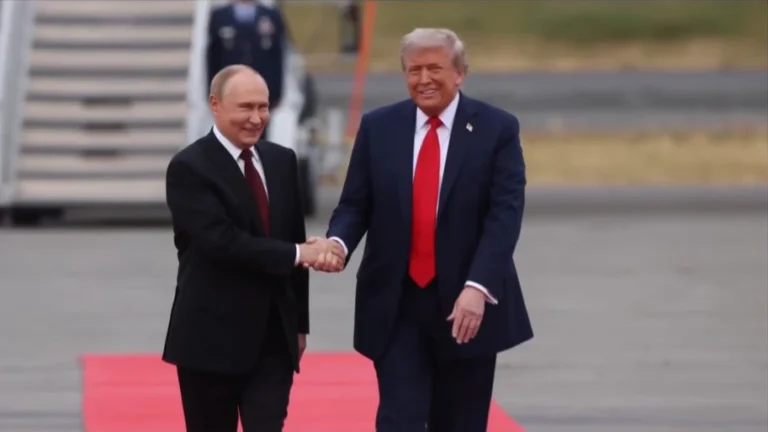
Trump’s goal was to culminate in a comprehensive, handshake deal between the two presidents, perhaps at the planned meeting on the sidelines of the Asia-Pacific Economic Cooperation (APEC) summit in Seoul at the end of October.
But a happy ending in South Korea currently seems more than uncertain. When the US recently significantly expanded its list of companies sanctioned for national security reasons, China no longer felt bound by the tacit agreement not to impose unilateral measures during diplomatic negotiations on the tariff conflict.
With its new export controls, Beijing is immediately resorting to the sharpest weapon. For the US government, this is the ultimate provocation. The softer tone of the weekend is therefore unlikely to bring about a lasting easing of tension.
What’s particularly dangerous is that both sides seem particularly confident that they have the upper hand. The US, for example, is increasingly seeking alternative sources for critical raw materials in Ukraine and Pakistan.
At the same time, Washington believes it has the power to stifle the Chinese technology boom by imposing export controls on high-end chips. And if that weren’t enough, it wants to bring the Chinese economy, which is extremely export-dependent due to systemic overcapacities, to its knees by restricting market access.
China appears unimpressed by this. It has already had positive experiences using its global dominance in the extraction and processing of critical raw materials and other intermediate products important to Western companies as leverage.
Without Beijing, the calculation goes, the assembly lines in the US will come to a standstill sooner or later. This applies not only to the sensitive area of the defense industry, but also to important US companies like Apple, which are almost existentially intertwined with China’s industrial manufacturing ecosystem.
Even if the conflict escalates further and leads to an economic downturn in China, Beijing considers its authoritarian government and social system more resilient than Western democracies with their constant elections and critical publics – especially since a confrontation with the US can be described in nationalist terms as the suppression of China’s rise. A narrative that can be used to mobilize large segments of Chinese society.
If the conflict escalates further, the situation resembles a boxing match between two heavyweights who consider themselves invincible and compete in a fight without rules. In such an unpredictable confrontation, however, not only the opponents but also the audience and the arena are affected.
The EU is also in the audience, dependent on both actors and simultaneously under pressure from both. It just concluded an unfavorable trade agreement with the US, not only to secure market access, but above all to stabilize the transatlantic alliance with its security guarantees, which are indispensable in times of Russian aggression.
Europe is in fierce industrial competition with China and is simultaneously dependent on the Chinese market and Chinese raw materials. Despite all assurances and efforts, it will take years to reduce existing dependence on China.
If the conflict between the US and China escalates, Brussels will find itself in a dilemma from which there is no escape in the foreseeable future. The alternative, in essence, is: security (US) or prosperity (China). Many countries in the Global South are in a similar situation. They have no interest in a further escalation of the US-China rivalry and fear nothing more than having to choose between the two sides one day.
The world has an interest in the two adversaries finding a way to resolve their geopolitical, geoeconomic, and even ideological conflicts peacefully and in a controlled manner. This is not about a grand compromise, but rather about the pragmatic management of the strategic rivalry between two superpowers.
Conflicts of interest and strategic differences do not need to be resolved but can be negotiated constructively. This requires red lines accepted by both sides and robust mechanisms that prevent uncontrolled escalation in the event of an emergency. Presidents Xi and Trump should focus their energies on this. It would be more productively invested there than in further spiraling the escalation spiral.
The EU and its partners in Asia, Africa, and Latin America would also benefit from this. A managed rivalry between the US and China enables third parties to balance their dependence on both sides. With its large internal market, the EU has considerable leverage that it could use strategically.
To continue with the analogy of the two boxers: Clear, previously agreed-upon competition rules are needed to ensure the fight stays in the ring and no one is deliberately injured. And if there’s no referee, the audience should loudly demand a fair fight.
Authors: Benjamin Reichenbach, Niels Hegewisch