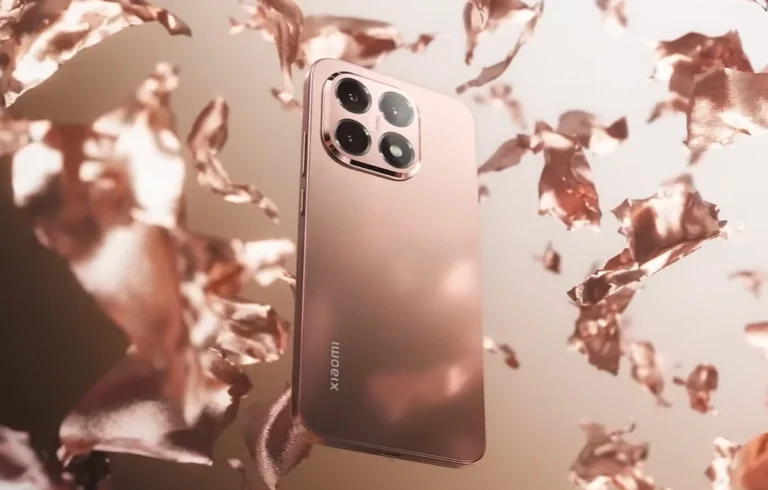

The Xiaomi 15T performed excellently in our test. The savings compared to the Pro model are barely noticeable. We rate the camera’s image quality as equally excellent, although the hardware is somewhat limited in terms of zoom and video recording. The 6.8-inch OLED display is very bright and offers good contrast and rich colours. The MediaTek processor performs brilliantly, even though it’s not the top-of-the-line model. The battery life is pleasingly long: 16.5 hours of runtime will easily get you through the day. Charging is also fast, albeit only via cable and not wirelessly. The Xiaomi 15T’s features are high-quality. And this great overall package comes at a very fair price of €650 at the time of testing.
Xiaomi 15T: A very bright display with smooth rendering
The Xiaomi 15T (for price comparison) impresses with both its quality and its price. Compared to the more expensive Xiaomi 15T Pro, the standard model lags slightly behind in processor performance, and there are minor differences in features. The Pro model also has better camera hardware.
However, the Xiaomi 15T costs around €150 less.
In terms of size, the two models are identical. The OLED display measures 6.83 inches diagonally with a resolution of 2,772 x 1,280 pixels. This results in a beautifully sharp image. Contrast and colours are equally impressive, with the extended DCI-P3 colour space being fully reproduced. There’s also a 120-hertz refresh rate for smooth scrolling.
In our brightness measurements, the Xiaomi 15T’s display even achieved a slightly higher value than the Pro model, reaching 2,888 cd/m² (nits).
However, given this enormous brightness, the difference is barely noticeable. In short, the display can withstand even the brightest sunlight and displays color-intensive HDR content brilliantly.
Not a top-of-the-line processor, but still strong performance
The processor makes a noticeable difference – probably also in the manufacturing price. Xiaomi uses current MediaTek SoCs, but while the Pro model offers the high-end chipset, the Xiaomi 15T has to make do with a lower-end version.
The built-in MediaTek Dimensity 8400 Ultra is nevertheless a powerful processor. The SoC (System on a Chip) easily handles everyday app use.
Graphics performance for gaming is also strong. In the benchmark scenario we use, GFXBench Manhattan, the Xiaomi 15T achieves a whopping 135 frames per second.
Only in the 3DMark Wild Life stress test do we see significant differences compared to the Xiaomi 15T Pro. The latter, with its top-of-the-line chipset, achieves a good 60 percent higher graphics performance.
But the performance level of both phones is so high that the difference between the processors will be barely noticeable in most games. The measurements also show that the Xiaomi 15T can maintain its peak performance for longer.
The Pro model throttles back more quickly due to heat buildup. Ultimately, the verdict is: very good performance. You’ll only need these performance peaks in rare cases.
Great battery life and quick recharge
Compared to the previous model, the Xiaomi 14T (reviewed), the battery capacity has increased slightly, from 5,000 to 5,500 mAh. In our standard test with limited display brightness and refresh rate, the smartphone now lasts a good 16.5 hours. That’s a great result and will easily get you through the day. It’s also a good hour longer than the Pro model.
Charging is fast. Charging via USB cable with up to 67 watts, so the battery is fully recharged in less than an hour. Half an hour of charging via cable is enough for a good 10 hours of battery life. The Pro model is even faster, capable of charging with up to 90 watts. But that’s not really necessary. What the Xiaomi 15T lacks entirely, however, is wireless charging using the Qi standard.
Modern equipment and six years of software updates
The Xiaomi 15T’s features are basically top-notch and even include a small extra—the infrared sensor typical of Xiaomi. While the Pro model offers Wi-Fi 7, the cheaper model makes do with Wi-Fi 6E. This shouldn’t be a problem in everyday use.
Both phones still forgo USB 3, opting for the older USB 2 standard. Therefore, data transfer via cable takes longer.
The dual-SIM slot for 5G mobile connectivity allows you to use either two nano-SIM cards or one nano-SIM and one eSIM. Bluetooth version 6.0 is available.
NFC is also available for mobile payments. The RAM is 12 GB, and you can choose between 256 or 512 GB of internal storage. Expansion via a microSD card is not possible. The casing is dust and water resistant (IP68).
Xiaomi’s so-called HyperOS is installed as the user interface, which is currently based on Android 15. However, an update to Android 16 is already planned for October 2025. Xiaomi promises four years of Android updates and six years of security patches, i.e., until 2031.
AI applications, such as image enhancements or text generation, are available via Xiaomi HyperAI, which is based on Google Gemini.
Slightly slimmed down camera, but still great image quality
The Xiaomi 15T’s triple camera setup consists of a 50-megapixel main sensor with optical image stabilization, a 12-megapixel ultra-wide-angle lens, and a 50-megapixel telephoto zoom camera.
The latter offers 2x optical zoom and up to 60x digital zoom. The Pro model boasts more in this regard—with 5x optical and 100x digital zoom—but the standard model’s camera hardware is sufficient for everyday use in most cases.
Above all, the different hardware isn’t noticeable in the image quality. Our subjective impression is that we give the photos from both phone models the same rating: they’re very good.
The Xiaomi 15T’s shots are rich in detail with clear contrast and beautiful colours. However, the latter depends on the selected colour profile: the “Leica Vibrant” mode produces richer colours, while “Leica Authentic” produces a more natural look. That’s a matter of taste.
Selfies with the 32-megapixel front camera also look good, but Xiaomi forgoes autofocus. Another difference between the standard and Pro models is in video recording: the MediaTek Dimensity 8400-Ultra processor supports a maximum of 4K resolution at 60 fps. The Xiaomi 15T Pro, on the other hand, can record in 8K resolution.
The Xiaomi 15T (for price comparison) has an MSRP of around €650 for the 256 GB model. The 512 GB version costs around €700. That’s a fair price for such a powerful smartphone.
Source: Chip.de | Follow Europeans24 for more updates!