
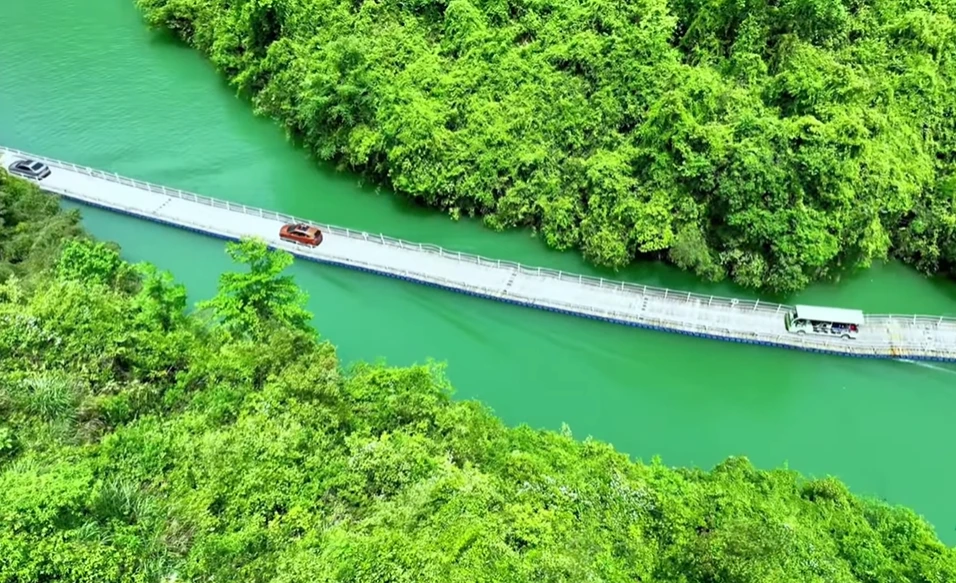
Discover China’s viral Shiziguan Floating Bridge in 2026, where cars glide across emerald water in Hubei’s Wuling Mountains. Learn the tragic 2023 accident, safety rules, visiting tips, and why this engineering marvel remains one of China’s most debated and photographed tourist attractions.
Nestled deep in the Wuling Mountains of Hubei Province, a wooden bridge appears to float on emerald water, swaying gently as vehicles glide across its surface. The Shiziguan Floating Bridge, known locally as the “Dream of the Corridor Bridge” or “China’s Most Beautiful Floating Bridge”, has become one of the country’s most photographed and debated tourist attractions. As travel to China rebounds in 2026, this engineering curiosity offers both breathtaking scenery and a sobering lesson in the risks of viral tourism.
What Is the Shiziguan Floating Bridge?
The Shiziguan Floating Bridge spans approximately 318 to 500 metres across the turquoise Qingjiang River, connecting two sides of the Enshi Prefecture’s fertile mountain valleys. Constructed using German-engineered high-density polyethylene floats filled with water for stability, the bridge was designed to harmonise with its environment rather than dominate it.
At roughly 4.5 metres wide, the bridge accommodates one-way vehicular traffic and pedestrians simultaneously, with a strict speed limit of 20 km/h (approximately 12 mph). When drivers respect this limit, the structure responds with a gentle, almost meditative sway that creates the sensation of gliding across the water’s surface.
The bridge opened in 2016 as the centrepiece of the Shiziguan Tourist Area, a 4A-level scenic zone in Xuan’en County that also features dry and water canyon systems, a wild macaque reserve, karst caves, and the Tujia ethnic group’s intangible cultural heritage performances.
Why It Went Viral: The “Driving on Water” Phenomenon
The bridge’s explosion in popularity owes everything to social media. Videos of cars creating S-shaped ripples across the emerald surface, framed by towering green mountains and nearly 60-metre-deep dazzlingly blue waters, spread across Chinese platforms like wildfire. The hashtag #狮子关浮桥 (Shiziguan Floating Bridge) accumulated hundreds of millions of views, transforming a remote Hubei county into a bucket-list destination.
The visual appeal is undeniable. On sunny days, the scene resembles a richly coloured oil painting; when mist rises from the river, it becomes a delicate ink-wash landscape. Drone footage capturing the full serpentine curve of the bridge against the canyon backdrop has become a staple of Chinese travel content creation.
The experience itself is unique. As one travel guide describes it, “Driving across at a steady 20 km/h, the bridge sways with the waves, creating unique S-shaped ripples – dubbed ‘China’s Most Beautiful Floating Bridge‘.” The sensation of wheels rolling over green traces while startling egrets into flight has a poetic quality that concrete highways cannot replicate.
The 2023 Tragedy: When Viral Fame Turned Deadly
The floating bridge’s idyllic image was shattered on May 16, 2023, when a multi-purpose vehicle carrying eight passengers crashed through the bridge’s railing and plunged into the deep Qingjiang River. Five people lost their lives; three managed to escape the submerged vehicle and swim to shore.
Surveillance footage revealed a chilling sequence: the vehicle drove onto the floating bridge at excessive speed, causing severe swaying that destabilised the car before it broke through the railing and sank. The incident exposed critical vulnerabilities in the bridge’s safety systems and raised questions about whether the structure was ever designed to handle the volume of tourist traffic it attracted.
The bridge was temporarily closed following the accident, underwent safety reviews, and has since reopened. However, the tragedy fundamentally altered how authorities and visitors approach the attraction. What was once marketed purely as a visual spectacle now carries explicit warnings about speed limits, weight restrictions (2.6–2.8 tonnes maximum), and the inherent dangers of driving on water.
Visiting Shiziguan in 2026: What Travellers Need to Know
Getting There
Shiziguan is located in Zhushan Town, Xuan’en County, Enshi Tujia and Miao Autonomous Prefecture, in southwestern Hubei Province. The most practical route is flying or taking high-speed rail to Enshi, followed by a 1 to 1.5-hour drive to the scenic area . Public transportation is limited; self-driving is strongly recommended to fully experience the floating bridge .
Tickets and Practical Information
| Detail | Information |
|---|---|
| Admission | Approximately ¥90–120 per person (varies by season and package) |
| Vehicle entry fee | ¥100 per car (required for self-driving experience) |
| Opening hours | 8:30 AM – 5:30 PM (last entry 5:30 PM) |
| Speed limit on bridge | Strictly 20 km/h |
| Weight limit | 2,600–2,800 kg |
| Recommended visit time | 1.5–2.5 hours |
The Full Shiziguan Experience
The floating bridge is merely the opening act. The broader Shiziguan Tourist Area encompasses:
Canyon Adventures: The scenic area divides into “Dry Canyon” (Mandarin Duck Gorge) and “Water Canyon” (Male-Female Gorge), featuring over 30 natural and cultural attractions . Highlights include Lion’s Roar Waterfall, the “One-Line Sky” crevice, and mysterious cliffside coffins—Xuan’en’s only suspended burial relics, hidden on 100-metre cliffs.
Macaque Water Village: A wild macaque nature reserve hosts over 100 monkeys that visitors can observe up close. Feeding is permitted with nuts purchased on-site; plastic-wrapped snacks are prohibited for animal safety.
Canyon Surfing: The “car surfing” experience involves driving through shallow water-covered roads in the scenic area’s final section, with staff occasionally spraying water for added effect . This has become a popular summer activity, though visitors should protect electronics and expect to get wet.
Glass Slides and Adventure Activities: Additional paid attractions include glass slides (¥80 per person), bungee jumping platforms, and high-altitude swings for adrenaline seekers.
Photography Tips
The floating bridge is undeniably photogenic, but capturing it well requires planning:
- Best angles: Drone footage or shots from the elevated viewing platform capture the full S-curve against the canyon backdrop
- Timing: Early morning offers the clearest light and thinnest crowds; golden hour creates dramatic reflections
- Weather: Sunny days produce oil-painting vibrancy; misty conditions create ethereal ink-wash aesthetics
- Safety first: The front passenger should handle photography while the driver focuses on the road at 20 km/h
The Broader Xuan’en Experience
Shiziguan anchors a broader tourism ecosystem that Xuan’en County has carefully developed. Travellers typically combine the floating bridge with the following:
Pengjiazhai Ancient Village: A well-preserved Tujia stilt house complex offering traditional customs, door-blocking wine ceremonies, glutinous rice cake pounding, and bamboo weaving demonstrations. Visitors can rent Tujia costumes for photos at the Wind and Rain Bridge.
Xianshan Gongshui Night Tour: The county town transforms after dark with the “Dragon Tour Gongshui”—36 bamboo rafts linked into a 252-metre illuminated dragon floating down the river. Musical fountains, drone shows, and intangible cultural heritage performances create a spectacle reminiscent of Spirited Away.
Wujiatai Tribute Tea Garden: A 4A-level scenic area where visitors can pick tea in ten-thousand-acre plantations, ride aerial balloons, and taste historically significant tribute tea once awarded plaques by Emperor Qianlong.
Yaotianyan Sinkhole: A 250-million-year-old geological formation accessible via a 50-second elevator descent of 290 metres, occasionally hosting “sinkhole concerts” that exploit the natural rock wall acoustics.
Cultural Context: The Tujia Heritage
Xuan’en sits within the Enshi Tujia and Miao Autonomous Prefecture, home to distinctive ethnic traditions that enrich the natural landscape. The Tujia “Eight-Treasure Bronze Bell Dance”—an intangible cultural heritage performance—features in seasonal celebrations at Shiziguan.
Local cuisine reflects this heritage: Xuan’en grilled live fish (with over 20 flavour variations), Tujia Hezha (tofu residue hotpot), oil tea soup, and Zhangguan fried dough are staples. The tradition of Suaiwanjiu—smashing bowls after drinking—adds theatrical flair to meals.
Safety in 2026: Lessons from Tragedy
The 2023 accident fundamentally changed the Shiziguan experience. Current safety protocols include:
- Strict speed enforcement: Cameras and staff monitor the 20 km/h limit
- Weight checks: Vehicles exceeding 2,600 kg are prohibited
- One-way traffic management: Prevents head-on encounters on the narrow bridge
- Weather closures: The bridge may close temporarily during heavy rain or high water levels, particularly during the June-July rainy season
- No lingering: Vehicles must maintain steady movement; stopping for photos is prohibited on the bridge itself
Visitors should wear anti-slip footwear, carry rain gear (mountain weather changes rapidly), and heed all staff instructions.
The Debate: Engineering Marvel or Tourist Trap?
The Shiziguan Floating Bridge encapsulates a tension central to modern Chinese tourism: the pursuit of viral spectacle versus sustainable safety engineering. Critics argue that a structure designed for light vehicular access was overwhelmed by social media-driven tourism, with visitor volumes far exceeding original capacity projections.
Defenders counter that the bridge represents innovative low-impact engineering, German float technology specifically designed to prevent rollovers, and that the 2023 accident resulted from driver negligence rather than structural failure. The bridge’s reopening after safety reviews suggests regulatory confidence in its fundamental design.
What remains undeniable is the bridge’s power as a symbol. In an era where China’s infrastructure dominates global headlines through mega-projects like the Hong Kong-Zhuhai-Macau Bridge, the Shiziguan Floating Bridge offers something different: intimacy, impermanence, and the thrill of engineering that yields to nature rather than conquering it.
Planning Your Visit: 2026 Tips
Best seasons: Spring (March–May) for tea culture and mild weather; summer (July–August) for water activities and cooling canyon temperatures; autumn for clear photography conditions
Avoid: Chinese public holidays when the floating bridge experiences extreme congestion; the June-July rainy season when closures are more frequent
Booking: Purchase tickets in advance via platforms like “Zhiyin Hubei” or “You Xuan’en” mini-programs, especially during peak periods
Accommodation: Stay in Xuan’en County for convenient night tour access, or choose boutique guesthouses near Shiziguan for immersive nature experiences (¥100–¥400 per night)
Essential packing: Waterproof phone case, sun protection, light jacket for evening river breezes, and comfortable walking shoes
The Shiziguan Floating Bridge in 2026 exists in a state of delicate equilibrium—between viral fame and responsible tourism, between engineering ambition and natural humility, and between the thrill of “driving on water” and the memory of lives lost. It remains one of China’s most visually extraordinary attractions, but one that demands respect for its limitations.
For travellers seeking authentic experiences beyond the standard Beijing-Shanghai circuit, Xuan’en County offers a compelling alternative: Tujia culture, pristine canyon landscapes, and the undeniable magic of a bridge that seems to defy gravity. Just remember to keep both hands on the wheel, both eyes on the road, and your speedometer firmly at 20 km/h.
READ More: Magical Karst Mountains of Guilin, China: Nature’s Timeless Masterpiece






[…] Shiziguan Floating Bridge: China’s Most Mesmerising and Controversial Water Highway in 2026 […]