Discover why Munich’s 219-year-old Viktualienmarkt remains Europe’s must-visit food destination in 2026. From Bavarian traditions and the iconic Maypole to 140 stalls of local and global flavours, explore what makes Germany’s most beloved open-air market a masterclass in culinary heritage, sustainable food culture, and authentic travel experiences.
In an era of supermarket chains and food delivery apps, one open-air market in the heart of Munich continues to draw up to eight million visitors annually, proving that the oldest traditions often hold the strongest appeal.
The Viktualienmarkt, Munich’s 219-year-old “Victuals Market,” has evolved from a simple farmers’ trading post into one of Europe‘s most dynamic food destinations. As global travellers seek authentic, local experiences in 2026, this Bavarian institution offers a masterclass in how heritage and innovation can coexist.
From Overcrowded Square to Gourmet Paradise: A Two-Century Journey
The Viktualienmarkt’s story begins with a practical problem. By the early 19th century, Munich’s central Marienplatz had become too congested for the city’s growing food trade. On May 2, 1807, King Maximilian I issued a decree relocating the market to a square between the Heilig-Geist-Kirche and Frauenstraße . Originally dubbed the “Green Market” for its produce, the name “Viktualienmarkt” later emerged from the Latin victualia, meaning food or provisions .
The market expanded rapidly. Between 1823 and 1829, additional space was carved out, and specialised halls followed, a butchers’ hall, fish pavilion, fruit stalls, and even a dedicated North Sea fish hall . By 1890, the market had reached its present dimensions. The devastation of World War II nearly erased this legacy, but Munich’s post-war administration made the pivotal decision to rebuild in the traditional form, organising the market into seven distinct sections .
Today, approximately 140 stalls and traders occupy 22,000 square metres in Munich’s historic core , making it one of the largest and most diverse urban food markets in Europe.
What Makes the Viktualienmarkt Unique in 2026
The Maypole: A Symbol of Bavarian Identity
Towering over the market centre stands the iconic blue-and-white striped Maypole (Maibaum), a surprisingly recent addition given the market’s ancient roots. Erected in 1962 at the suggestion of then-Mayor Albert Bayerle, who famously remarked, “If we are already a village, then we also need a maypole” , the 35-metre spruce pole has become an emblem of Munich’s self-image as a “village of millions.”
The Maypole’s carved figures tell the story of Bavarian life: brewery horse teams, Oktoberfest scenes, the traditional Schäfflertanz (Coopers’ Dance), musicians in folk costume, and the patron saints of brewing, St. Boniface and St. Florian . Every few years, Munich’s six major breweries donate a new pole, raised during a festive ceremony that draws thousands .
Memorial Fountains: Celebrating Munich’s Folk Soul
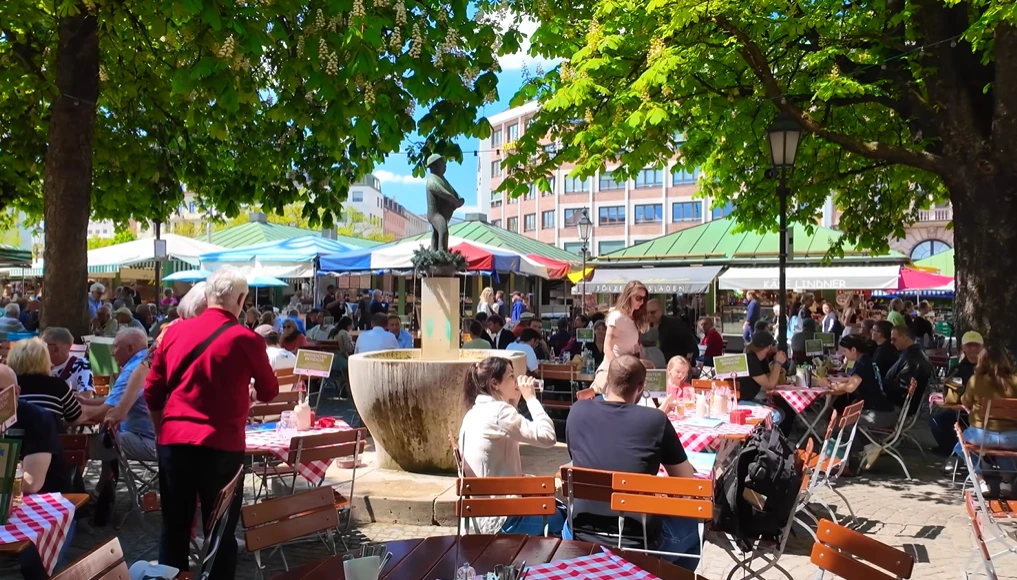
Scattered across the market, six fountains honour the comedians, folk singers, and actors who shaped Munich’s cultural identity . Tributes to Karl Valentin, Weiß Ferdl, Liesl Karlstadt, Ida Schumacher, Elise Aulinger, and Roider Jackl transform functional water features into monuments of local pride. The fountains serve practical purposes too, market-goers use them to wash produce, fill water bottles, or let their dogs drink .
The Beer Garden: Europe’s Most Central Social Hub
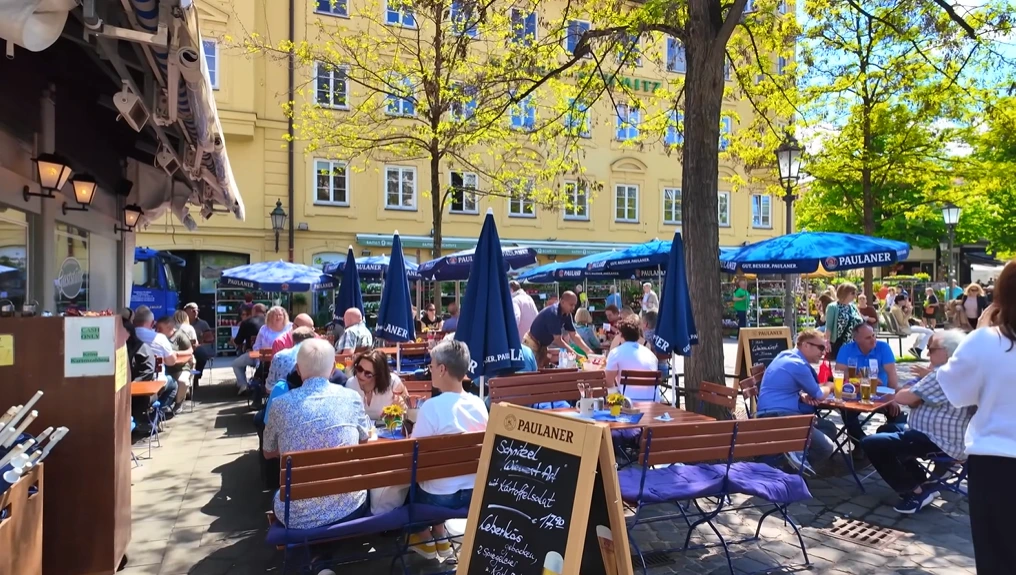
At the market’s heart lies Munich’s most central beer garden, a year-round gathering place where all six Munich breweries rotate serving duties . This isn’t merely a tourist attraction; it’s where office workers grab lunch, retirees meet for morning beer, and families gather under chestnut trees. The beer garden embodies the Gemütlichkeit—that untranslatable Bavarian concept of cosy conviviality—that defines Munich’s social culture .
The 2026 Vendor Landscape: Tradition Meets Innovation
The Viktualienmarkt’s vendor mix reveals how the market balances heritage with contemporary food trends. Permanent stalls, many operated by families who have held their positions for generations, sit alongside mobile vendors and newer arrivals .
Traditional Bavarian staples remain the market’s backbone. The Metzgerzeile (butchers’ row) offers Leberkäse (Bavarian meatloaf), Schweinshaxe (pork knuckle), and Weißwürstel (veal sausages) with sweet mustard . The Wörle Kaspar horse butcher’s shop stands as Munich’s only remaining horse butcher , while bakeries like Hofpfisterei maintain stone-oven techniques dating to the Wittelsbach era .
Alpine and European specialities dominate the dairy section. The Tölzer Käseladen and Thoma Fromages et Vines sell aged Bergkäse from Alpine dairies, truffle cheeses, and handmade goat’s cheese . Ten stalls offer dairy goods primarily from nearby Alpine regions but also from across Europe .
Global flavours have expanded the market’s reach. Greek antipasti, Spanish hams, exotic fruits, and fresh seafood from “river, lake and sea” reflect Munich’s cosmopolitan evolution . The Münchner Suppenküche serves seasonal soups and stews, while Café Nymphenburg Sekt offers sparkling wine with homemade cake .
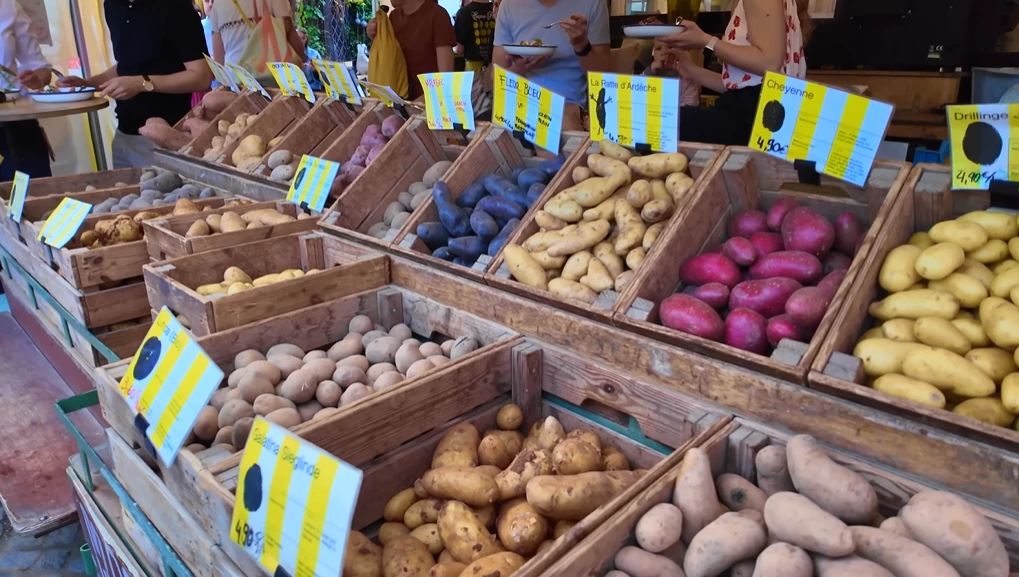
Sustainability and local sourcing increasingly shape vendor offerings. Caspar Plautz, the market’s renowned potato stand, exemplifies this trend—almost all products are locally and organically grown or produced, and the operators track Munich’s latest food trends while maintaining traditional methods . The “Lebe Gesund” (Live Healthy) stall caters to growing demand for organic vegetables, fruits, and homemade products .
The 2026 Event Calendar: When to Visit Viktualienmarkt
The Viktualienmarkt isn’t static-it pulses with seasonal events that transform routine shopping into cultural spectacle :
| Event | 2026 Date | Significance |
|---|---|---|
| Narrhalla Carnival Kick-off | November 11, 2025, at 11:11 | Official opening of carnival season with the Munich Carnival Prince and Princess |
| Market Women’s Dance | February 17, 2026 | Costumed market women perform rehearsed dances; attracts thousands annually |
| Asparagus Season Opening | Mid-April 2026 | Signals the arrival of Bavaria’s “royal vegetable” |
| Maypole Raising | May 1, 2026 (periodic) | Folk festival with muscle power and musical accompaniment |
| Brewers’ Day | June 2026 (biennial) | Procession from St. Peter’s Church; brewing apprentices take their traditional oath |
| Fountain Festival | First Friday, August 2026 | Merchants decorate the six memorial fountains with flowers |
| Gardeners’ Day | First Tuesday, August 2026 | 17th-century tradition: decorated wagons parade to the Hofbräuhaus |
| Celebrity Weighing | Post-Oktoberfest 2026 | Charity event since 1974: personalities weighed against groceries |
| Winter Magic | November 21, 2025–January 5, 2026 | Christmas lights, mulled wine, and a nativity scene in the beer garden |
The Winter Magic market, running through early January 2026, offers a distinctively food-focused alternative to Munich’s larger Christmas markets, with festive lighting and the beer garden nativity scene as standout attractions .
Why the Viktualienmarkt Matters in 2026
A Model for Urban Food Markets
The Viktualienmarkt has become a case study in how public markets can anchor city life. The Social Life Project, which analyses public spaces globally, identifies several factors behind its success: seamless connection to surrounding streets through eight separate entrances, “inside-out” stall designs that spill displays into pathways, and the layering of restaurants, cafés, and small standing-table bars that invite lingering .
The market functions as both commercial hub and social infrastructure. Locals like Teja Ebel, a 21-year-old Munich resident, visit weekly for fresh vegetables, cheeses, and meats while meeting friends in the garden . Tourists from around the world, Germany‘s National Tourist Board projects 121.5 million international overnight stays by 2030 —discover Bavarian culture through its flavours.
Economic Resilience and Challenges
Like all traditional markets, the Viktualienmarkt faced existential threats during the COVID-19 pandemic. Some stalls disappeared, though new vendors emerged by 2023 . The market’s municipal operator, Markthallen München, also runs the Elisabethplatz, Wiener Platz, and Pasing Viktualienmarkt locations, suggesting a networked approach to sustaining public market infrastructure .
The market’s premium positioning—some visitors note higher prices compared to suburban alternatives —reflects its central location and quality guarantee. Yet it remains accessible: credit cards are widely accepted, most vendors speak English, and free Wi-Fi is available through Stadtwerke München .
Cultural Preservation in a Digital Age
In 2026, the Viktualienmarkt represents something increasingly rare: a physical space where commerce, culture, and community intersect without digital mediation. The market’s design—kiosk structures creating intimate courtyards, water fountains encouraging spontaneous interaction, the beer garden as democratic meeting ground—resists the atomisation that online shopping encourages .
The 2026 Munich Creative Business Week (mcbw) recognised this value, installing a “wishing well” pop-up container at the market where visitors could toss coins and share hopes for the future . The installation, created by Augsburg University students, raised funds for Herzenswünsche e.V., demonstrating how the market continues to serve as a platform for civic engagement .
Visiting in 2026: Practical Guide
Best timing: For atmosphere and people-watching, visit Thursday to Saturday after midday . For grocery shopping without crowds, arrive before 8 a.m.—some stalls open as early as 5:30 a.m. .
Getting there: A five-minute walk from Marienplatz and major tram/subway stations .
What to try: Start with a Weißwurstfrühstück (white sausage breakfast) with wheat beer, sample Leberkässemmel from the butchers’ row, try Alpine cheese at Tölzer Käseladen, and finish with Schmalznudeln (fried dough pastries) at Café Frischhut .
Pronunciation tip: It’s “Fiktualienmarkt”—the German “V” sounds like “F” .
As food tourism evolves in 2026, travellers increasingly seek authenticity over convenience, provenance over packaging, and community over consumption. The Viktualienmarkt delivers all three. From its 1807 origins as an overcrowded square’s overflow to its current status as one of Europe’s great marketplaces, it demonstrates that the best food destinations don’t merely sell products—they preserve culture, sustain local economies, and create the social connections that define great cities.
For visitors to Munich in 2026, the Viktualienmarkt isn’t just a stop on an itinerary. It’s an immersion into Bavarian life as it’s actually lived—one Maß Bier, one Brezel, and one conversation with a market vendor at a time.
Sources: Munich Official Tourism Board, Viktualienmarkt München, Social Life Project, From Place to Place Travel, Munich Creative Business Week, City Tour Card München, GoKonfetti