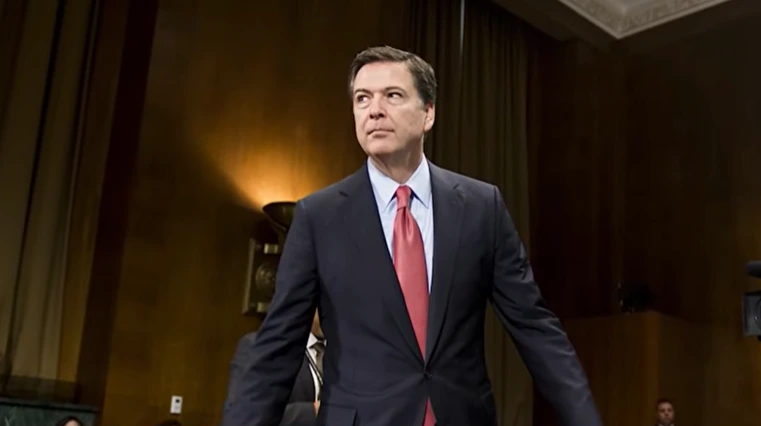
Former FBI Director James Comey faces two federal counts for a social media post showing seashells arranged as “86 47”.
The long-simmering feud between former FBI Director James Comey and the current administration reached a dramatic legal boiling point Tuesday. A federal grand jury in the Eastern District of North Carolina returned a two-count indictment against Comey, alleging that a seemingly benign photo of seashells he shared on social media nearly a year ago constituted a criminal threat against President Donald Trump.
The case centers on a May 2025 Instagram post featuring a photograph of shells arranged on a beach to form the numbers “86 47”. While Comey has long maintained the post was an encounter with a “political message” he found on a morning walk, federal prosecutors now argue the imagery was a coded call for violence.
The Charges: A “Serious Expression of Intent”
The three-page indictment, signed by Assistant U.S. Attorney Matthew Petracca, alleges that the “86 47” arrangement was a clear signal to harm the 47th president. Under federal law, “86” is often used as slang for banning or removing someone, but prosecutors contend it can also be interpreted as a call for assassination.
| Charge Count | Description | Potential Penalty |
| Count 1 | Knowingly and willfully making a threat to take the life of and inflict bodily harm on the President. | Up to 5 years in prison and a fine. |
| Count 2 | Knowingly and willfully transmitting in interstate commerce a threat to kill the President. | Up to 5 years in prison and a fine. |
Acting Attorney General Todd Blanche, who previously served as Trump’s personal lawyer, defended the move during a Tuesday evening press conference. “Threatening the life of the president of the United States will never be tolerated,” Blanche stated, asserting that the investigation had been underway for roughly a year.
The “Beach Walk” Defense
Comey, who was fired by Trump in 2017, has vigorously denied any violent intent. In a video statement posted shortly after the indictment was made public, the former FBI director appeared resolute but weary of the ongoing legal battles.
“This is not who we are as a country,” Comey said in the video. “I am still innocent, I am still not afraid, and I still believe in the independent federal judiciary”.
Shortly after the original post surfaced in 2025, Comey deleted it and issued a clarification, stating he saw the formation on a beach walk and assumed it was a political message. “I didn’t realize some folks associate those numbers with violence,” he wrote at the time, adding that he opposes violence of any kind.
Legal Thresholds and Procedural History
This marks the second time the Justice Department has pursued a criminal case against Comey. A separate indictment in September 2025—alleging he lied to Congress—was tossed by a federal judge because the lead prosecutor had been unlawfully appointed.
Legal experts suggest the “seashell case” may face significant hurdles.
- True Threat Standard: Prosecutors must prove to a jury that Comey intended the post as a “true threat,” a high legal bar for ambiguous symbols or slang.
- Contextual Evidence: The indictment does not currently list evidence beyond the public Instagram post.
- Vindictive Prosecution: Comey’s lawyers have previously argued that the government is targeting him out of “personal spite”.
The case has been assigned to U.S. District Judge Louise Wood Flanagan in the Eastern District of North Carolina, a jurist originally appointed by George W. Bush.