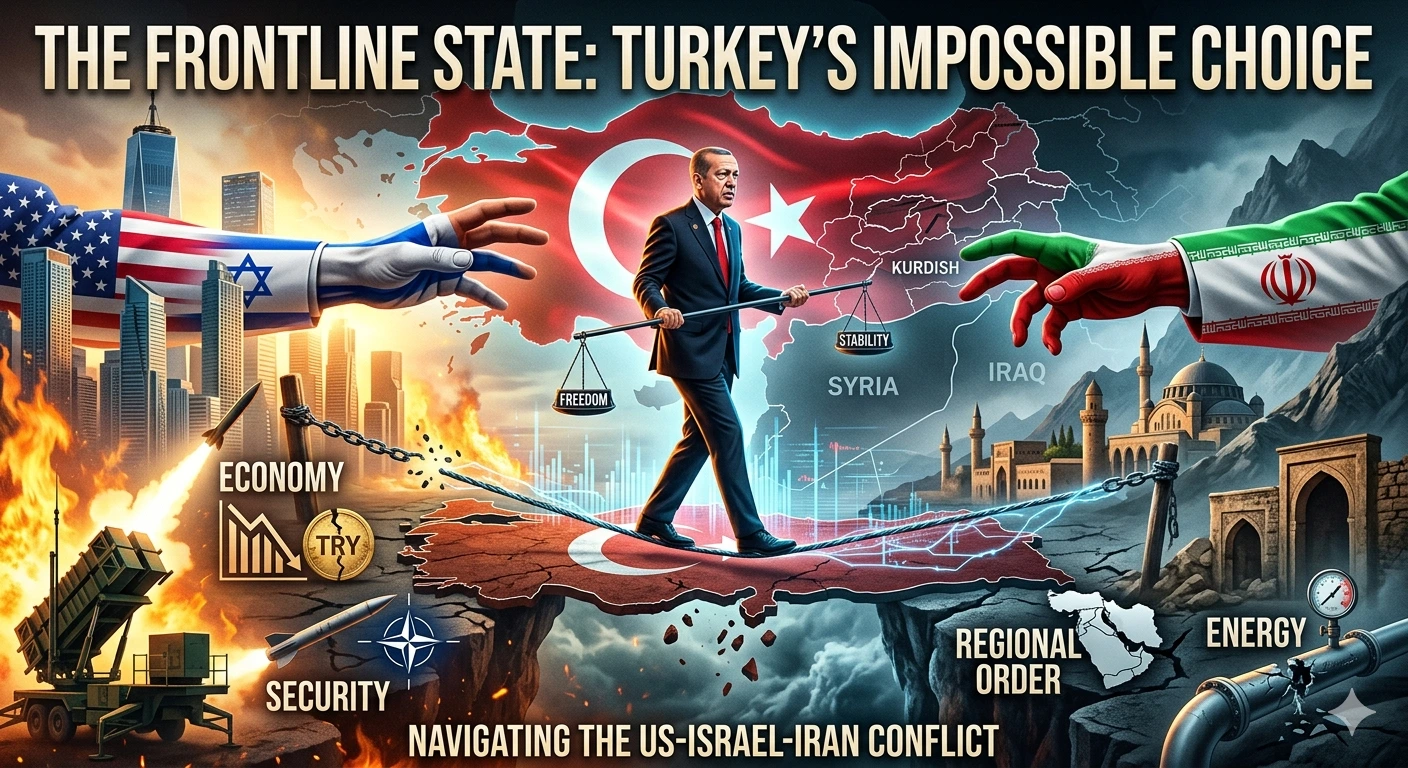
The US-Israel aggression in Iran has forced Turkey into a sensitive position, placing strain on the economy, security, and regional order.
For years, Türkiye’s foreign policy has been based on opportunistic maneuvering rather than strong alliances: it keeps pathways open to opposing centers of power, rejects full strategic dependency, and maintains flexibility in a fractured area.
However, the battle with Iran not only puts this method to the test, but it also places Ankara in a far more constricted position. Ankara is neither a combatant nor a spectator, but rather in the problematic position of a frontline state that cannot afford to pick sides but must shoulder the consequences of a conflict it did not initiate and cannot easily exit.
The costs to the economy, security sector, and regional order are increasing. Individually, each of these areas may still be managed. Taken together, they raise the basic question of whether Turkey can truly retain its careful middle ground in this war.
Turkey’s economy was already extremely weak before the crisis. Years of unconventional monetary policy, frequent currency depreciation, and high inflation have eroded private buying power and business trust. The Iran conflict did not create Turkey’s economic crisis; rather, it hastened and intensified it.
This is particularly visible in the energy sector. Iran formerly covered around 14% of Turkey’s natural gas imports, a structural reliance that has directly resulted in price pressures due to war-related supply interruptions and exacerbates already difficult-to-control inflationary tendencies. Transportation costs, industry inputs, and consumer prices are all influenced in equal measure.
Beyond the oil industry, the battle throws into doubt Turkey’s ambitions to become a transit hub between Central Asia, the Middle East, and Europe. For Turkish strategists, regional stability is more than simply a geopolitical priority. It is part of the economic model.
Some in Turkey believe that weakening Iran might shift freight, oil, and aviation transportation flows to Turkish borders. However, potential gains from this would only occur in the longer future and would be a necessity.
In the short term, however, unrest in Iran and Iraq has eroded investor confidence and delayed the return on infrastructure investments. There is also a chance that a fractured Iran may produce the same cross-border issues as Syria did: refugee flows, illicit networks, and a widespread economic crisis along Turkey’s southern border.
The security implications of the Iran conflict were felt immediately in Turkey. The authorities have verified that at least three Iranian ballistic or cruise missiles landed or were intercepted within Turkey’s borders. NATO air defense systems were participating in the interception mission.
However, the Iranian government has denied culpability, blaming the occurrences on technological failures or third-party operations.
The Turkish government has responded with remarkable restraint. Officials acknowledged the provenance of the missiles but avoided language that might worsen the problem. Crucially, Ankara has not invoked Article 5 of the North Atlantic Treaty, despite the fact that the occurrences officially qualify for it.
This forbearance is a deliberate strategic move to keep diplomatic lines open and prevent an escalation that would require Turkey to align with one faction.
The deployment of more Patriot missile batteries has revived a politically charged discussion about Turkey’s air defense infrastructure. Ankara is no longer fully interoperable with NATO’s integrated air defense network as a result of its decision to buy the Russian S-400 system in 2019 and subsequent exclusion from the American F-35 program. The current crisis has shown this difference with exceptional clarity, reintroducing the problem into public discourse.
Economic and security challenges may be considerable, but they are not the primary source of Turkey’s problems. Turkey’s strategic considerations revolve around what the post-war regional order would look like once Iran has been completely crippled or destabilized. It’s more difficult to answer.
Turkey’s policy has never been based on ideological similarities with the Islamic Republic. Nonetheless, Iran served a useful role in Turkey’s estimation of the regional balance of power. He served as a counterweight to Israeli power and was one of the few surviving entities capable of establishing a multipolar regional framework.
According to Ankara, the fighting has eventually resulted in a shift in regional supremacy to Israel, a scenario that the Turkish leadership is deeply concerned about.
This anxiety has been bolstered by Israeli discourse. In a speech in February 2026, former Israeli Prime Minister Naftali Bennett referred to Turkey as “the new Iran” and warned of a growing Turkish danger. The relevance of such phrases resides less in their analytical clarity than in what they convey to Ankara: Israel may increasingly regard a more assertive Turkey in a post-Iranian regional order as a strategic concern.
Whether this corresponds to an established doctrine of Israeli state policy or reflects the sharper tone of the war climate is controversial. The effects on Turkey’s threat perception are not.
The conflict has posed considerable challenges for Turkey. The Kurdish dimension is the most difficult. Before the battle, Ankara engaged with the PKK to disarm after imprisoned leader Abdullah Öcalan called for the group to disarm and disintegrate by February 2025. In May 2025, the PKK stated that it would cooperate with the most serious attempt in the organization’s almost five-year existence to put a stop to an insurrection that has killed tens of thousands. But the Iran conflict is placing a strain on this process.
The Party for a Free Life in Kurdistan (PJAK), the PKK’s Iranian sister group, strongly opposed Öcalan’s proposal for disarmament. According to reports, the CIA was considering equipping Kurdish forces in Iran to apply pressure on the regime. Washington originally disputed it.
President Trump then urged Iran’s Kurds to take up weapons, calling it “wonderful.” He did, however, reverse his mind within 48 hours. For Ankara, the ramifications of reactivating armed Kurdish players throughout Iran would be obvious: the war would extend beyond Iran.
For decades, Turkey and Iran have worked together to resolve the Kurdish matter. Not as partners, but as two governments committed to opposing Kurdish territorial consolidation along their shared border. Joint operations against the PJAK and PKK infrastructure, intelligence exchange mechanisms, and coordinated cross-border strikes all followed the functional logic of a single security policy. What Ankara now fears is more than just a weakening of its neighbor. It represents the breakdown of a regional order in which the Kurdish issue was contained, although violently.
Iran has a different position in Turkey’s strategic thinking than Syria or Iraq ever did. The Turkish-Iranian boundary was codified in 1639 and is one of the region’s oldest stable boundaries. When Turkish authorities assert Iran’s sovereignty and territorial integrity, it is not only a diplomatic declaration. It also serves as a historical memory of this order and indicates a strategic concern of what may happen if one of the region’s few stable state systems collapsed.
This explains why Turkey has been so cautious about the conflict. Ankara is attempting to hold several fronts at once: to cushion the economic shock without exacerbating domestic political instability; to mitigate the security consequences without being drawn into a direct confrontation; to prevent a new wave of Kurdish insurgencies beyond its borders; and to oppose a regional order characterized by either Iran’s collapse or Israel’s unchecked domination.
The basic dilemma of Turkish foreign policy is whether this attitude still gives Turkey freedom to modify the developing order or whether it endangers it even more if the order becomes established.
The author, Evren Balta, is a Professor at the Department of Comparative Politics & International Politics, Özyeğin University, Istanbul, Türkiye. She’s a graduate of Columbia University and received her doctorate from CUNY, USA.
The article first appeared on IPG.