Starring Giacomo Giorgio and Dharma Mangia Woods, “Morbo K” revisits a vital chapter of Italian history. Explore the blend of fiction and fact in the new Rai Fiction drama about the Roman Ghetto roundups.
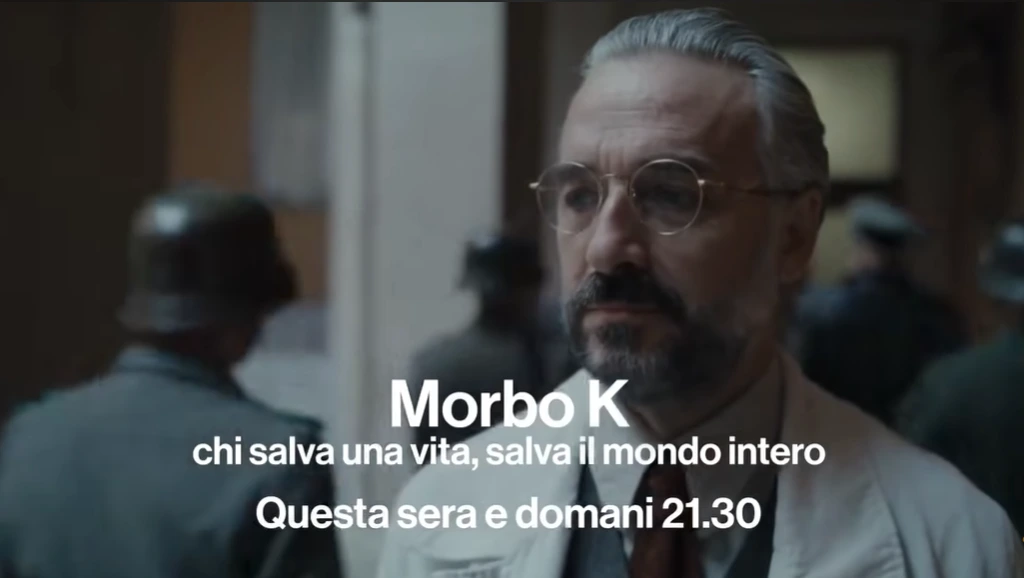
The series Morbo K, which airs on Rai 1 on January 27th and 28th (the first episode coinciding with Holocaust Remembrance Day), highlights a particularly courageous and vital chapter in Italian history that occurred at the height of the catastrophe of World War II.
Produced by Rai Fiction and Fabula Fiction, the series directed by Francesco Patierno revisits a pivotal episode centred on Dr Giovanni Borromeo, head physician at the Roman Fatebenefratelli hospital (whose name in the series is changed to Professor Prati, played by Vincenzo Ferrara).
It is September 1943, after the armistice, and Rome is occupied by the Nazis: German Colonel Herbert Kappler blackmails the capital’s Jewish community by demanding 50 kilogrammes of gold to avoid deportation, but many suspect that this is merely a greedy diversion to enrich himself while still completing the mission of deporting Jews to Germany.
Having guessed the colonel’s true intentions, the head physician of the Fatebenefratelli hospital—a hospital located on Tiber Island, just steps from the Jewish Ghetto—has an idea to save as many people as possible from the roundups: he transfers some Jewish families to a special ward of the hospital, inventing a phantom virus called K disease or K’s disease (the initial, not coincidental, is that of Kappler but also of the infamous Luftwaffe Field Marshal Albert Kesselring), whose dangerous and contagious nature was supposed to keep German soldiers away.
Those hospitalised in the ward were advised to cough loudly and cover their faces with handkerchiefs as soon as foreign soldiers came, thus warning them of the potential infection. Meanwhile, the network formed around Borromeo was intended to allow the bogus patients to create false documents in order to avoid deportation after their genuine identities were proclaimed dead.
On the day of Kappler’s terrible roundup of the Roman Ghetto on October 16, 1943, many more individuals were admitted to the K-Mode ward. Despite this, it is estimated that the Nazis captured around 1,259 individuals and loaded them onto trains, most of which were bound for concentration camps such as Auschwitz.
However, it is unknown how many Jews were saved as a result of Borromeo’s and those close to him’s intuition: according on the sources, the number is approximately twenty persons, but the amounts might range from 45 to a hundred.
Borromeo also distinguished himself by other acts of bravery and assistance for the Resistance, such as building a clandestine radio in the Fatebenefratelli cellar and assisting General Roberto Croci, his patient and Fosse Ardeatine hero.
The Rai drama Morbo K adds fictional plots to the historical reconstruction of a true event, such as the fraught love story between aspiring artist Silvia Calò (Dharma Mangia Woods), a member of one of the Jewish families close to Dr. Prati, and Pietro Prestifilippo (Giacomo Giorgio), the professor’s assistant who is already engaged to another woman.
The confluence of their stories with key historical events will reach a culmination during the Roman Ghetto’s roundup and expulsion by train.
Among the love tale and the drama of deportation, Giovanni Borromeo’s brave gesture stands out, possibly never fully reported before today. Borromeo, who died at the age of 63 in 1961, was honoured in 2004 by Yad Vashem, Israel’s national Holocaust Remembrance Centre, who named him to the list of the Righteous Among the Nations, a group of non-Jews from around the world who distinguished themselves by saving and protecting Jews during the Holocaust.