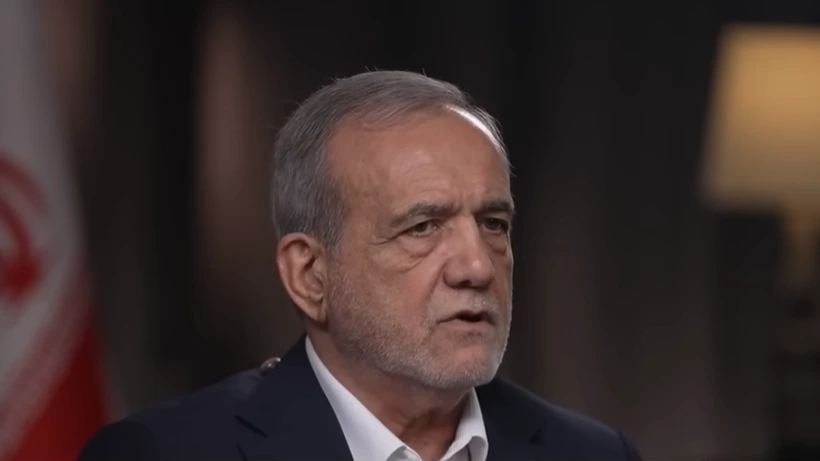
President Masoud Pezeshkian states Iran is in a “full-scale” conflict with the US, Israel, and Europe.
In a chilling escalation of rhetoric that has sent shockwaves across global capitals, Iranian President Masoud Pezeshkian declared on Saturday that the Islamic Republic is now in a state of “total war” with the United States, Israel, and Europe.
In an extensive interview published on the official website of Supreme Leader Ayatollah Ali Khamenei, Pezeshkian characterized the current geopolitical standoff as a multidimensional conflict more “complex and difficult” than the devastating eight-year Iran-Iraq war of the 1980s.
The declaration comes at a fragile moment for the Middle East, just six months after a brief but intense military exchange in June 2025, and days before a high-stakes summit between U.S. President Donald Trump and Israeli Prime Minister Benjamin Netanyahu.
The Rhetoric of ‘Total War’
President Pezeshkian’s comments mark a departure from the “shadow war” era, bringing the confrontation into stark, official terms. He argued that Iran’s adversaries are no longer just targeting military assets but are attempting to “bring the country to its knees” through a coordinated assault on all fronts.
“In my view, we are at total war with the United States, Israel, and Europe,” Pezeshkian stated. “They do not want our country to stand on its own feet. They are besieging us from every aspect—economically, culturally, politically, and in terms of security.”
Comparing the current climate to the 1980s conflict with Iraq, Pezeshkian noted that while the previous war had clear frontlines and conventional missile exchanges, the modern “total war” involves a sophisticated pressure campaign designed to destabilize the Iranian livelihood and provoke domestic unrest.
The Legacy of the June ‘12-Day War’
Central to the current escalation is the fallout from the “12-Day War” in June 2025.10 During that conflict, Israel—later joined by the United States—conducted a series of precision airstrikes on deeply buried Iranian nuclear and military facilities, including sites at Natanz and Fordow.
While a ceasefire brokered on June 24 has technically held, Tehran has used the months since to signal its resilience. Pezeshkian claimed on Saturday that Iran’s military is now “stronger than during the 12-day war” in terms of manpower and equipment, warning that any further provocations would face a “decisive and crushing response.”
A Multidimensional Siege
The Iranian leadership’s shift to “total war” terminology reflects the severe economic strain currently felt in Tehran.13 Recent reports indicate the Iranian rial has hit record lows, with widespread shopkeeper protests breaking out in the capital over the last 48 hours.
Tehran views these economic hardships not as mismanagement, but as a deliberate “weaponization” of global finance by Western powers. By framing the crisis as a “total war,” the government appears to be attempting to galvanize nationalistic sentiment and justify further military expenditures despite the domestic economic turmoil.
Global Stakes and the Trump-Netanyahu Summit
The timing of Pezeshkian’s declaration is widely seen as a message to Mar-a-Lago, where President Trump and Prime Minister Netanyahu are scheduled to meet this week.
Intelligence reports suggest the two leaders will discuss options for “Operation Midnight Hammer II,” aimed at preventing Iran from rebuilding the ballistic missile production facilities damaged in the June strikes.
As the shadow of 2025 draws to a close, the international community watches with bated breath. With Iran officially declaring a state of total war, the transition into 2026 threatens to be one of the most volatile periods in modern Middle Eastern history.