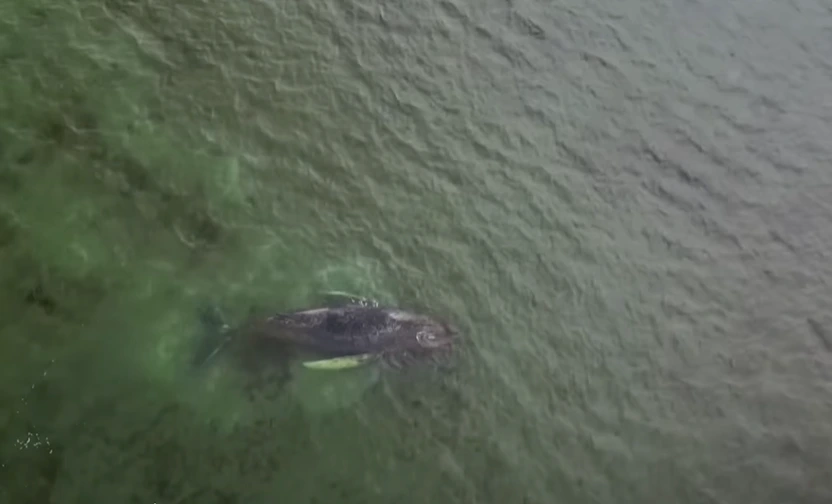
“Timmy”, the whale, is stranded for a third time in Wismar Bay. Read the latest on the critical rescue efforts, the 500m exclusion zone, and why experts fear the Baltic Sea has become a trap for the 15-metre giant.
The coastline of northern Germany is holding its collective breath as “Timmy”, a young male humpback whale, remains immobilised in the shallow waters of Wismar Bay. After a gruelling week that has seen the 14-metre giant free itself twice only to run aground again, marine biologists warned on Monday that the animal’s condition has reached a critical “bottleneck” where survival is now a slim mathematical probability.
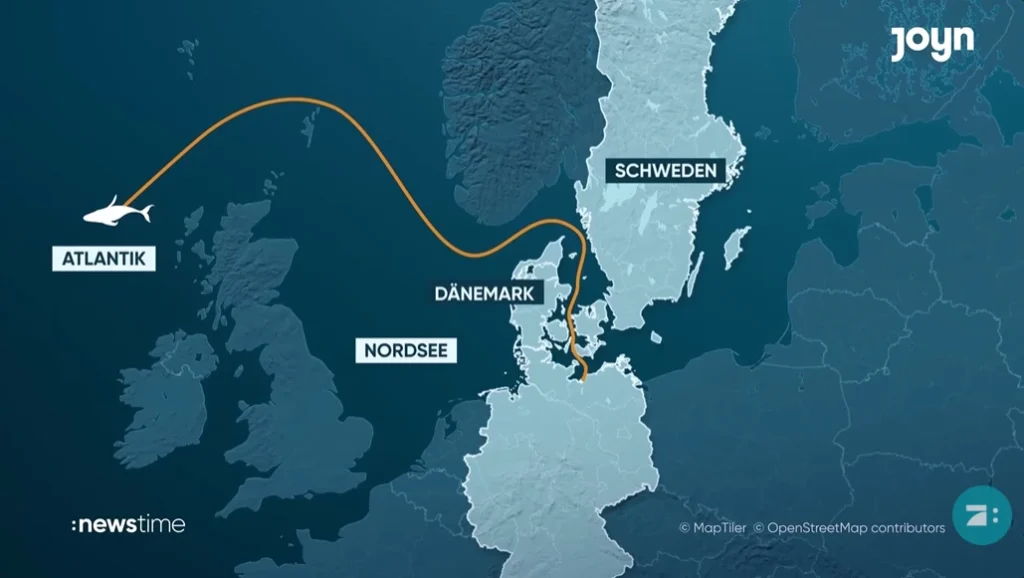
Since first appearing in the Baltic Sea on March 3, the whale—nicknamed “Timmy” after his initial stranding at Timmendorfer Strand, has become a national symbol of the fragile boundary between human intervention and nature’s harsh reality.
A Week of Desperate Measures
The rescue operation has been one of the most complex in German maritime history. When Timmy first became stuck on an “underwater ramp” near Niendorf on March 23, local authorities took the unprecedented step of deploying a heavy-duty excavator to dig an escape channel through the sandbank.
While the whale successfully navigated that trench on Friday morning under a “police escort” of six vessels, his journey toward the Atlantic was cut short. By Saturday, he was spotted struggling further east near Wismar, and by Sunday evening, experts confirmed a third, more severe stranding.
| Data Point | Details of “Timmy” the Humpback Whale |
| Estimated Size | 12–15 meters (approx. 40 feet) |
| Weight | Estimated 25–30 tons |
| Current Location | Wismar Bay (Mecklenburg-Western Pomerania) |
| Health Markers | Skin disease (low salinity), slow breathing, fishing net scars |
| Safe Distance | 500-meter restricted zone established around the animal |
“The Prognosis is Not Good”: Expert Assessments
On Sunday afternoon, Till Backhaus, the Environment Minister of Mecklenburg-Western Pomerania, held a somber press conference in Wismar. He announced a total exclusion zone of 500 meters to prevent onlookers from further stressing the animal.
“He is weakened, and he is sick,” Backhaus stated frankly. “We have decided to give him space. If he regains his strength, he must find the path himself. But we must also prepare for the possibility that he will not leave this bay alive.”
Burkard Baschek, Director of the German Oceanographic Museum in Stralsund, was even more clinical in his assessment. “To reach the North Sea and the Atlantic, he must navigate nearly 500 kilometers (310 miles) of narrow, shallow straits. In his current state, with visible skin lesions and a plummeting respiratory rate, those chances are relatively slim.”
Why the Baltic is a “Death Trap” for Humpbacks
Humpback whales are not native to the Baltic Sea, and for a deep-water mammal, these waters present three lethal challenges:
- Low Salinity: The Baltic’s brackish water lacks the salt concentration needed for whale skin health, leading to the rapid development of fungal and bacterial infections.
- Lack of Nutrition: While whales can go weeks without eating, they cannot replenish the massive energy reserves required for a 500-kilometer sprint through the Danish straits without their usual diet of krill and small fish found in the Atlantic.
- Acoustic Confusion: Experts speculate Timmy may have been disoriented by the noise of a submarine or followed a shoal of herring too far into the narrow “bottle opening” of the Baltic.
The Final Effort: “Silent Observation”
As of Monday morning, March 30, the rescue teams have shifted from active intervention to “silent observation.” Marine biologist Stefanie Groß noted that Timmy did not react when vessels approached on Sunday evening, a sign of extreme exhaustion.
The strategy now is to hope that a combination of rest and the next high tide will provide one last window of opportunity. “If the whale can’t get off the sandbank in the next 24 hours,” said Sven Biertümpfel of Sea Shepherd, “it will be a death sentence.”