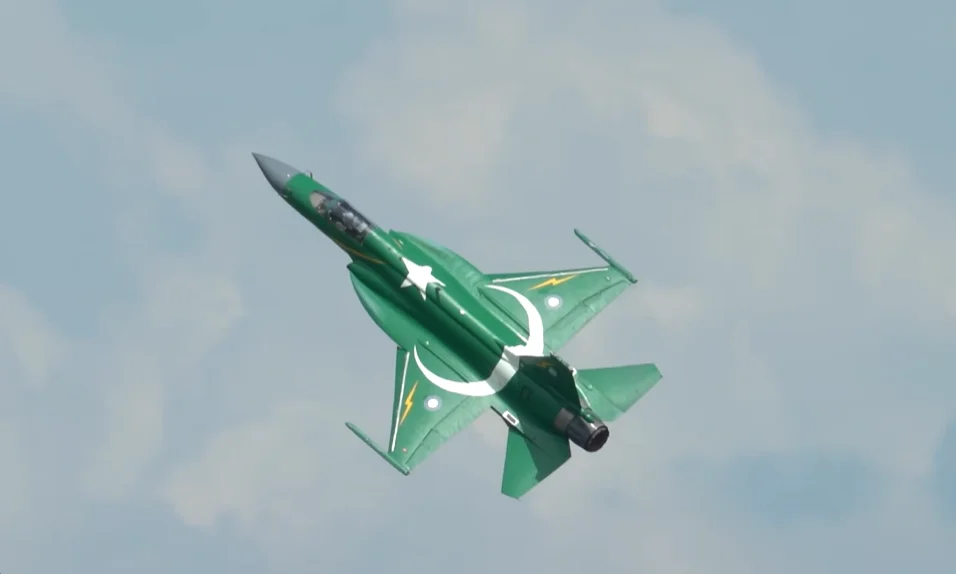
JF-17 Thunder Block III review: $16M multirole fighter with AESA radar, PL-15E missiles. Full operator list, capabilities, and why emerging economies choose Pakistan’s jet.
In an era where fourth-generation fighter aircraft routinely command price tags exceeding $60 million per unit, the emergence of the JF-17 Thunder represents nothing short of a paradigm shift in military aviation economics. This Pakistan-China collaborative project, once dismissed by Western analysts as a “budget alternative,” has evolved into a sophisticated multirole combat platform that is rapidly becoming the aircraft of choice for air forces across the developing world.
From the deserts of Nigeria to the Caucasus mountains of Azerbaijan, the Thunder is proving that strategic air power need not bankrupt national treasuries. With unit costs ranging between $16–30 million roughly one-third the price of an American F-16 Block 70 the JF-17 offers an unprecedented value proposition: near-peer combat capability at a fraction of the cost, delivered without the geopolitical strings that typically accompany Western military hardware .
Genesis of a Disruptor: The JF-17 Development Story
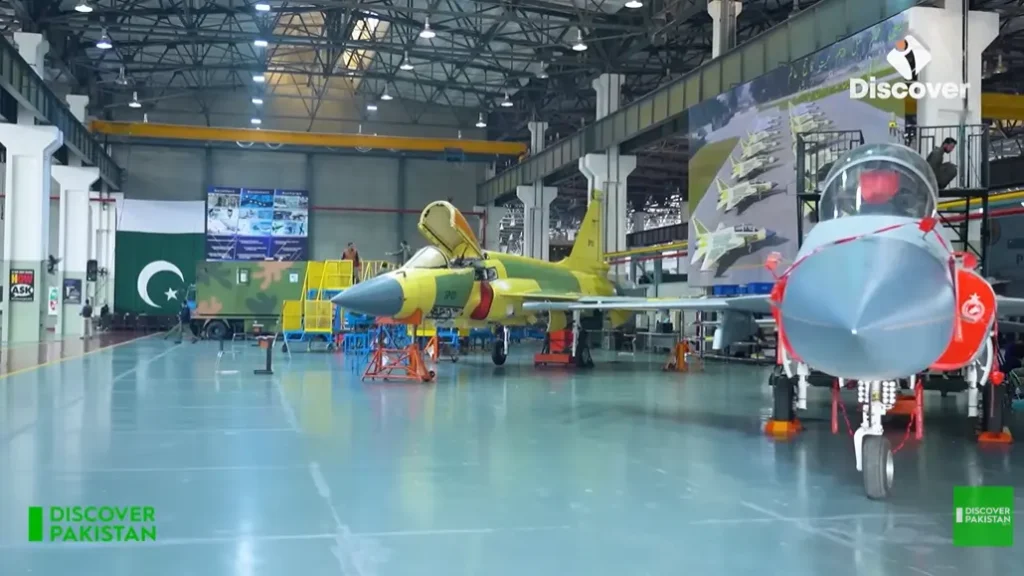
The JF-17 Thunder designated FC-1 Xiaolong (Fierce Dragon) in China, emerged from necessity in the late 1990s. Pakistan, facing chronic budget constraints and increasingly unreliable access to American F-16s due to shifting geopolitical winds, partnered with China’s Chengdu Aircraft Corporation to develop an indigenous solution. The goal was ambitious yet pragmatic: create a modern, affordable fighter that could replace aging fleets of Chinese J-7s, French Mirage IIIs, and American F-7s while avoiding dependence on foreign suppliers .
The result was a lightweight, single-engine multirole fighter that first flew in 2003 and entered Pakistan Air Force (PAF) service in 2007. What began as a stopgap measure has evolved through three major blocks, with the latest Block III variant representing a generational leap that places the Thunder firmly in the 4.5-generation category alongside far more expensive competitors .
Technical Evolution: From Basic to Block III
Block I & II: Establishing the Foundation
The initial JF-17 variants provided essential multirole capability—air defense, ground attack, and reconnaissance—powered by the Russian-designed Klimov RD-93 engine, a derivative of the MiG-29’s powerplant. These early blocks featured pulse-Doppler radar, limited beyond-visual-range (BVR) capability, and a top speed of Mach 1.6. While modest by Western standards, they offered developing nations something previously unavailable: a pathway to modern air combat without prohibitive costs or technology transfer restrictions .
Block III: The Game-Changer
The JF-17 Block III, which entered PAF service in 2023 and began export deliveries in 2025, transforms the Thunder from a capable light fighter into a genuine threat to heavyweight opponents. At its core lies the NRIET/CETC KLJ-7A Active Electronically Scanned Array (AESA) radar—a system capable of detecting targets at ranges exceeding 105 kilometers while tracking 15 aircraft simultaneously and engaging four at once .
This AESA radar represents a critical technological threshold. Unlike traditional mechanically scanned radars, AESA systems offer superior resistance to electronic jamming, lower probability of intercept, and the ability to conduct multiple functions simultaneously—search, track, and electronic warfare. The KLJ-7A provides detection capabilities comparable to systems found on the Saab Gripen E and F-16 Block 70, aircraft costing three to four times as much .
The Block III’s cockpit represents another quantum leap. Pilots interface with three multifunction displays, a wide-angle holographic head-up display (HUD), and a Helmet-Mounted Display/Sight (HMD/S) system that enables “look-and-shoot” capability with high-off-boresight missiles. An integrated Infrared Search and Track (IRST) sensor and Missile Approach Warning System (MAWS) create a multi-layered defensive network against modern threats .
Combat Capability: Punching Above Its Weight
Air-to-Air Arsenal
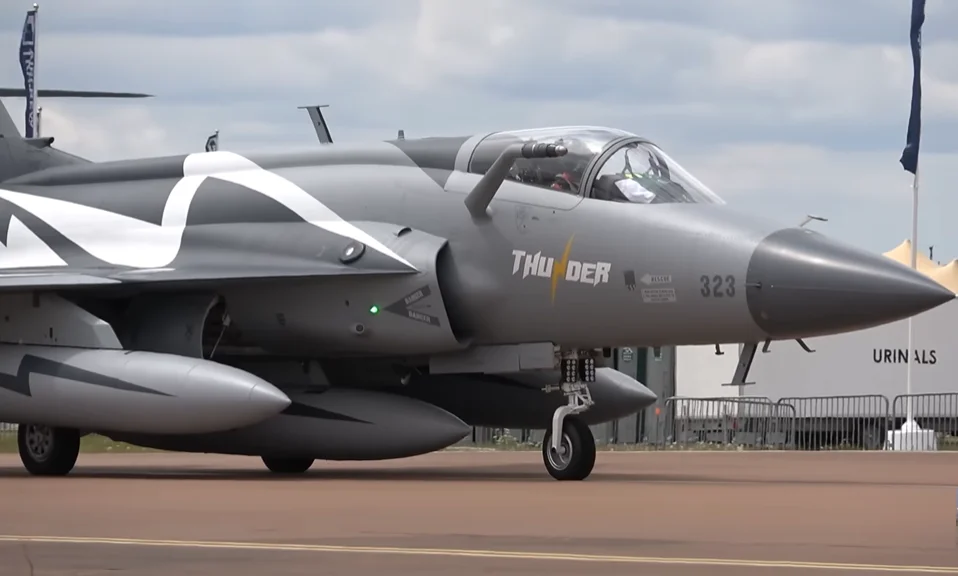
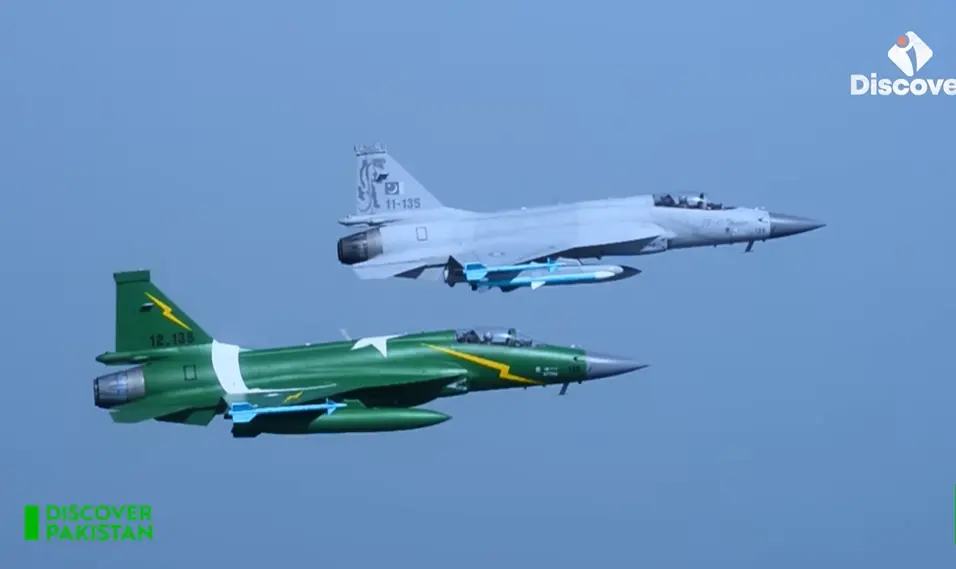
The Block III’s most significant combat advantage lies in its integration of the PL-15E beyond-visual-range missile, with an engagement envelope exceeding 145 kilometers. This weapon, equipped with an active radar seeker and dual-pulse motor, outranges most Western and regional adversaries, including India’s Astra Mk.1 (110 km range). When paired with the PL-10E short-range imaging infrared missile for close combat, the Thunder presents a credible threat even to advanced opponents .
For comparison, the F-16 Block 70 carries the AIM-120D AMRAAM with approximately 160 km range—only marginally superior to the PL-15E—yet costs $40+ million more per aircraft. This missile-range parity fundamentally alters cost-benefit calculations for air forces operating under budget constraints .
Ground and Maritime Strike
The Thunder’s eight external hardpoints accommodate 3,600 kilograms of ordnance, enabling simultaneous multirole operations. Precision strike options include the CM-400AKG supersonic standoff missile, C-802AK anti-ship missile, and MAR-1 anti-radiation weapons for Suppression of Enemy Air Defenses (SEAD) missions. Integration with Turkish ASELPOD targeting pods further enhances precision ground-attack capability, reflecting growing defense cooperation between Islamabad and Ankara .
Current Operators: A Growing Fraternity
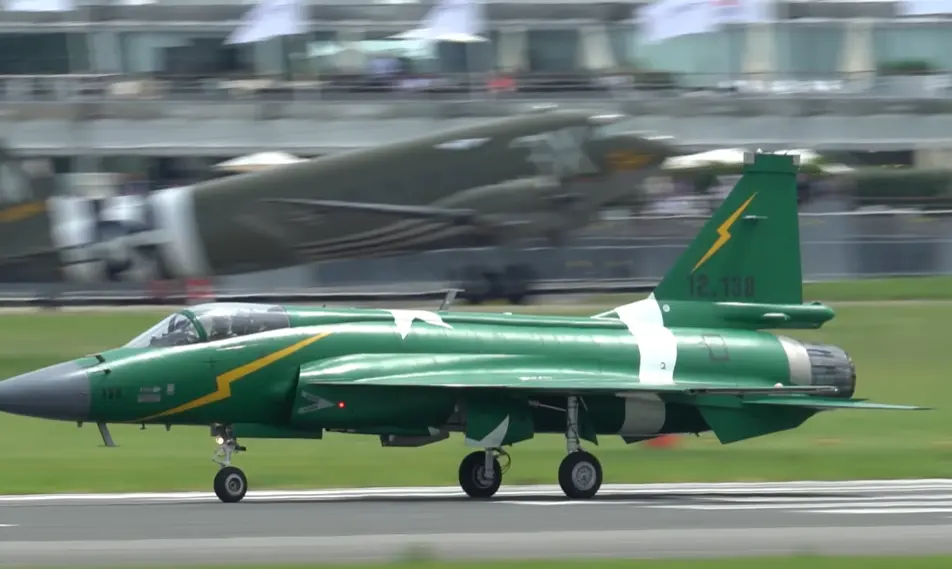
As of early 2026, the JF-17 operates with four confirmed export customers, with several others in advanced negotiations:
Pakistan (158+ Aircraft)
The PAF remains the Thunder’s primary operator, having inducted over 158 aircraft across all blocks. The JF-17 now forms the backbone of Pakistan’s fighter fleet, replacing legacy Mirage III/5 and F-7 aircraft while complementing newer F-16s and J-10Cs .
Myanmar (16 Aircraft)
Myanmar became the first export customer in 2015, acquiring 16 Block II fighters for approximately $560 million ($35 million per unit). These aircraft have operated in counter-insurgency roles against ethnic armed groups in challenging tropical and mountainous terrain, validating the Thunder’s reliability in Southeast Asian conditions .
Nigeria (3 Aircraft)
The Nigerian Air Force received three Block II fighters in 2021 for $184 million, including training and support infrastructure. Operating primarily against Boko Haram insurgents in the Lake Chad region, Nigerian officials have publicly described the JF-17 as a “game-changer” for counter-terrorism operations. Future procurement of Block III units remains under discussion .
Azerbaijan (40 Aircraft)
Azerbaijan represents the Thunder’s most significant export success to date. In September 2024, President Ilham Aliyev announced a $4.6 billion contract for 40 Block III fighters—the largest defense export deal in Pakistan’s history. The first deliveries arrived in October 2025, with aircraft participating in Baku’s Victory Day parade that November. This acquisition replaces aging Soviet-era MiG-29s and Su-25s while strengthening ties with Pakistan and Turkey .
Iraq (12 Aircraft)
Baghdad finalized a $1.8 billion deal for 12 Block III fighters in 2023, seeking to rebuild air combat capabilities degraded by decades of conflict and sanctions. Deliveries are expected to commence pending logistical preparations .
Future Operators: The Pipeline Expands
Multiple nations are actively negotiating JF-17 acquisitions, signaling the aircraft’s growing acceptance in global markets:
Argentina
Buenos Aires has allocated $664 million for 12 Block III fighters to replace obsolete A-4 Skyhawks and counter British Typhoons in the Falklands theater. Political opposition and potential U.S. counter-offers remain obstacles, but the JF-17 represents Argentina’s only viable path to modern air combat capability given British arms embargoes .
Bangladesh
Dhaka has expressed sustained interest in acquiring 8–16 aircraft to supplement its aging F-7 and MiG-29 fleets, though negotiations have proceeded cautiously due to regional power dynamics .
Other Prospects
Countries including Egypt, Sudan, Bolivia, and Congo have reportedly held discussions with Pakistani officials. At the November 2025 Dubai Airshow, the PAF signed a Memorandum of Understanding with an undisclosed “friendly nation” for potential Block III sales, suggesting additional announcements may be imminent .
Comparative Analysis: JF-17 vs. The Competition
| Specification | JF-17 Block III | F-16 Block 70 | Tejas Mk.1A | Gripen C |
|---|---|---|---|---|
| Unit Cost | $16–18 million | $63+ million | $42 million | $60 million |
| Generation | 4.5 | 4.5 | 4.5 | 4.5 |
| Radar | KLJ-7A AESA | AN/APG-83 AESA | Uttam AESA | PS-05/A Mk.4 |
| Max BVR Range | 145 km (PL-15E) | 160 km (AIM-120D) | 110 km (Astra) | 150 km (Meteor) |
| Thrust/Weight | 1.07 | 1.095 | 0.98 | 1.02 |
| Combat Radius | 900 km | 1,295 km | 1,000 km | 800 km |
| Hardpoints | 8 | 9 | 8 | 8 |
| Payload | 3,600 kg | 7,700 kg | 3,500 kg | 4,200 kg |
Sources: Defense Security Asia, Jane’s Defence Weekly, IDSA Issue Brief
The comparison reveals the JF-17’s strategic positioning: it sacrifices some payload capacity and raw performance compared to the F-16, but delivers comparable sensor and missile capabilities at roughly 25% of the cost. For developing nations prioritizing air defense and regional deterrence over global power projection, this trade-off proves highly favorable.
Why the JF-17 Succeeds: The Developing World Perspective
The Thunder’s export success stems from addressing specific pain points experienced by air forces in Africa, Asia, and Latin America:
1. Economic Accessibility
At $16–30 million per unit (depending on configuration and support packages), the JF-17 enables “quantity over quality” procurement strategies. For the price of one F-16, air forces can acquire two to three Thunder fighters, maintaining operational readiness through numerical superiority rather than technological overmatch .
2. Operational Sovereignty
Unlike American platforms subject to Congressional oversight, end-use monitoring, and potential sanctions under laws like CAATSA (Countering America’s Adversaries Through Sanctions Act), the JF-17 comes without political conditionalities. Operators maintain full control over deployment, armament, and maintenance schedules a crucial consideration for nations with complex foreign policy portfolios .
3. Maintenance Simplicity
The Thunder’s design philosophy emphasizes ease of maintenance suitable for infrastructure-limited environments. Pakistan Aeronautical Complex (PAC) offers comprehensive training programs, and the aircraft’s Russian-derived engine enjoys global supply chains independent of Western approval .
4. Flexible Financing
Chinese state backing enables creative financing arrangements—barter agreements, long-term payment plans, and offset arrangements that Western manufacturers rarely match. This financial flexibility proves decisive for cash-constrained governments .
5. Combat Proven
Having participated in Operation Swift Retort (2019) against India and sustained counter-insurgency operations in Pakistan’s tribal areas, the JF-17 has demonstrated reliability under combat conditions—credentials many competing light fighters lack .
Limitations and Criticisms: The Other Side of the Coin
Objective analysis requires acknowledging the Thunder’s constraints:
Engine Performance
The RD-93 engine, while reliable, generates 91.2 kN of thrust with afterburner—adequate but not exceptional. The JF-17’s thrust-to-weight ratio of 1.07 provides acceptable maneuverability but falls short of supermaneuverable fighters like the Su-35 or F-22. Hot-and-high performance at elevated airfields remains a documented limitation .
Payload Constraints
With 3,600 kg maximum external load compared to the F-16’s 7,700 kg, the Thunder cannot match heavyweight strike missions. It excels as an air defense interceptor and light strike platform but requires support for heavy precision strike or deep interdiction roles .
Electronic Warfare Limitations
While the Block III incorporates advanced radar warning receivers and jamming pods, its electronic warfare suite lacks the sophistication of dedicated platforms like the EA-18G Growler or integrated systems on the F-35. In high-threat environments against advanced integrated air defense systems (IADS), the JF-17 requires careful mission planning .
Logistical Footprint
Despite maintenance advantages, the JF-17’s unique Pakistan-China supply chain creates potential vulnerabilities. Unlike F-16s with global support networks or Russian aircraft with established spare parts markets, Thunder operators depend heavily on Islamabad and Beijing for critical components—a consideration for nations seeking supply chain diversification .
Combat Record Limitations
While combat-tested, the JF-17 has not faced peer adversaries in aerial combat. Its performance against modern fighters like the Rafale, Typhoon, or F-15 remains theoretical. The 2019 India-Pakistan aerial skirmishes saw JF-17s provide support roles rather than direct BVR engagements, leaving questions about its effectiveness against top-tier opposition .
Strategic Implications: Redefining Military Aviation Markets
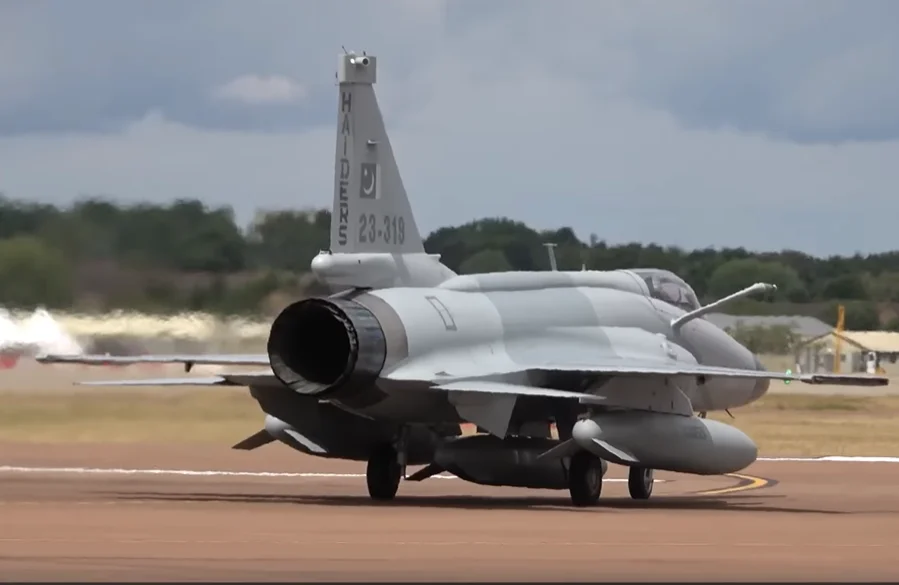
The JF-17’s emergence carries profound implications for global defense economics:
Democratization of Air Power
By making fourth-generation-plus capability accessible to nations with defense budgets under $5 billion annually, the Thunder challenges the historical monopoly of wealthy nations on advanced air combat. This democratization enables middle powers to assert air sovereignty previously unattainable .
Shift in Defense Industrial Centers
Pakistan’s transition from arms importer to significant exporter, generating over $5 billion in JF-17-related revenue, demonstrates how collaborative development programs can elevate developing nations in global defense supply chains. The Kamra production facility’s annual capacity of 20–25 aircraft supports both domestic and export demand, creating sustainable industrial capacity .
Geopolitical Realignment
JF-17 sales strengthen Pakistan-China defense cooperation while expanding Islamabad’s diplomatic influence. Azerbaijan’s acquisition, for instance, followed Pakistani support during the 2020 Nagorno-Karabakh conflict, illustrating how military sales reinforce political alliances .
Pressure on Western Manufacturers
The Thunder’s success forces legacy manufacturers to reconsider pricing strategies for entry-level fighter markets. Saab’s Gripen E and Lockheed’s F-16V face increasing pressure to demonstrate value propositions justifying 3–4x cost premiums, a challenge intensifying as Block III capabilities narrow the performance gap .
The Road Ahead: Future Developments
Pakistan and China continue refining the Thunder platform:
PFX Program
Unveiled in 2024, the Pakistan Fighter-X initiative aims to develop a stealth-enabled derivative bridging the gap between fourth and fifth-generation capabilities. While details remain classified, analysts anticipate reduced radar cross-section, internal weapons bays, and advanced avionics drawing from China’s FC-31 program .
Engine Upgrades
Russian manufacturer UEC has developed the RD-93MA variant offering enhanced thrust and reliability. Integration with future Block III+ aircraft could address current performance limitations while maintaining logistical compatibility .
Expanded Weapon Integration
Ongoing development focuses on integrating hypersonic weapons, advanced anti-ship missiles, and standoff jamming pods, progressively expanding mission profiles without requiring airframe changes—a benefit of the Thunder’s open-architecture avionics .
For air forces of developing economies, the JF-17 Thunder represents not merely an affordable alternative, but a strategically optimal solution. It delivers the critical 80% of combat capability, modern radar, long-range missiles, network-centric warfare—at 25% of flagship fighter costs, while avoiding the political dependencies and operational restrictions inherent in Western procurement.
The aircraft’s limitations, modest payload, adequate rather than exceptional performance, supply chain concentration, are real but manageable for nations prioritizing territorial defense over power projection. As Azerbaijan’s $4.6 billion investment and Iraq’s $1.8 billion commitment demonstrate, the Thunder has transcended its “budget fighter” origins to become a genuine contender in mainstream defense markets.
In an increasingly multipolar world where strategic autonomy gains value, the JF-17 offers something unique: credible combat capability on developing world terms. For nations from Buenos Aires to Dhaka seeking air power without bankruptcy or subordination, the Thunder provides a viable path to the skies—one that is reshaping global military aviation economics for decades to come.
This analysis is based on open-source intelligence, manufacturer specifications, and defense industry reporting. Unit costs and specifications vary by configuration and contract terms.