
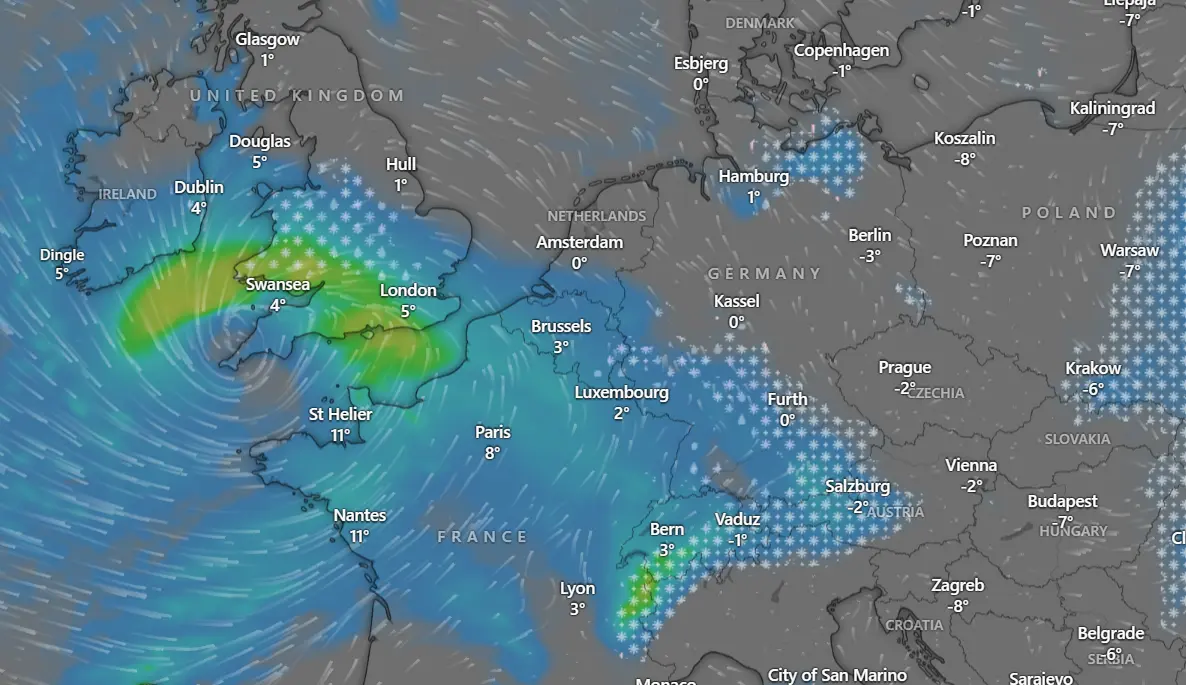
Winter has fully gripped Germany, with schools shuttered, transportation restrictions in place, and waste stacking up. The initial effects of the forecasted storm “Elli” have already been felt. Meteorologists predict that the worst of the storm is still to come.
Heavy snowfalls have already fallen in the north, but Danijel Stanic of the ARD meteorological centre in Frankfurt am Main warns that this is only the beginning. Storm Elli’s first fringes are scheduled to arrive in the southwest this evening.
There, the snow will transition to rain, and ice conditions may occur. Up to 15 centimetres of snow are anticipated in central Germany. The northern climate will stay generally dry.
On Friday, snow will fall as far as the Elbe River. “This will be an extreme situation,” stated a meteorologist from the German Weather Service (DWD) in Potsdam. A region running from the North Sea eastward may see widespread accumulations of roughly 10 centimetres, with some locations receiving up to 20 centimetres of new snow.
The DWD has issued a severe weather warning (level three out of four) for the area stretching from East Frisia to Hamburg, as well as major portions of Schleswig-Holstein.”It could become dangerous,” warns ARD meteorologist Stanic. Wind gusts could generate snowdrifts. Walks, particularly through the forest, should be avoided because the weight of the snow may cause tree branches to break.
Cancellations and delays in bus and train services
According to operators, S-Bahn, U-Bahn, and bus services in Hamburg were cancelled or disrupted on Thursday. Regional rail lines in Schleswig-Holstein and Lower Saxony were also partially disrupted.
Long-distance services were cancelled, including those connecting Hamburg, Kiel, Rostock, Copenhagen, Hanover, and the Ruhr region. Speeds were also decreased on numerous high-speed lines, including those between Berlin and Wolfsburg, as well as Cologne and Frankfurt am Main, which may cause delays.
Due to inclement weather, Deutsche Bahn has relaxed the train-specific ticket limits for long-distance train journeys booked in advance for travel between Friday and Sunday. The business also encouraged passengers to assess the situation before beginning their journey and to avoid unnecessary travel.
Some ferries to and from the East Frisian Islands are not scheduled to operate on Friday.
Accidents on slick roadways
There have already been numerous accidents on the roads, some of them fatal. Near Gehrde in Lower Saxony, a driver died on Thursday morning when, according to police, he lost control of his car on a slippery federal highway and crashed into a tree.
In Baden-Württemberg, an 86-year-old man died on Wednesday after being struck by a turning snowplow in Villingendorf.In Hesse, the Interior Ministry called on residents to refrain from unnecessary car and bicycle journeys on Friday. While the state is expected to be less severely affected, weather-related dangers are still a threat, explained Interior Minister Roman Poseck (CDU).
Firefighters, police, and rescue services are preparing accordingly. In Cologne, the city administration warned of falling branches due to storms, snow, and freezing rain. Forests and parks should be avoided.
Schools are closed, and waste collection has been cancelled.
Authorities in Hamburg, Bremen, sections of Schleswig-Holstein, and many Lower Saxony districts have chosen to cancel in-person school lessons on Friday. The Hamburg Senate and the Schleswig-Holstein State Firefighters Association recommended residents to stay at home as much as possible on Friday and avoid needless travel.
Parents in Berlin, Mecklenburg-Western Pomerania, and Brandenburg were allowed to leave their children at home on Friday owing to inclement weather, according to state administrations. School bus services in two regions of Mecklenburg-Western Pomerania were also scheduled to be cancelled on Friday. However, schools in all three states stayed open.
Garbage collection in numerous Lower Saxony regions has been halted owing to inclement weather, since ice roads prohibit trash disposal vans from reaching all communities. Hamburg is also experiencing some waste collection issues due to snow and ice.
CDU cancels closed-door meeting
Even politics has not avoided the snowstorm. The CDU executive committee cancelled its closed-door meeting in Mainz on short notice owing to weather threats. However, during his visit to the CSU’s closed-door conference in Bavaria, Chancellor Friedrich Merz announced that a virtual gathering of the party’s leadership will be convened to adopt several resolutions.
The CDU’s closed-door gathering on Friday and Saturday was scheduled to attract 350 people and perhaps 100 media representatives. The party intended to kick begin the 2026 election year, which would include five state elections. Among other things, the intention was to issue a “Mainz Declaration” aimed largely at encouraging the economy.
Bundesliga matches are set to take place
The anticipated winter storm has so far had little effect on the Bundesliga. “The DFL is on alert. However, all matches are now under progress,” a German Football League representative informed the German Press Agency (dpa). They basically monitor and appraise the situation in the north on a daily basis.
Fan clubs have already asked for assistance with snow removal. Some Union Berlin fans scraped ice and snow off the stadium’s walkways and entrance gates so that Saturday’s match versus Mainz could go place.
Given the freezing temperatures, social welfare organizations are warning of the risk of homeless people freezing to death. “For people living on the streets, it is sometimes life-threatening,” said Elke Ronneberger, Executive Director for Social Policy at Diakonie Germany. She called on cities and municipalities to provide and fund more warm shelters.
It is crucial these days that no one looks away, emphasized Kerstin Tack, chairwoman of the Lower Saxony branch of the Paritätische Wohlfahrtsverband (a social welfare organization). “Every encounter can save lives: approach people, offer help, and immediately call emergency services if you notice any health warning signs.”
According to the Federal Association for Homeless Assistance, approximately 56,000 people across Germany are currently living on the streets without any accommodation.
Residents in Great Britain and France are also preparing for the severe winter storm: Weather services in both countries have warned of strong winds and heavy snowfall. The British Met Office issued severe weather warnings for several regions. Significant snowfall is expected, particularly in Wales and the English Midlands. Heavy snow is also forecast for southern England. Furthermore, gusts of 95 to 110 kilometers per hour are possible along the southwest coast of England.
The French weather service warned of gale-force winds of up to 160 kilometers per hour, particularly in the Manche department on the English Channel coast, where the highest level of severe weather warning was issued. The prefecture urged people to stay home and not to travel by car. Rail services in the region are also experiencing disruptions.