
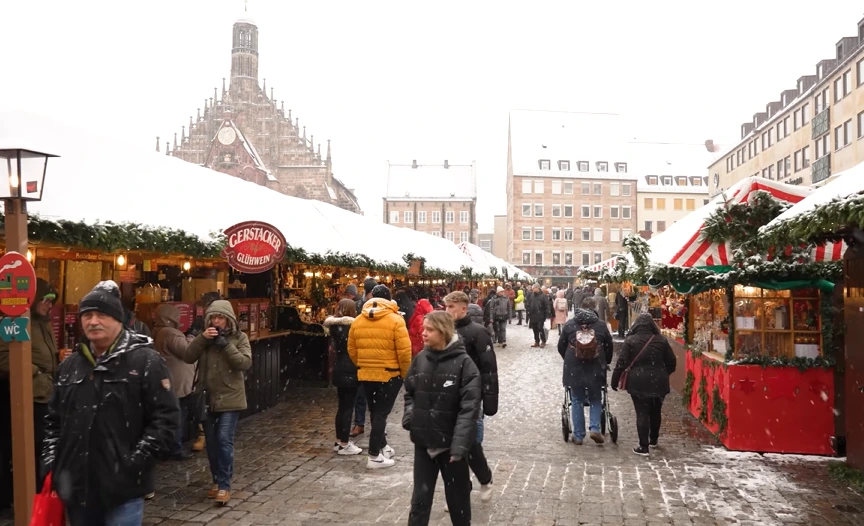
Snowmen on Christmas? In most parts of Baden-Württemberg, the possibilities are small. Why the idea of a winter wonderland is becoming increasingly uncommon.
Every year in Baden-Württemberg, there is a modest hope that a few snowflakes will fall from the sky on Christmas. The Christmas markets smell of mulled wine, and strings of lights glitter – yet somewhere in the air, the question lingers: will the region between the Odenwald forest and Lake Constance become a winter paradise in December?
Meteorologists at the German Weather Service (DWD) are currently scrutinising their models attentively. And these models convey an image that is more realistic than romantic. A peek ahead to the holidays:
What are the chances of a white Christmas this year?
Meteorologist Uwe Schickedanz expresses little optimism. The German Weather Service (DWD) can anticipate the next five to seven days, with a maximum of one week and a half. “But we don’t see any sign of winter at all until just before Christmas,” according to the scientist. The reverse is also true: “With the weather we’re experiencing these days, the chance of a white Christmas has actually decreased somewhat.”
Where are the chances the lowest?
Meteorologists largely use statistics. According to Schickedanz, climate change has the potential to drastically alter these results. According to these figures, a quality sledding run will be difficult to achieve in low-lying places; chances in cities such as Karlsruhe, Stuttgart, and Mannheim are fewer than 3%. In mid-mountain locations such as the Swabian Alb, the middle Black Forest, or the upper altitudes of the Odenwald, the statistical odds increase to 20 to 40 percent, and in the high elevations of the Black Forest, they reach 70 percent.
Why are there such large differences?
In Baden-Württemberg, altitude is the most important element affecting the possibility of snowfall: lower-lying places have a substantially reduced chance of a white Christmas. This is why Stuttgart, Ulm, and Reutlingen see more snowfall than the bigger Baden cities of Karlsruhe, Mannheim, and Heidelberg. The last time the entire state saw a fully white Christmas was in 1986 and 2010.
However, geographical factors do have an influence. For example, the little resort town of Schwarzach in the Odenwald forest is at a similar altitude as Freiburg, Weil am Rhein, and Müllheim – however, “Baden Siberia” has seen eight snowy Christmases since 1991, whilst southern Baden has only had three.
Is there anywhere in the nation or at high altitudes where snow is guaranteed?
Not really. Even the Feldberg, the Black Forest’s highest summit at about 1500 meters, can no longer guarantee a white Christmas. ” We got more than half a metre of snow on the Feldberg by the end of November. Even the snow has melted, leaving just a few melancholy relics, according to Schickedanz. Freudenstadt in the Northern Black Forest has the highest Christmas snow dependability, whereas Westerheim in the Swabian Alps is a tiny winter sports resort.
Why do snowy Christmases occur so seldom in this country?
Meteorologists refer to it as the normal “Christmas thaw”. A white Christmas is an uncommon event, unless you reside in the Central Uplands or near the Alps. “For most Germans, Christmas is more green than white,” explains Schickedanz.
According to the German Weather Service (DWD), the first snowfall of the season frequently occurs as early as the end of November. In certain regions, another cold wave may occur in mid-December. However, just before Christmas, the snowy cover normally disappears when moderate Atlantic air moves in from the west. “These mild air masses often completely melt the previously fallen snow cover,” according to a DWD study. Depending on the location, this “Christmas thaw” is projected to occur 60 to 70 percent of the time each year.
What is the relationship between climate change and a white Christmas?
“A great deal,” says DWD meteorologist Schickedanz. In Baden-Württemberg, the temperature has risen by around 2 degrees Celsius over the last 60 years – yet these are 2 degrees that might be crucial for snowfall at around 0 degrees Celsius. “This implies that climate change plays an important role,” explains Schickedanz. “Climate change has made it substantially less probable to enjoy a white Christmas in many sections of the country. They will become much less probable in the future.
According to one research, climate change has resulted in an average of 18 more winter days with minimum temperatures above 0 degrees Celsius in Germany during the last ten years than in a world without climate change. “According to our analysis, Germany is among the ten countries most affected by the loss of cold winter days,” says Kristina Dahl, Vice President and Chief Scientific Officer of Climate Central, a Princeton-based non-profit organisation.