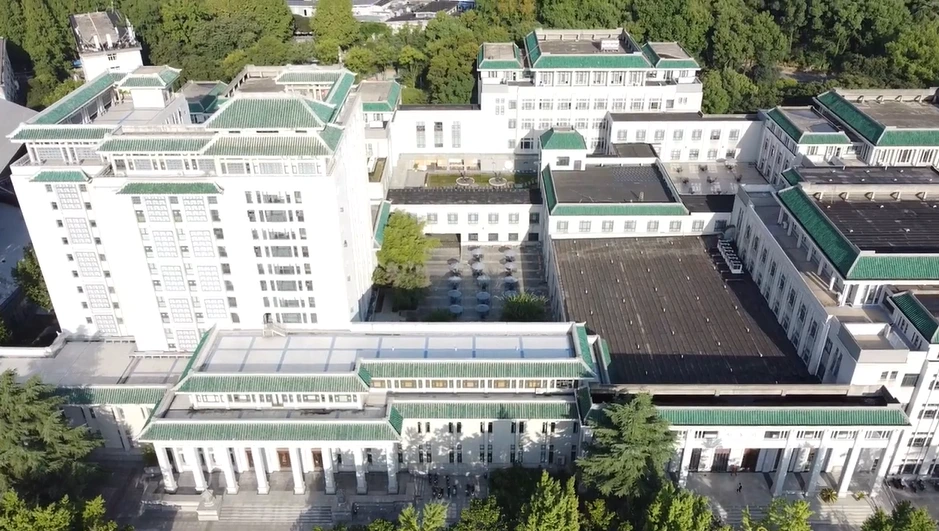
Wuhan University Library, built in 1917, is a grand intellectual landmark that combines traditional Chinese architecture with cutting-edge study areas. This in-depth piece delves into the company’s history, collections, design, and future ambitions.
Origins and Architectural Grandeur
Founded in 1917 and formally titled National Wuhan University Library in 1928, the library owes its roots to the Zi Qiang School library established by reformer Zhang Zhidong in the late nineteenth century.
Its famed Old Library, sitting atop Lion (Luojia) Hill since 1935, is a crown-shaped edifice that echoes the majesty of the Forbidden City. It was designed by F. H. Kales, an MIT-educated architect, and has a reinforced concrete structure, traditional eaves, dougong brackets, and a rooftop seven-ring tripod chimney.
Semicircular staircases and an octagonal upper level provide the building’s aesthetic and historic value. It was recognised as a national-level cultural heritage property in 2000.
Expansion and Modernization
When the institution expanded in 2000, library facilities were unified across combined campuses and considerably enlarged. The New Main Library, built in 1985 next to the original structure, was expanded in 2011 to create a contemporary complex of about 35,548 square meters. The current system encompasses 112,333 sqm, with almost 77,400 sqm dedicated to library operations, reference rooms, and cyber-engineering branches.
Collections: Depth, Diversity, and Digital Reach
As of the end of 2023, the library holds over 22.82 million items:
- 7.32 million print materials: including 6.04 million books and 880,000 bound periodicals
- 200,000 volumes of ancient thread-bound books, with unique holdings including over 1,000 local chronicles and 2,600 historical newspapers
- 180,000 maps, microfilm, and audiovisual media
- Access to 15.5 million digital resources, including 13 million e-books and 2.48 million e-journals, across 572 academic databases
Its geomatics collection is particularly well-known, with over 2,700 global periodical titles, including the historic Zeitschrift für Vermessungswesen from 1873 onwards, which provides crucial archives for surveying and earth sciences.
Innovation: Makerspace to Intelligent Design
The Information Science Library, reopened in 2016 after renovations, features a 14,896 sqm layout with advanced learning zones. Students are engaged in:
- An on-site Makerspace furnished with 3D printers, dual-screen workstations, touch panels, and design software
- An Innovative Learning Room crafted for creative, collaborative learning and group study
The entire library ecosystem now offers:
- Mobile seat reservation systems
- Automated holds and metadata services
- Overnight study amenities and integration of digital services with physical study spaces.
Luojia Resource Library: Honoring Intellectual Legacy
The Luojia Library, which opened in February 2022, is a curated chamber within Building E that has more than 20,000 volumes of works by former university presidents, senior professors, and noteworthy graduates. This solemn room contains old wood décor, chandeliers, spiral staircases, and silent alcoves to encourage thought and respect for the university’s academic past.
Educational and Research Functions
The library serves multiple academic roles, offering:
- Reference services, interlibrary loans, and document delivery
- Information literacy training, citation verification, and research impact assessments
- Support for intellectual property research and open science architecture, aligned with academic programs in Library and Information Management
Architecture Meets Sustainability
MVRDV is designing a new central library for Wuhan’s core business district. Its design, inspired by the Yangtze-Han River confluence, has tiered terraces, panoramic windows, and solar-integrated rooflines. Passive cooling and natural ventilation harmonise green technology with Wuhan’s aesthetic and environmental conditions.
An Overview of Wuhan University Library
| Feature | Detail |
|---|---|
| Established | 1917 (Zi Qiang School origin in ~1893) |
| Iconic Old Building | Built 1935 atop Lion Hill, modeled on imperial Chinese design |
| Expansion Projects | New library (1985), major expansion (2011), Makerspace branch (2016) |
| Total Area | ~112,333 sqm library facilities |
| Collections (2023) | 22.82 million items: print, ancient books, maps, digital, and multimedia |
| Specialized Holdings | Geomatics journals, ancient Chinese local chronicles, rare editions |
| Innovation Facilities | Makerspace, seat reservation app, private carrels, group study zones |
| Heritage Resource Center | Luojia Library displaying works of distinguished individuals |
| Architectural Award Project | Upcoming MVRDV-designed central library combining sustainable design and public accessibility |
Wuhan University Library is more than just an academic repository; it’s a visual representation of cultural synthesis, innovation, and intellectual continuity. For more than a century, it has acted as a learning laboratory, growing from a tiny catalogue of 3,000 books to a multi-branch, contemporary library system that combines history with technology.
From ancient scrolls on Luojia Hill to digital labs in Information Science, the library continues to serve as a lively hub of information, anchoring Wuhan University’s identity and fuelling future generations’ quests for knowledge.
Follow Europeans24 for more news from China.