
Explore the rich and detailed history of Wuhan from antiquity to modern China. Learn how Wuhan evolved through the Northern and Southern Dynasties, Imperial China, and revolutionary periods into today’s industrial and cultural hub.
Wuhan, the capital of Hubei Province in central China, has a history of over 3,500 years. This storied city lies where the mighty Yangtze River meets the Han River, earning it a pivotal geographic role. The confluence of these two great waterways made ancient Wuhan a crossroads of trade and culture. Archaeologists have found Neolithic and Shang-dynasty remains (such as the Panlongcheng site, circa 1500–1300 BCE) in the region. These finds show Wuhan’s lands were part of the ancient E and Chu states during the Zhou dynasty. In that era, what is now Wuhan was a frontier between competing kingdoms. In short, the history of Wuhan in antiquity is one of early settlement and strategic river valleys. People farmed the fertile Jianghan Plain, and the rivers carried crops and armies, connecting Wuhan to the wider world.
Wuhan in Antiquity
From the Shang dynasty onward, Wuhan’s rivers shaped its destiny. The discovery of Panlongcheng (盘龙城) – a major Shang-era city at Huangpi District – demonstrates that Wuhan’s area was part of the Bronze-Age Shang civilization. Panlongcheng occupied about one square kilometer and was surrounded by walls, indicating an organized, urban settlement. Over the centuries, the E-states of the Western Zhou (1046–771 BCE) first controlled lands south of the Yangtze around present-day Wuchang. After E fell, the Chu state absorbed the region for the rest of the Zhou period. When the Qin and Han dynasties unified China, Hanyang (on the north bank) became a bustling river port, and Wuhan remained an important junction in the Han commanderies. Throughout antiquity, the Yangtze (Chang Jiang) – the world’s longest river – and the Han River were like twin highways running through Wuhan. Boats brought rice, silk, and tea downstream, and armies marched upstream, making Wuhan a vital hub in early Chinese history.
Origin of the Name “Wuhan” and the Three Towns

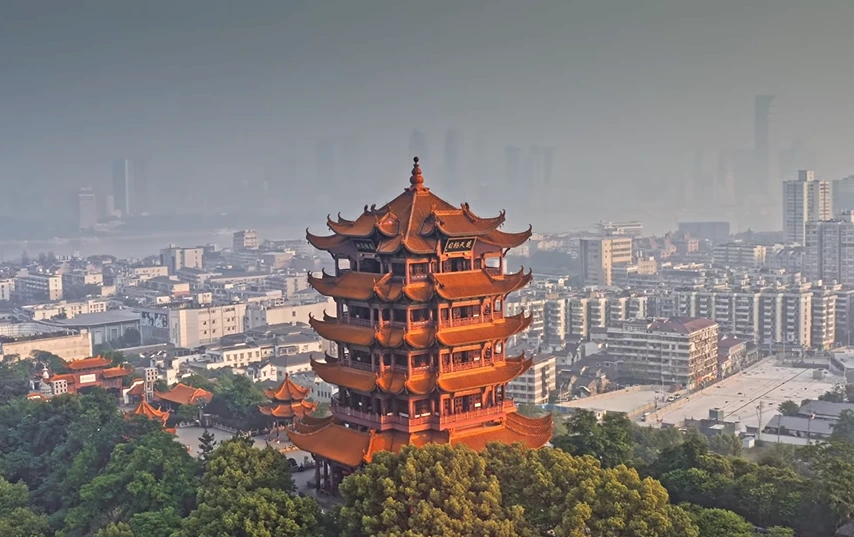
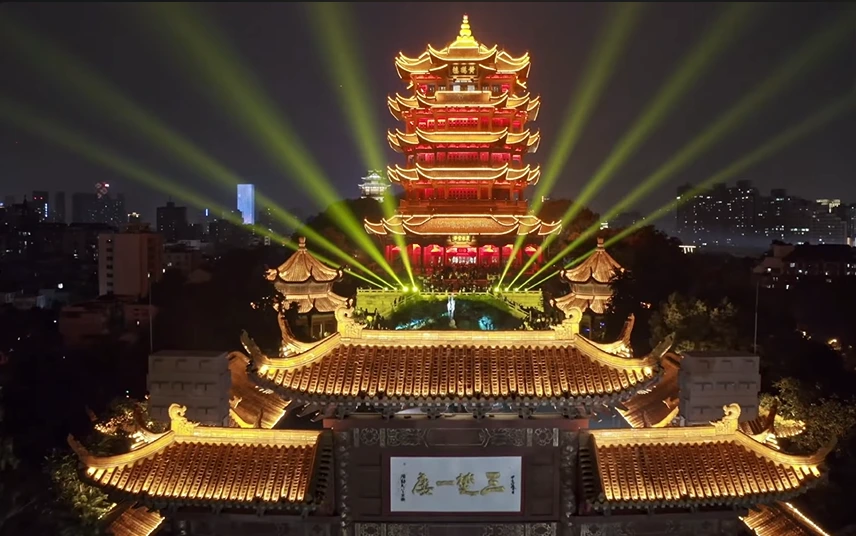
The modern name Wuhan reflects the merger of three separate towns that grew around those rivers: Wuchang (武昌) on the south bank of the Yangtze, and Hankou (汉口) and Hanyang (汉阳) on the north side. For much of history these were distinct communities. Wuchang was the oldest – its name was given around 223 CE when Eastern Wu (one of the Three Kingdoms) fortified the town and built the famous Yellow Crane Tower. Hanyang was founded as a fortress city on the Han River during the Sui dynasty (581–618). Hankou, originally called Xiakou, began to flourish by Song times (960–1279 CE) at the mouth of the Han River. In the Ming dynasty (1368–1644), engineers even diverted the Han River to a new course around Guishan, which helped Hankou develop as a river port. By the Qing dynasty, Hankou and Hanyang were among China’s busiest trade towns, linked to markets as far away as Europe (after the 19th century opening to foreign trade).
The name “Wuhan” itself is a modern portmanteau. It combines the “Wu” of Wuchang with the “Han” of Hankou/Hanyang. In 1899 local authorities began calling the three adjacent towns the “Three Towns of Wuhan”. After the 1911 revolution and the founding of the Republic of China, Wuhan’s importance grew. In fact, in December 1926 the Nationalist government moved its capital to Wuchang, and in January 1927 the governments merged Hankou and Wuchang into one administrative region named Wuhan. (Hanyang was already considered the third of the triplet.) Officially, the three cities were merged into the single prefecture-level city of Wuhan in 1949. Thus, Wuhan’s name and identity date to the 20th century unification of those three river towns, although the sites themselves have much older roots.
Northern and Southern Dynasties: A Time of Division
After the fall of the Han dynasty (220 CE), China entered the Northern and Southern Dynasties (420–589 CE), a period when the north and south were ruled by rival regimes. Wuhan found itself in the southern camp. For roughly two centuries, the Wuhan area was part of successive Southern dynasties (Liu Song, Southern Qi, Liang, and Western Liang). The city of Jiangxia (Wuchang) was the seat of local princes and warlords. It was a strategic frontier: northern armies from Wei, Qi, or the Daoist-led northern states often campaigned here. For example, in 550 CE General Hou Jing used Jiangxia (modern Wuhan) to invade eastern regions, even crowning himself “Prince of Han” nearby. Despite the wars, life continued along the rivers. Wuchang (Jiangxia) served as an important military prefecture of the Southern dynasties, protecting the fertile Yangtze basin from northern incursions. In short, during the Northern and Southern era Wuhan’s sites remained strategic military and administrative centers while cultural life in the south (scholar-official government and Buddhism) quietly flourished.
Tang and Song Dynasties: Cultural Flourishing
With China reunified under the Tang (618–907) and later the Song (960–1279), Wuhan’s region became a stable part of the empire and continued to prosper. Wuchang (then often called Jiangxia or Ezhou) was made the seat of Hubei’s governor. The Yellow Crane Tower on Wuchang’s riverbank became a famous landmark – Tang poets like Cui Hao wrote verses about it, making the site legendary throughout China. Under the Song, the area’s official name was Jiangxia Prefecture, covering much of modern Hubei. Trade and scholarship grew: by the 11th century there were academies and Buddhist pagodas (the Wuying Pagoda, for example, was built in late-Song Wuhan). Hankou (then called Xiakou) and Hanyang (then known simply as Hanyang under the Han River) started to appear in records as bustling market towns by Song times. In fact, Song-era Wuhan was already a magnet for commerce and learning, as ships could sail upriver from the sea to reach it, and poets and officials traveled through its busy wharves. Despite periodic wars (for example, the great rebel Huang Chao passed through Wuhan around 878), the Tang-Song period was generally one of growth: Wuhan’s bridges, temples, and markets thrived, setting a foundation for later fame.
Yuan and Ming Dynasties: Strategic Outpost and Trade Center
The Mongol conquest in the 13th century (the Yuan dynasty, 1279–1368) brought all of Hubei under foreign rule. Kublai Khan’s armies even besieged Wuchang in 1259 as part of the final campaign against the Southern Song. After the Yuan unified China, Wuhan (then still Jiangxia/Wuchang) remained the chief city of its region, overseeing Jiangling and other Hubei prefectures. The Ming dynasty (1368–1644) shifted focus to developing river trade. Under Ming rule, Wuchang became the capital of Huguang Province (covering modern Hubei and Hunan) – one of China’s largest provinces. This made Wuchang the seat of the provincial governor (and later the Governor-General of Huguang). A key engineering feat occurred under the Ming Chenghua Emperor (1465–1487): the Han River was dredged to alter its confluence, which helped create the port of Hankou on the north bank. From then on, the three towns took on the shape we recognize: Wuchang as the south bank capital, Hankou as the growing trade town at the Han River mouth, and Hanyang to the west. By late Ming, Wuhan was a major inland gateway: rice and goods from Sichuan and Guizhou flowed down the rivers to its markets. Wealthy merchants and local magistrates funded temples and schools in Wuchang, preserving Wuhan’s reputation for learning and culture.
Qing Dynasty and Late Imperial Era
During the Qing dynasty (1644–1911), Wuhan’s importance continued to rise. The Qing emperors maintained the combined province of Huguang, with Wuchang as its capital. In the 17th century (Kangxi Emperor’s reign, 1660s), Wuhan even became a customs center for levying goods, a sign of its growing trade. But the biggest change came in the 19th century. Following China’s defeats in the Opium Wars, Hankou was opened to foreign trade in 1861 as a treaty port. Almost overnight, European and American merchants poured into Hankou’s concessions. The government also built the Hanyang Iron Works and Jianghan Arsenal in the late 1800s. By the late Qing era, Hankou and Hanyang together were counted among China’s “Four Great Towns,” rivaling the likes of Beijing and Suzhou in commercial activity. Tens of steamships unloaded cotton, silk, tea, and coal at the banks of Hankou. The railways even began to reach Wuhan, such as the Beijing–Hankou line (completed in 1905). In sum, the Qing period transformed Wuhan from a regional river-town into a national center of industry and trade. The three cities still kept their distinct personalities – spiritual Wuchang, bustling Hankou, industrial Hanyang – but increasingly, writers spoke of them as a single economic cluster on the banks of China’s rivers.
Republican Wuhan: Revolution and Renewal
The early 20th century was a tumultuous yet pivotal time for Wuhan. Its location – in the geographical center of China – made it an ideal base for revolutionaries. In 1911, student and army officers in Wuchang rose against the Qing dynasty, triggering the Xinhai Revolution. The Wuchang Uprising (October 10, 1911) quickly spread upriver, leading to the end of imperial rule and the founding of the Republic of China. A provisional government was set up in Wuchang, making Wuhan the cradle of modern China. During the 1910s–1920s, Wuhan continued to be a focus of reform. In 1911–12, the first rail lines to Wuhan (like the Wuhan-Guangzhou Railway) opened, linking central China by train. Education reformers and industrialists modernized the city: for example, Zhang Zhidong (governor of Huguang) had earlier built schools and factories here, and his pupils now ran modern textile mills along the rivers.

In the mid-1920s, Wuhan also became a political capital. After Chiang Kai-shek’s northern expedition ousted warlords, the Nationalist Party (Kuomintang) split into left and right factions. For a few months in 1926–1927, Wuchang (with Hankou) served as the Nationalist capital under a left-wing coalition. Students and party members renamed schools in honor of Sun Yat-sen (Sun Zhongshan). In fact, Wuchang University was renamed “National Wuchang Zhongshan University” in 1926 to commemorate the late founding father. In January 1927, the cities of Hankou and Wuchang were even merged administratively (the name “Wuhan” was then officially adopted) while the KMT briefly ruled from there. Although this government was short-lived (Chiang broke with the Wuhan leaders later that year), it underscored Wuhan’s stature: if anywhere was a capital of revolution, it was Wuhan. The period left a legacy of modern schools, banks, and factories. Chinese intellectuals and Communists also gathered in Wuhan, making it a laboratory of 20th-century ideas. In short, the Republican era saw Wuhan become a symbol of China’s rebirth – industrial and national – with the Wuchang Uprising and the Wuhan government as central chapters in the history of Wuhan.
Industrial and Revolutionary Significance in the 20th Century
Beyond politics, Wuhan’s industrial growth accelerated in the 20th century. The city was often called one of the birthplaces of Chinese industry. As early as the late Qing, it had the Hanyang Iron Works and the first modern shipyard on the Yangtze. In the Republic, textile mills, cement plants, and engineering works multiplied. The Triple rivers made raw materials plentiful: steel and ore came from nearby Hubei mines, coal was shipped in, and the rivers carried bulk goods out to ocean-going ships at the Yangtze ports. This industrial base made Wuhan strategically important during wartime. For example, in 1937–38 during the Second Sino-Japanese War, Wuhan (especially Hankou and Wuchang) was a major defensive stronghold and briefly served as China’s wartime capital. When the city fell in October 1938 after fierce battles (the Battle of Wuhan), much of its industry was destroyed or scattered, but it was a testament to Wuhan’s new national role.
After World War II, during the Chinese Civil War, Wuhan again was contested by the Communists and Nationalists. But after 1949, under the People’s Republic, it entered a new era of development. Factories were rebuilt, and Wuhan was proclaimed a direct-controlled municipality before becoming Hubei’s provincial capital again in 1954. The first bridge over the Yangtze at Wuhan opened in 1957, linking Hanyang and Wuchang. In the late 20th century, Wuhan’s role as an industrial heartland only grew. It became known for big state enterprises like the Wuhan Steel Works, numerous machinery plants, and as a center for optoelectronics and automation in later decades. Throughout the 1900s, Wuhan remained associated with revolution (the PLA still recalls battles fought there) and with rapid modernization. The 1911 uprising is commemorated every year, and decades of scholarship have studied Wuhan as a hotbed of China’s republican transition. For a general audience today, it is enough to say that the 20th century entrenched Wuhan’s reputation as both “China’s thoroughfare” and one of its industrial engines.
Modern Wuhan: Transportation and Economic Hub

Today’s Wuhan is a bustling metropolis reflecting all these layers of history. Often nicknamed “Jiu Sheng Tongqu” (九省通衢, “Thoroughfare of Nine Provinces”), modern Wuhan is the largest city in central China. It stands at the intersection of major railways (north–south Beijing-Guangzhou and east–west Shanghai-Chengdu lines meet here), multiple highways, and huge Yangtze bridges. In 2025, Wuhan has four Yangtze bridges and a new highway tunnel, carrying high-speed trains and thousands of road vehicles every day. Its new airport and river ports connect the Yangtze River economy to the coast and the interior. Economically, Wuhan has diversified far beyond heavy industry. It is a center for automobile assembly, high-tech manufacturing (including China’s famous “Optics Valley” of Wuhan in Wuchang District), biotechnology, and education/research. Wuhan University and Huazhong University of Science and Technology (evolving from the wartime amalgamations of the past) make the city a leading university hub.
In sum, the history of Wuhan – from Panlongcheng and the Three Kingdoms through revolution and reform – has culminated in a vibrant modern city. Wuhan’s rivers still define it: one can ferry across the Yangtze between gleaming skyscrapers in Hankou and the historic campus of Wuchang on the south. The city’s identity as a link between North and South, East and West China comes from this long history. Understanding Wuhan’s past – its ancient settlements, its era of dynastic prominence, its role in Sun Yat-sen’s revolution, and its rise as an industrial/transport hub – is key to appreciating why Wuhan today is both a gateway and a capital of China’s heartland.
Follow Europeans24 for more history articles!






+ There are no comments
Add yours